The establishment of the United Nations in 1945 was, it must be said, the most significant event in the history of humanity's search for effective global governance. It was not the first global international organisation — we know that the League of Nations was created after the First World War — but the League proved in practice to be a failure. Japan's invasion of China in 1931, the Mukden Incident mentioned earlier, was a case in point: the League's response was, in effect, a failure. It was precisely this that made it necessary, after the Second World War, to build an entirely new international organisation. The United Nations was born against that backdrop. One might say that the birth of the United Nations was built upon the bloody lessons of two world wars, together with the experience — or rather the cautionary lessons — of the League of Nations' earlier attempt to establish an international organisation.
Eighty years of history have demonstrated that the United Nations is the most authoritative, the most representative, and the most universal organisation at the level of states that the world possesses to this day. Its contributions to the maintenance of world peace and security, and to the promotion of human development, are plain for all to see. That is the first point I wish to make. This year marks the 80th anniversary of the founding of the United Nations, and what I have on my screen now is the United Nations official website's display of this year's commemorative activities, whose theme is 'Building Our Future Together.' The United Nations has organised a series of activities around this theme. Looking back through history at these activities, I see at least three facts that I believe are objectively, and one might say universally acknowledged — or at least so it appears to me personally.

The first of these three facts: the United Nations is the fruit of victory in the world anti-fascist war. Its founders were the victorious nations, but more than that, they embodied international justice. That is to say, it was not simply an international organisation built by the victorious powers alone. The United Nations Charter (UN Charter), which forms the entire foundation of the United Nations, constitutes a core pillar of the norms of international relations underpinning the post-war international system. One might say that it is the cornerstone of the post-war international order. The four purposes and seven principles it enshrines all represent international justice. Among the four purposes, for instance, are the maintenance of international peace and security, the development of friendly relations among nations, the promotion of international cooperation, and the harmony of the actions of nations. Among the principles it includes sovereign equality, the faithful fulfilment of obligations, the peaceful settlement of disputes, the refrainment of threat or use of force, and non-interference in internal affairs. These are among the basic principles set out in the UN Charter. In my view, these principles carry universal significance for the construction of the post-war international system and international order. They do not represent merely the will of the victorious powers; they represent the commonly recognised basic principles of all nations.
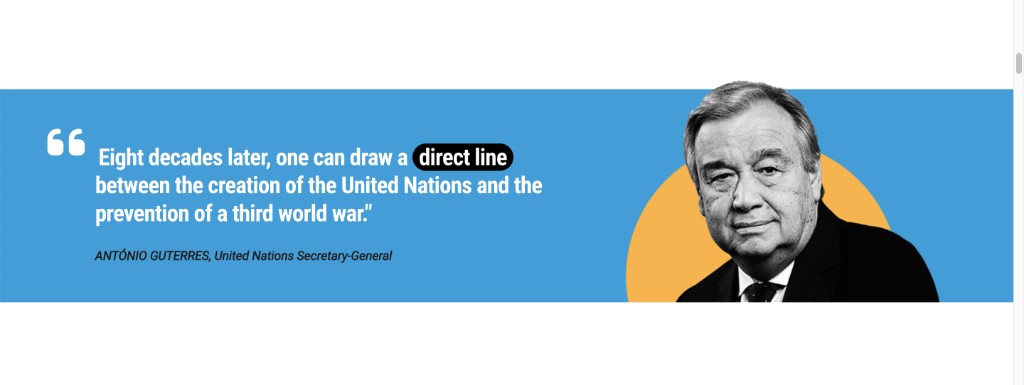
From this standpoint, although the fifty-one founding members of the United Nations were essentially drawn from the anti-fascist alliance and belonged to the camp of the victorious nations, the organisation was by no means one built solely to serve the interests of the victors. Certain right-wing groups and individuals have mounted attacks on the authority of the United Nations from precisely this angle, but I believe that the facts are sufficient to refute their mistaken position. I would cite the words of United Nations Secretary-General Guterres, who noted that one can draw a direct line between the creation of the United Nations eight decades ago and the prevention of a third world war. Today we once again find ourselves in an age of great uncertainty, in which the outbreak of a Third World War is a real possibility, and it is for this reason that commemorating the 80th anniversary of the United Nations carries a particular significance.
The second point I wish to make is that eighty years of the United Nations' development demonstrate that the United Nations, with the Charter as its cornerstone, truly is the core of the international order built after the Second World War, and the guardian of world peace. Although the post-war international organisation was built by the victorious powers, the defeated fascist nations were not permanently excluded. From 1955 onwards, the wartime defeated powers, namely Germany, Japan, and Italy, were admitted one by one though they are three major fascist states and the principal instigators of the Second World War. Italy was admitted on 14 December 1955; Japan in 1956; and Germany, which was at the time divided into East and West, was admitted somewhat later, in 1973.
Other wartime fascist satellite states, including Romania, Bulgaria, and others, were also gradually admitted to the United Nations during roughly this same period. In other words, the United Nations now encompasses all nations, including victors, defeated powers, and all others. The right-wing attack on the United Nations has therefore lost its foundation.
The eighty years of the United Nations can broadly be divided into several stages: the period immediately before and at the outset of the Cold War, from 1945 to 1947, which was very brief; the Cold War period; and the post-Cold-War period. Each of these three stages has its own distinctive characteristics. The first stage was essentially one dominated by the victorious powers. In the second stage, the expansion of the United Nations brought in not only former defeated powers but also the newly emerging countries of the Third World. During this process of expansion, both the American-led and Soviet-led blocs were highly active, though their motivations were in no small part shaped by the desire to draw more countries into their respective corps. After the Cold War, the collapse of the Soviet Union left the United Nations effectively under American unipolar dominance, with the result that in many international disputes and on many issues, the United States proceeded by bypassing the United Nations and marginalising it, a pattern that persists to the present day.
This brings me to the third point I wish to raise. Great-power rivalry today is posing a serious challenge to the authority of the United Nations, therefore, we need to pool our collective wisdom to defend it. The challenges confronting the United Nations are not only the ravages of the climate crisis, growing inequality, and deepening poverty; more pressing still are the realities we see before us: armed conflicts and wars in many regions, such as the Russia–Ukraine conflict, the Israel–Palestine conflict, the India–Pakistan conflict, among others. Of particular concern is what appears to be a growing appetite for taking of war as a means of resolving disputes between states, compounded by the resurgence of far-right forces, all of which has placed the United Nations in a relatively passive position in responding to these challenges. The principal reason is that among the five permanent members of the Security Council, the logic of alliance politics and great-power rivalry has prevented the principle of great-power unanimity from being carried out, confronting the United Nations with a new challenge.
On the question of how to strengthen the authority of the United Nations, I have three personal suggestions. To paraphrase the words of His Excellency Philémon Yang, President of the 79th session of the United Nations General Assembly: 'As we look ahead, we would be wise to remember our past, celebrate our successes, and build our future on the foundation of the UN Charter.' In other words, we must look back at history, draw lessons from it, and at the same time reinvigorate the promotion and dissemination of the purposes of the United Nations Charter. The first suggestion is to take the time of the 80th anniversary of victory in the Second World War and of the founding of the United Nations to intensify the exposition and promotion of a correct historical understanding of the Second World War and of the purposes of the UN Charter. China has done a certain amount of research on the United Nations, but I feel that there is still room for expansion. The second is to strengthen research on the United Nations and to develop education in the history of the United Nations, in our textbooks and in our everyday education of young people, with an emphasis on expounding the authority of the United Nations and the justness of its existence. The third is to support reform of the United Nations' institutional mechanisms, and in particular to support the multilateralism that the United Nations promotes, so as to jointly safeguard the authority of the United Nations and to preserve world peace.
Watch the whole speech here: