I represent the second largest university in Russia, Saint Petersburg State University. We celebrated our 300th anniversary last year and will celebrate 80 years of journalism education at our school next year. I am also the head of the Department of Digital Media Communications, Doctor of Political ==Science==, an expert at the SPbU centre for Artificial Intelligence and Data ==Science==, and the head of the Master's programme 'Artificial Intelligence in Journalism and Media Communications.'
Today, I would like to tell you about our research on the integration of neural networks into newsrooms mainly in Russian regions, as well as how we train professionals in the field of artificial intelligence for the media industry. By artificial intelligence, I mean mainly generative AI and large language models.
In 2023, we launched pilot research projects on the implementation of neural networks using the examples from the southern and northern regions of Russia. We quickly realised that behind descriptions of editorial practices lie much broader social and institutional challenges. This prompted us to raise deeper questions about the place of AI studies within the social and human sciences.
Just to remind you, there are 89 regions in Russia. Why did we focus specifically on the regions? Previous studies have shown that Russia is divided not only into clusters of industrial development, but also in terms of social dissatisfaction reflected in the media space. Therefore, we decided to start directly with regional diversity, rather than focusing on the success stories of national media. Some Russian scholars argue that adopting neural networks is the only way for regional media to survive. The starting point – what we call 'Point A' – is not just the year 2025, but the entire 25-year history of digital transformation in local media in Russia. The results of this transformation include both new opportunities and more complex challenges compared to the era of traditional or classical journalism.
Our theoretical framework also draws on neo-Marxist thought, which views artificial intelligence as a driver of 'digital capitalism,' reshaping production processes, transforming labour markets, and accelerating monopolisation in the digital economy. Our first step was to study the general tone of public discourse. As you can see, it turned out to be largely positive. The professional community is divided into two groups: those who see these changes as another round of digital evolution, and those who believe the very essence of journalism is being transformed. A similar division occurred earlier during the wave of digital transformation, which in academic literature came to be described precisely as 'transformation,' not 'evolution.' When we speak of such essential changes, we refer to the transformation of journalistic normativity, including ethics, autonomy, and objectivity. The emergence of new professional rules – especially for technical specialists in newsrooms – and the expansion of human responsibility now extends to machines.
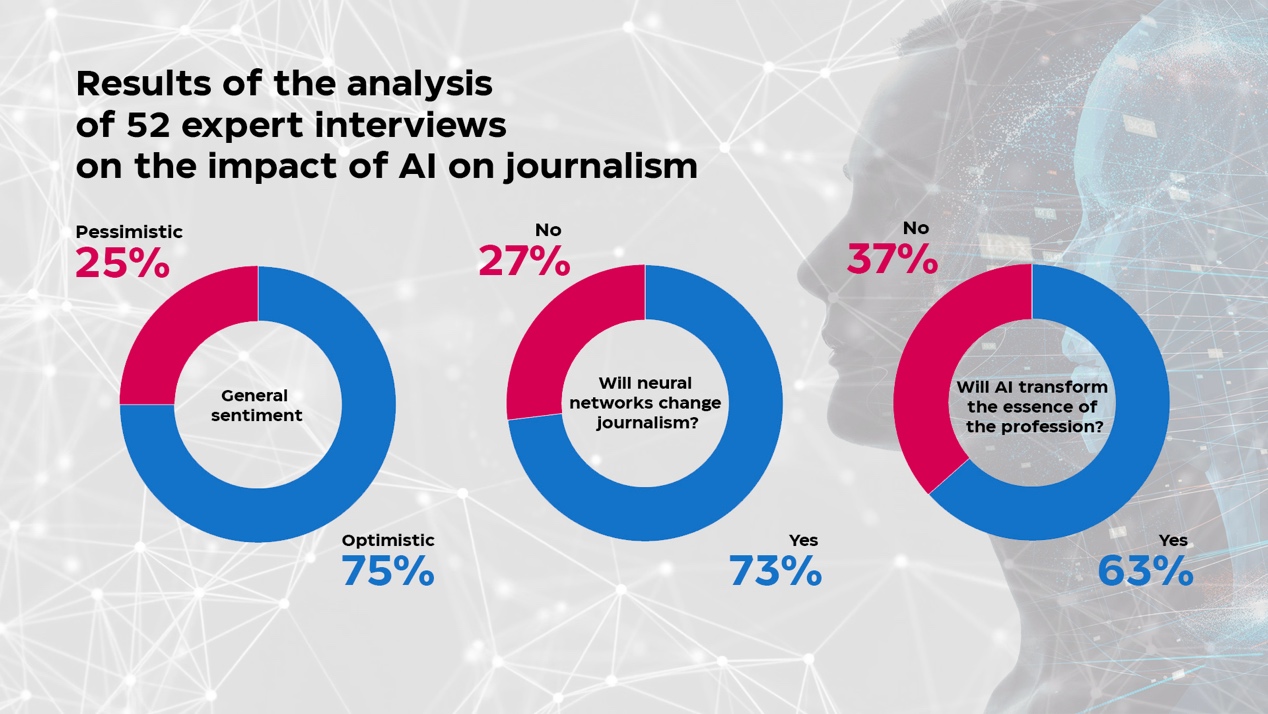
The second step was conducting pilot interviews in three regions. They revealed that there are currently no grounds to expect a breakthrough in AI implementation within the next year or the next two years: there are no special regulations in the newsrooms, targeted investments, or large-scale training programmes. At this stage, we collected data on the most popular large language models and the tasks they help solve. And as you might guess, they are mainly ChatGPT and GPT-based models. We found that media managers are generally optimistic and highly value the potential benefits of AI adoption. We have accumulated diverse experience in implementing large language models and other kinds of machine learning and deep learning in newsrooms. In national newsrooms, AI is mostly used as predictive analysis for calculating trends in audience engagement, and this is more interesting for newsrooms than generating images or texts. The main challenges they mention include the need for fact-checking, compliance with ethical standards, and the inability (especially in state-owned media) to use foreign AI services for moral or political reasons, but they still use them.
The second phase of the pilot study was conducted in Saint Petersburg and the Leningrad Region in the North, and Rostov-on-Don and Krasnodar Krai in the South, and several other regions. This pilot study shows that there is no single pattern of AI adoption, but there are recurring elements. For instance, in some newsrooms, change started from below. When an ordinary employee began using large language models and then demonstrated the results to his manager. This was the case in Delovoy Peterburg, for example, a daily newspaper where a marketing specialist set up a chatbot to handle phone calls for marketing purposes. In other cases, change is initiated from above: for example, at Don-24 TV channel, a digital director became the AI pioneer, while at the Sakhapechat media holding in the Yakutia region, implementation began with large-scale training for all staff. I was invited as a trainer and visited Yakutia in January. Although we have not asked respondents directly about tensions between management and creative staff, the challenge is clear.
Another shared feature amongst regional outlets is the absence of a dedicated AI specialist, the lack of official guidelines from journalists' unions or university departments, and little preference for job applicants with AI skills. All this indicates that, whilst there are no preconditions yet for large-scale systemic effects in 2025–2026, awareness and literacy are steadily growing. I travel a lot across the country, and what I observe is very telling: there is no one pattern in Russia for AI use in newsrooms. Every newsroom tries to 'invent a bicycle,' reinventing the wheel rather than learning from others. The experience throughout the country is very diverse and, frankly, quite chaotic at the regional level.
An important pressure factor on the media system is the everyday use of AI by general audiences, which develops faster than its professional adoption within media ==organisa==sions – two quite different things. This may lead to a gap between audience expectations and newsroom capacities. Another pressure factor is the growing competition between national and foreign large language models. Now there are two of them in Russia leading the market: YandexGPT, which is a Russian AI, Sphere, and GigaChat. At the moment, American products still dominate, but Chinese models such as DeepSeek and Qwen are quickly catching up. An increasing number of journalists report bias in foreign LLMs and the framing of answers due to training on English-language Internet data. In Russia, several initiatives are now working on sovereign national LLMs.
Thus, returning to systemic effects for the media industry, we can outline the expected trends by 2027 at both national and regional levels:
- Widening gap between newsrooms that have adopted AI and those still struggling with social media; by 'struggling,' I mean that not every newsroom in Russia is ready to work on social media;
- Widening gap in media literacy and audience awareness;
- Growing divide between AI-literate journalists and conservative media managers, and vice versa;
- Widening income gap between those who have optimised production and SMM as well through AI and those who still rely on manual labour, including differences in salaries between specialists and managers.
It is important to emphasise: we are not talking about another decline or threat, but rather about the need for a renaissance and the use of emerging opportunities for a breakthrough, especially in the regions. At this moment, we can share our nationwide experience, though not the regional experience, because as I mentioned, it's very chaotic. I think sharing this experience, not reinventing bicycles but forming patterns and algorithms to make AI implementation effective, is a very interesting perspective for ==collaboration== with all countries through the Global South.
It is appropriate here to say a few words about a Master's programme which I run: 'Artificial Intelligence in Journalism and Media Communications,' launched at ==SPbU== in 2024 in partnership with Yandex company. The programme focuses on training media professionals with AI competencies.
Our experience shows that it is impossible to develop autonomously without industrial partners. Practical work must be integrated into the academic environment. The main challenge for universities is that technology evolves faster than the market and much faster than academia can systematize and convert it into teaching materials. As a result, such programmes rely more on heuristics than deduction, and graduates' competencies tend to anticipate possibilities rather than simply reproduce known results. Learning is project-based, with industry experts participating in assessment. We also have students from China enrolled in this programme.
The goal of the Master's programme is not merely to train AI specialists for media, but to prepare managers capable of implementing innovation in media production with measurable results. In practice, AI implementation today usually involves three parties: a newsroom hires an IT specialist, consults philologists or linguists, and integrates the technology under the supervision of a commercial director. One case occurred at a regional TV station in Yekaterinburg (in the middle of Russia, or in the Urals), where the newsroom developed its own AI-based content management system. An employee from that newsroom is now studying in our Master's programme, but I should notice and underline that this software inside contains OpenAI solutions.
An important internal partnership for the programme is cooperation with the Centre for Artificial Intelligence and Data Science of Saint Petersburg State University. Our students complete internships there and participate in scientific events focused on industrial AI and the Internet of Things. At least four times a year, we invite media managers to share their experiences in AI-driven automation of media production.
Speakers in 2025 highlighted two key challenges: the issue of public trust in media, and the issue of professional trust within the media community itself. For example, journalists are becoming less trusting of PR professionals, and vice versa.
At a recent event in October, we discussed the use of large language models and AI agents in education, and our students presented three chatbot projects designed to assist students for different purposes. For instance, one helps Chinese students navigate information about Saint Petersburg State University.
However, I should note and underline that I was speaking about large language models where we as a country compete with foreign models, predominantly America; we also compete with Chinese models. However, if we speak about industrial and military purposes, Russia is independent. We do have our own digital solutions for that.
Thank you very much.
Watch the whole speech here: