The subject of my presentation is China's land reform, rural migration and rural revitalisation. As in many other countries, China's agricultural transformation has been driven jointly by the state, capital and the people who work the land, all operating within a given institutional framework and set of agrarian structures.
Taking China as an example, its agricultural transformation can broadly be divided into two periods: 1947 to 1978, and the years since 1978. Before 1978, rural land ownership in China went through two distinct transformations, the Land Reform of 1949 to 1953 and the period of collectivisation from 1953 to 1978. The Land Reform of 1949 to 1953 did not alter the private nature of land ownership as such, but it did eliminate the landlord class and redistribute land equally among farmers.
Before land reform, landlords and rich peasants made up only 10 per cent of the population, yet held 70 to 80 per cent of rural land, while poor peasants, tenant farmers and agricultural labourers made up 90 per cent of the population and held only 20 to 30 per cent. After land reform, 300 million farmers received 50 million hectares of land, around 45 per cent of the total cultivated area at the time. The principal farming unit in China also shifted, from landlord estates worked by tenants and hired labourers to small peasant family farms. This system of private land ownership was, in turn, replaced by collective ownership through four stages of collectivisation. At first, the state encouraged farmers to form mutual aid teams in order to boost agricultural production, largely because poor farming households were unable to produce enough grain on their own, lacking, in various combinations, sufficient labour, livestock or tools. Pooling resources and helping one another with farm work greatly improved productivity, and this formed the first stage of collectivisation.
In the second stage, the state encouraged farmers to merge their small plots into larger ones, making it easier to organise major agricultural infrastructure projects such as irrigation systems. Farmers were paid according to the resources and labour they contributed to the collective, and it was this arrangement that gave rise to the Elementary Agricultural Producers' Cooperatives. The third stage, a particularly critical one, saw all resources, including land, livestock and tools, transferred to the cooperative; farmers lost their claim on the harvest based on these resources and were paid solely according to the labour they contributed. In this way, the state established the Advanced Agricultural Producers' Cooperatives, and the share of the harvest taken by the state grew larger still.
In the final stage, that of the People's Communes, the principal transformation took place at the political, social and cultural level. The commune became the lowest tier of government, holding the power to claim and redistribute the harvest and able to establish institutions such as banks, schools, hospitals and media outlets. As you can see, the process of collectivisation shifted land ownership from private to collective hands, a change whose merits and drawbacks are still debated today. One significant view holds that collectivisation helped China accumulate the capital needed to launch industrialisation and urbanisation, and that the irrigation systems, reservoirs and roads built during the commune era continue to benefit rural areas to this day.
What can be said with certainty, however, is that collectivisation also widened the gap between urban and rural areas, giving rise to social inequality and rural unrest, and the Household Responsibility System emerged directly out of that unrest. By 1978, relations between farmers and the state over claims on the harvest had grown increasingly strained; farmers had little incentive to produce more grain, and the state found it ever harder to extract sufficient capital from agriculture to drive industrialisation further. Following pilot trials in Anhui Province, the Household Responsibility System replaced China's rural commune system between 1978 and 1982. It restored family-based production in place of collective farming, although ownership of the land remained collective.
Under this system, land that had previously been farmed collectively was contracted out to individual farming households, who were responsible for cultivating the land, paying tax to the state and setting aside sufficient funds for the collective's public accumulation, with any surplus belonging to the household itself.
This did a great deal to encourage farmers and improve agricultural output. To protect farmers' rights, land contracts initially ran for fifteen years, from 1978 to 1993, or, in many areas, from 1982 to 1997. As the first round of land contracts began expiring in some areas in 1993, the state announced that household land contracts would be extended by a further thirty years.
As the second round of land contracts drew to a close in 2023, state policy extended them for another thirty years, to 2053, or to 2057 in many areas. The Household Responsibility System did, however, lead to fragmented landholdings and low productivity. In 1984, just two years after the system had been rolled out nationwide, the Central Document No. 1 began encouraging land to be concentrated in the hands of skilled farmers and large-scale operators, a policy of promoting land transfer to improve productivity that has continued ever since.
In 2013, China introduced a more detailed national policy: farmers holding contracted land rights were encouraged to transfer the right to use their land to other farmers or economic entities, an arrangement known as the 'separation of three rights.' These changes in land policy went hand in hand with changes in China's rural population policy. Looking back to the 1970s, the era of the People's Communes, China had, by 1975, already begun shifting from an agricultural economy towards a relatively industrialised one, with industry accounting for 72 per cent of total economic output. This was, more precisely, a labour-intensive, export-oriented economy, the one that would later become known as the 'world's factory.' The hunger of these emerging industries for labour set off the largest wave of internal migration in China's history, with more than a third of China's farmers on the move at any one time. Yet this vast internal migration did not happen overnight. The earliest movement of people began with the rise of township and village enterprises, which emerged once the People's Communes came to an end and began flourishing through the 1980s and 1990s.
At that time, rural people generally sought work at township and village enterprises, since urban labour markets had not yet opened to them. In 1982, for example, the state issued the Measures for the Custody and Repatriation of Urban Vagrants and Beggars, under which anyone in a city who had failed to find work would be sent back to the countryside. It was not until 1984 that the first policy allowing a small number of rural people to work in cities was introduced, and even then they were required to bring their own grain rations. Large-scale migration to the cities began in the late 1980s and early 1990s. With the market economy essentially established in 1992, urban labour markets gradually opened to rural people, particularly in the major cities and the special economic zones of southeastern China. Population policy in this period, however, remained characterised by discriminatory access, with the great numbers of migrant workers pouring into the cities confined largely to poorly paid jobs offered in unsanitary and unsafe conditions.
It was only from the 2000s onwards that large-scale internal migration, in the form we now know it, became the norm. This period also saw more policies and investment favourable to rural areas. In 2003, for instance, the state abolished the Measures for the Custody and Repatriation of Urban Vagrants and Beggars, so that farmers and other migrants without local household registration no longer needed to apply for work permits, temporary residence permits and similar documents in order to remain in the cities. The state also abolished the agricultural tax in 2006, freeing farmers from having to pay tax on the land they cultivated.
Two further important rural development strategies followed: the campaign to 'Build a New Socialist Countryside' launched in 2007, and the 'Rural Revitalisation Strategy,' launched in 2017. Since then, China has seen large-scale outward migration for work exist alongside large-scale return migration to the countryside.
The table below shows the number of migrant workers leaving home to work elsewhere since 2008. As you can see, the total has grown very rapidly, reaching close to 600 million people by 2024, while the average annual income of migrant workers has reached 59,532 yuan, or around 8,355 US dollars.
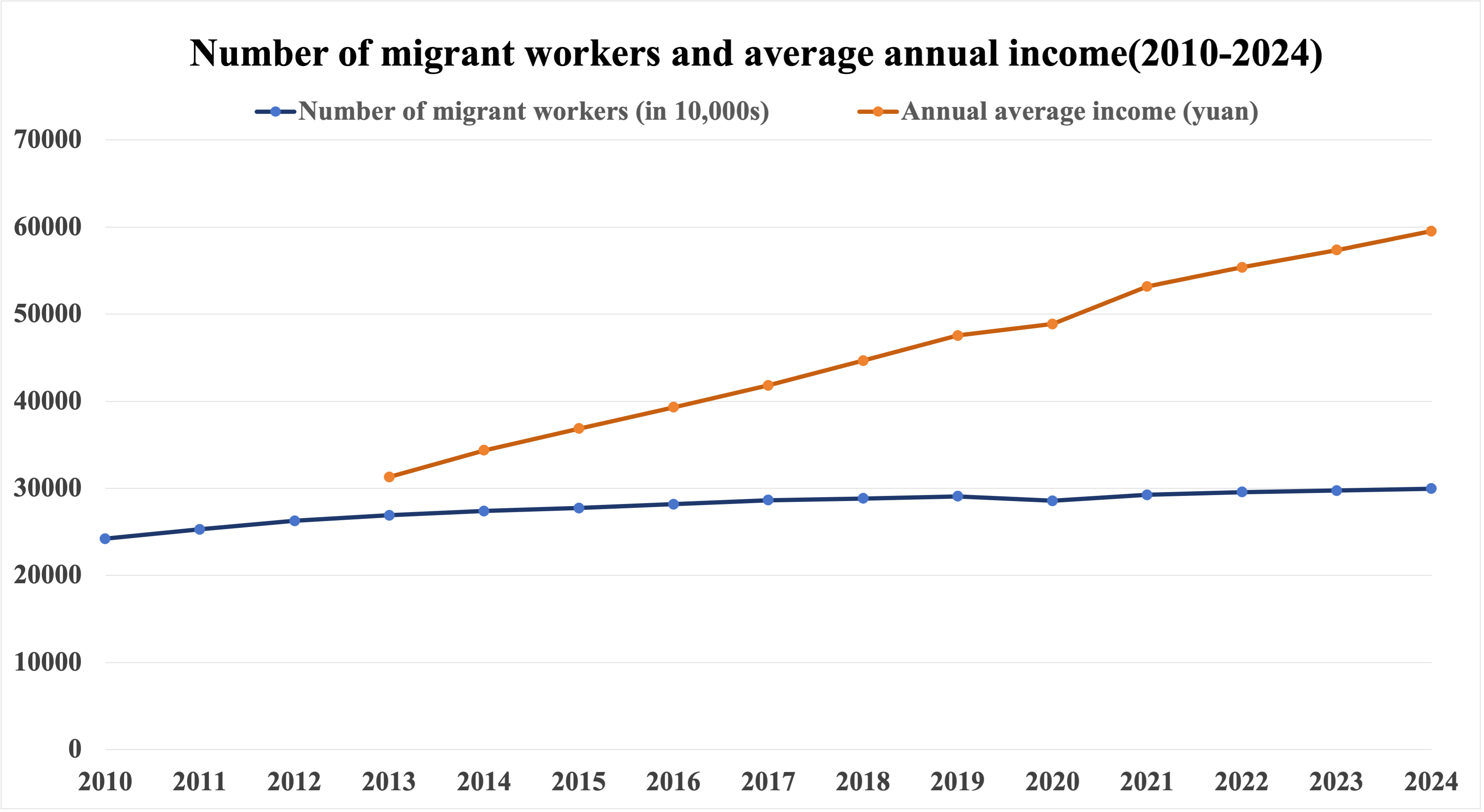
Source: National Bureau of Statistics of China, compiled by Luo Zhijie.
In recent years, the Rural Revitalisation Strategy has driven the transformation of agriculture and rural areas. At the 19th National Congress of the Communist Party of China in 2017, General Secretary Xi Jinping called for the strategy to be implemented. He stressed that priority must be given to developing agriculture and rural areas; that rural areas must be built with thriving industry, a pleasant living environment, civility, effective governance and prosperous livelihoods; and that smallholder farmers must be encouraged to integrate organically with modern agriculture.
The state has invested hundreds of billions of yuan to revitalise rural areas, build high-standard farmland, promote the development of rural industry and raise rural incomes, with the ultimate goal of achieving integrated urban–rural development and common prosperity. China's agricultural transformation, together with that of other countries, will continue to advance, and it is my hope that these transformations will help bring about a kinder, better and fairer world.
Watch the whole speech here: