

The year 2025 marks the 80th anniversary of the victory of the Chinese People's War of Resistance Against Japanese Aggression, the Soviet Great Patriotic War, and the World Anti-Fascist War, as well as the 80th anniversary of the founding of the United Nations. The World Anti-Fascist Alliance made profound sacrifices during World War II, which promoted the formation of the post-war international order centred on the United Nations and provided a historical opportunity for national liberation movements in Asia, Africa, and Latin America. However, the resurgence of 'New Cold War' thinking today, the intensification of structural suppression of the Global South by hegemonic states, and the repeated distortion of the history of the Anti-Fascist War narrative have created a situation where the unequal and unjust global governance system urgently needs reform, which has become a consensus.
At this significant historical juncture, to commemorate the great victory of the World Anti-Fascist War, prevent the resurgence of new fascism, address the interwoven problems and challenges of the Global South—such as multipolarity, anti-globalisation, and the rise of new fascism—and effectively strengthen the solidarity, exchange, and cooperation among Global South countries to collectively pursue and defend a fair and just post-war world order centred on the United Nations, the Global South Academic Forum (2025), themed 'The Victory of the World Anti-Fascist War and the Postwar International Order: Past and Future', was held in Shanghai on November 13-14, 2025. It aimed to connect the forces of the South, trace historical truths, rectify incorrect historical views, and jointly dismantle hegemonic and unilateral narratives.
Following the 'Communication for Solidarity' Global South International Communication Forum (2023) and the 'Global South and World Modernisation' Global South Academic Forum (2024), the forum continued to implement the mission of building a Global South academic community and persistently construct an international communication platform for the Global South to speak in concert. Over two hundred renowned scholars, government representatives, and media practitioners from more than thirty countries and regions, including China, Argentina, Brazil, Germany, Russia, Cuba, Ghana, and Gabon, engaged in in-depth exchanges from three perspectives—historical, realistic, and future—focusing on various topics such as the post-war international order, the new pattern of world information dissemination, digital sovereignty of Southern countries, rural development experiences, and global peace governance. They jointly discussed how the Global South can inherit the spirit of the Bandung Conference in the era of multipolarity, reshape a fair and just international order, and maintain genuine and lasting world peace with more resolute solidarity.
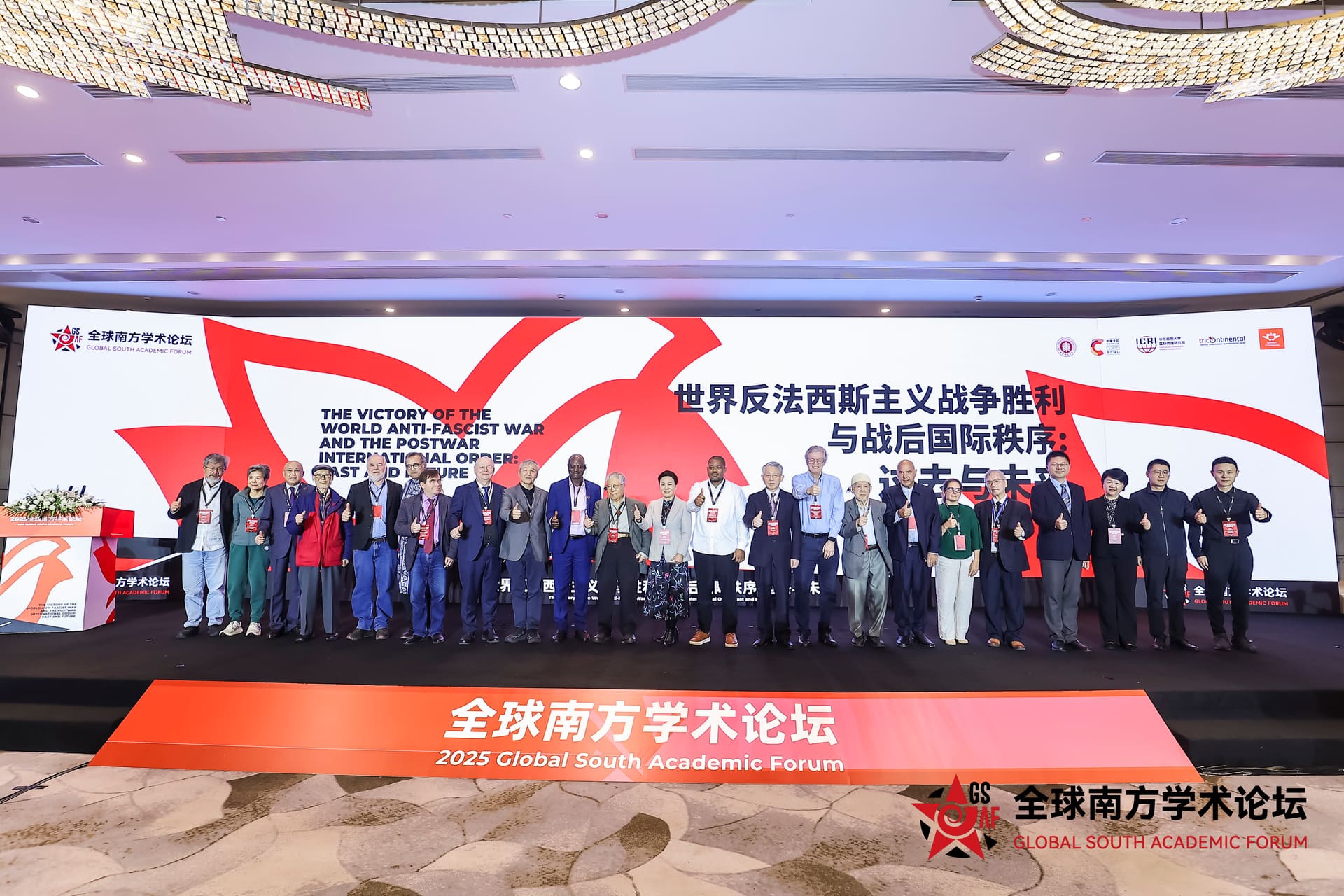
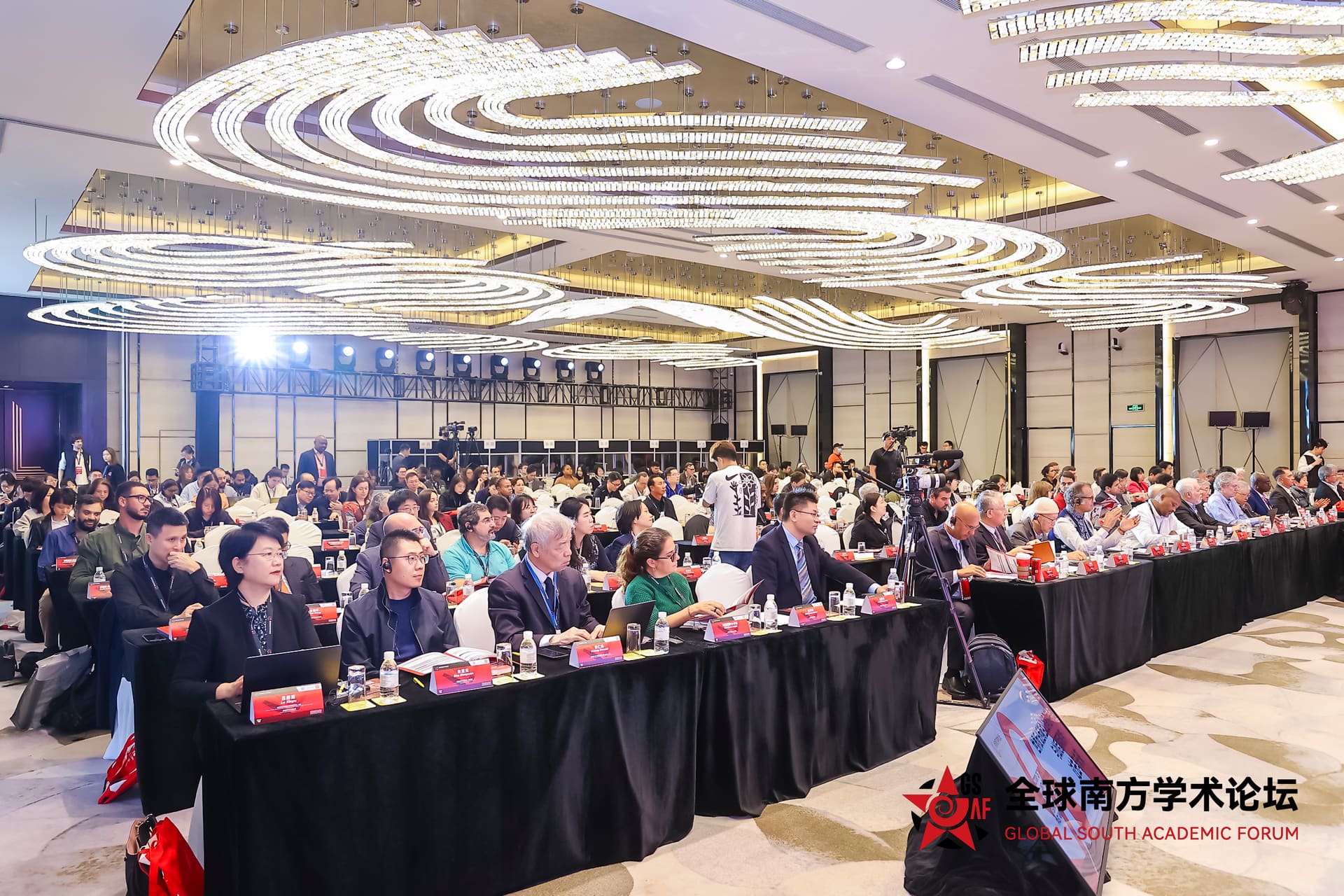
This forum was jointly hosted by East China Normal University (ECNU), the University of Johannesburg (South Africa), and Tricontinental: Institute for Social Research, and organised by ECNU's International Communication Institute, ECNU's School of Communication, and Shanghai Jiao Tong University's School of Marxism. Co-organizers included ECNU's Institute for Regional and Country Studies, Fudan University's Institute for Global Communication and All-Media, and Oriental Publishing Center's Institute for Regional and Country Publishing. Kankan News App and ShanghaiEye streamed the entire forum live.
Consolidating Anti-Fascist Memory and Defending the Cause of Peace
At the opening ceremony, Kuai Shuguang, Director of the International Cooperation and Exchange Division of East China Normal University; Zhang Meifang, Director of the International Exchange Working Committee of the China Association for Innovation and Development Strategy; and Alberto Blanco Silva, Cuban Ambassador to China, delivered speeches, conveying the consensus among China and Global South countries to join hands in promoting exchange, cooperation, and maintaining fairness and justice.
Kuai Shuguang, Director of the International Cooperation and Exchange Division of East China Normal University, extended a sincere welcome to guests from all over the world on behalf of ECNU. Kuai Shuguang stated that as global governance reaches a new crossroads, the solidarity, exchange, and cooperation among the vast Global South countries are of even greater significance, and he looked forward to jointly remembering history and creating a peaceful future through this forum.
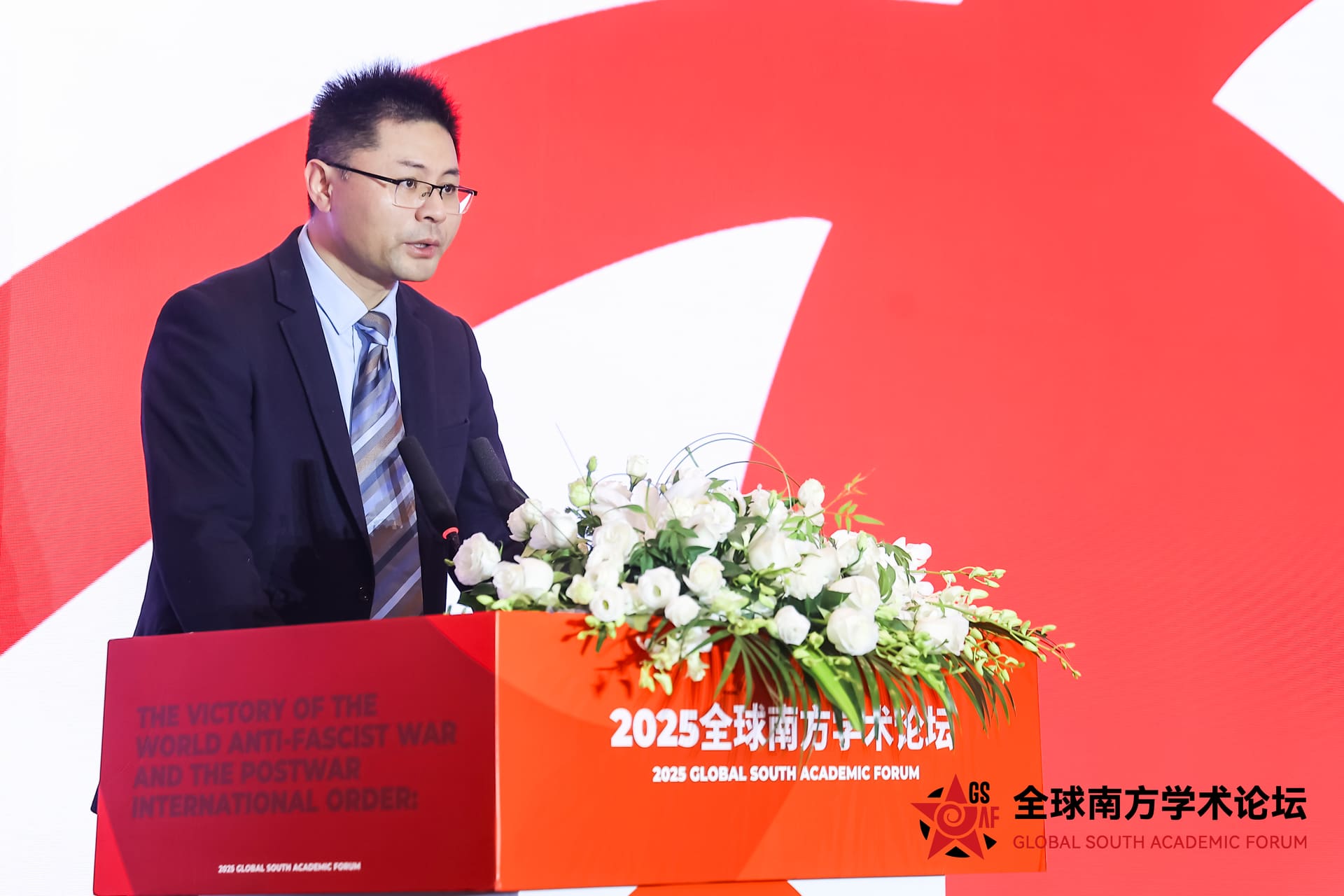
Kuai Shuguang, Director of the International Cooperation and Exchange Division of East China Normal University, delivers a speech.
Zhang Meifang, Director of the International Exchange Working Committee of the China Association for Innovation and Development Strategy, delivered the opening address. Zhang Meifang pointed out that on the important occasion of the 80th anniversary of the victory of the World Anti-Fascist War, Global South countries should review history, grasp the present, and plan for the future, working together to maintain the post-war international order and fairness and justice. She emphasised the need to promote exchange and cooperation between China and Global South countries through think tank collaboration and policy research, jointly exploring an inclusive, just, and sustainable development path.
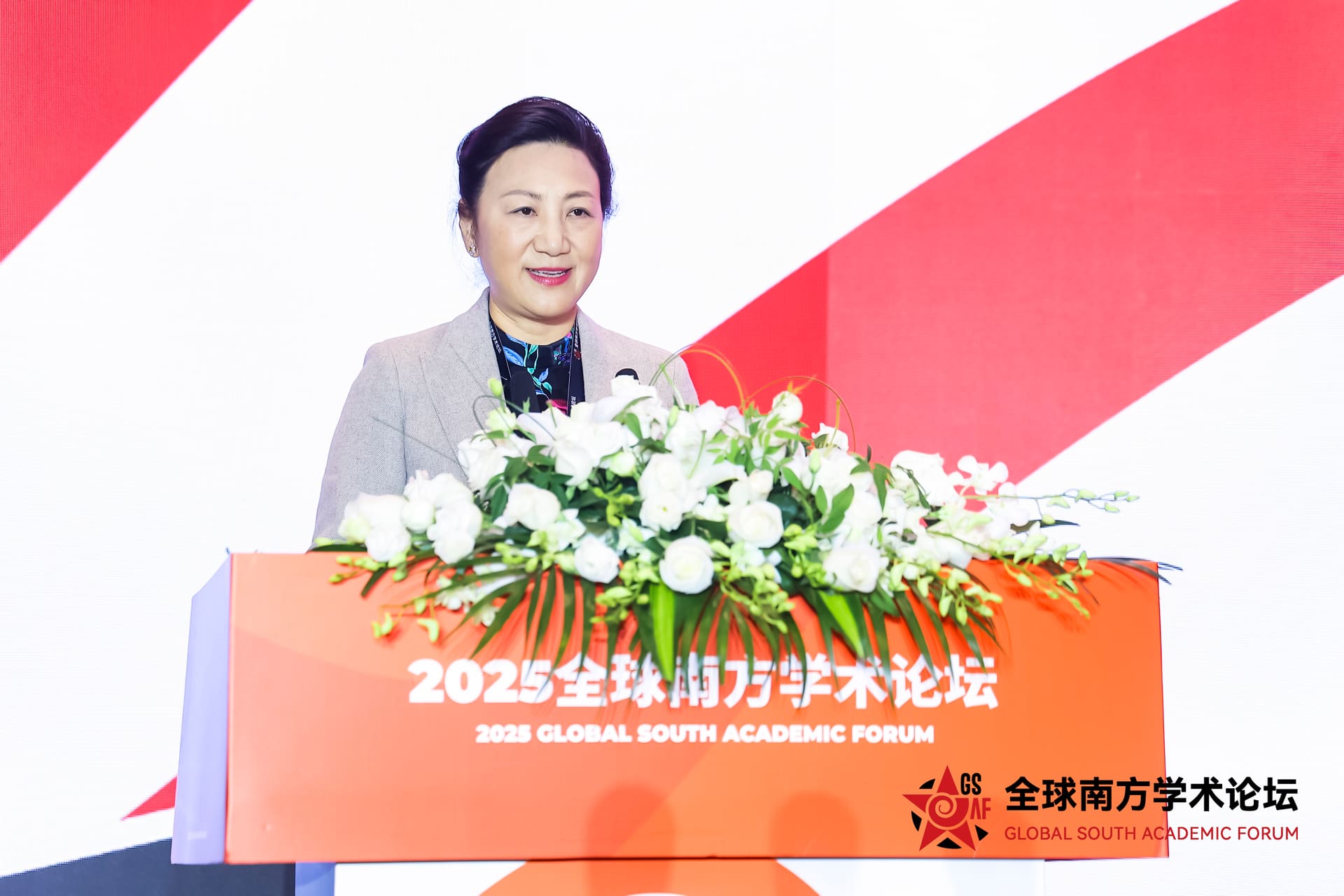
Zhang Meifang, Director of the International Exchange Working Committee of the China Association for Innovation and Development Strategy, delivers a speech.
Alberto Blanco Silva, Cuban Ambassador to China, affirmed in his video address China's significant contribution as the main Eastern battlefield of the World Anti-Fascist War, stressing the spirit of the people of China and Cuba in jointly opposing unilateralism and defending national sovereignty. Blanco Silva stated that socialist China has become an important force for global stability, balance, and opportunity, and the hope of the Global South, standing in solidarity with Global South countries against hegemony.
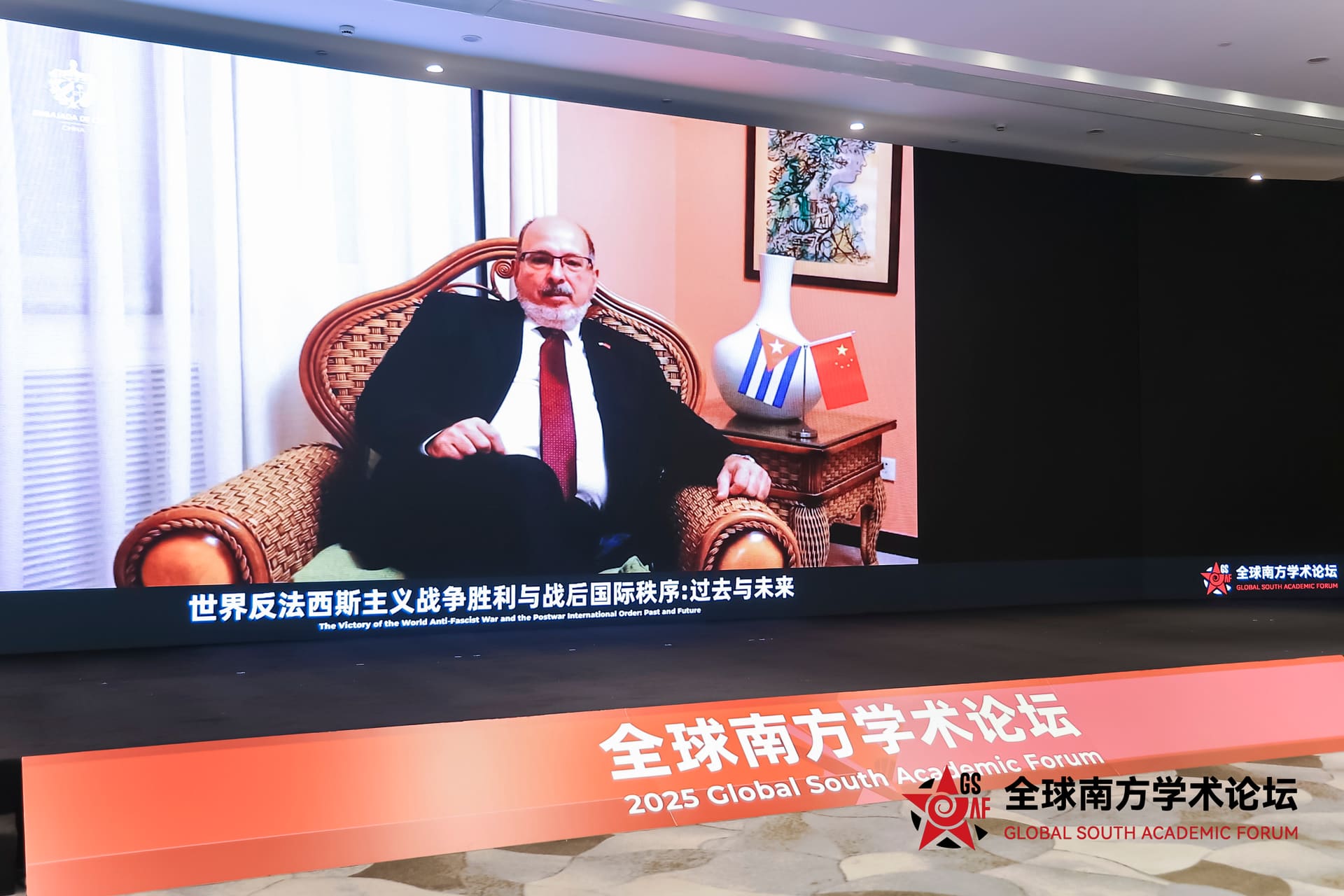
Cuban Ambassador Alberto Blanco Silva delivers a video address.
At the opening ceremony, the report '80th Anniversary of the Victory of the World Anti-Fascist War: Acknowledging Who Truly Saved Human History and Restoring Historical Truth', written by Neville Roy Singham, Chairman of the Advisory Board of Tricontinental: Institute for Social Research, and jointly compiled by the Global South Forum, was officially released. The report is highlighted by its multi-dimensional research and comprehensive statistical analysis, compiling a large amount of genuine war data charts and materials to restore, with irrefutable evidence, the immense sacrifices and vital contributions of the people of China and Russia and the Global South in the Anti-Fascist War. It breaks the historical narrative and discourse hegemony of the Cold War victors and holds profound and far-reaching significance for promoting the construction of a multipolar world platform.
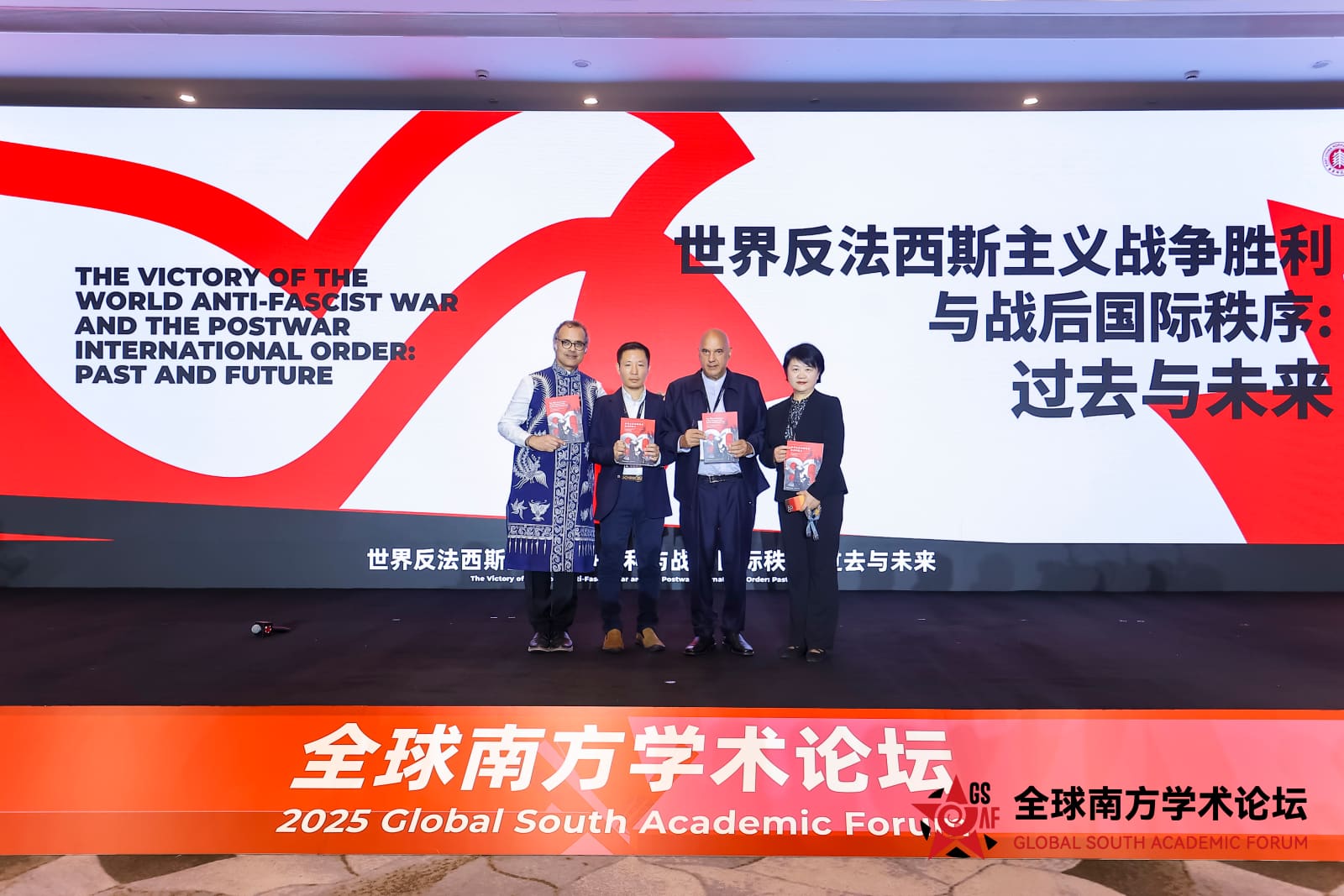
Historical Truth, People's War, and Permanent Peace
During the forum, Vijay Prashad, Director of Tricontinental: Institute for Social Research; Li Shenming, Distinguished Professor at the University of Chinese Academy of Social Sciences and former Vice President of the Chinese Academy of Social Sciences; Wang Hui, Director and Professor of the Institute for Advanced Study in Humanities and Social Sciences at Tsinghua University; Busani Ngcaweni, Director and Professor of the Centre for Public Policy and African Studies at the University of Johannesburg; and Lu Xinyu, Dean of the International Communication Institute at East China Normal University and Chairman of the Global South Academic Forum, delivered keynote speeches. They connected and unified the grand history of the World Anti-Fascist movement, the struggle for peaceful development, and the theoretical and practical paths for building a community with a shared future for mankind, profoundly explaining how and why the forces of the Global South can join hands to construct a new international order.
Vijay Prashad, Director of Tricontinental: Institute for Social Research, used the history of the Soviet people's struggle during the Siege of Leningrad as an introduction, exposing the long-standing lie in Western-dominated narratives that neglects the contributions of the Eastern front and solely promotes the role of Europe and the United States. He called on the Global South to remember the sacrifices of the people, expose the hypocrisy of imperialist narratives, and jointly safeguard the 'great truth' in the struggle for sovereignty, dignity, and peace.
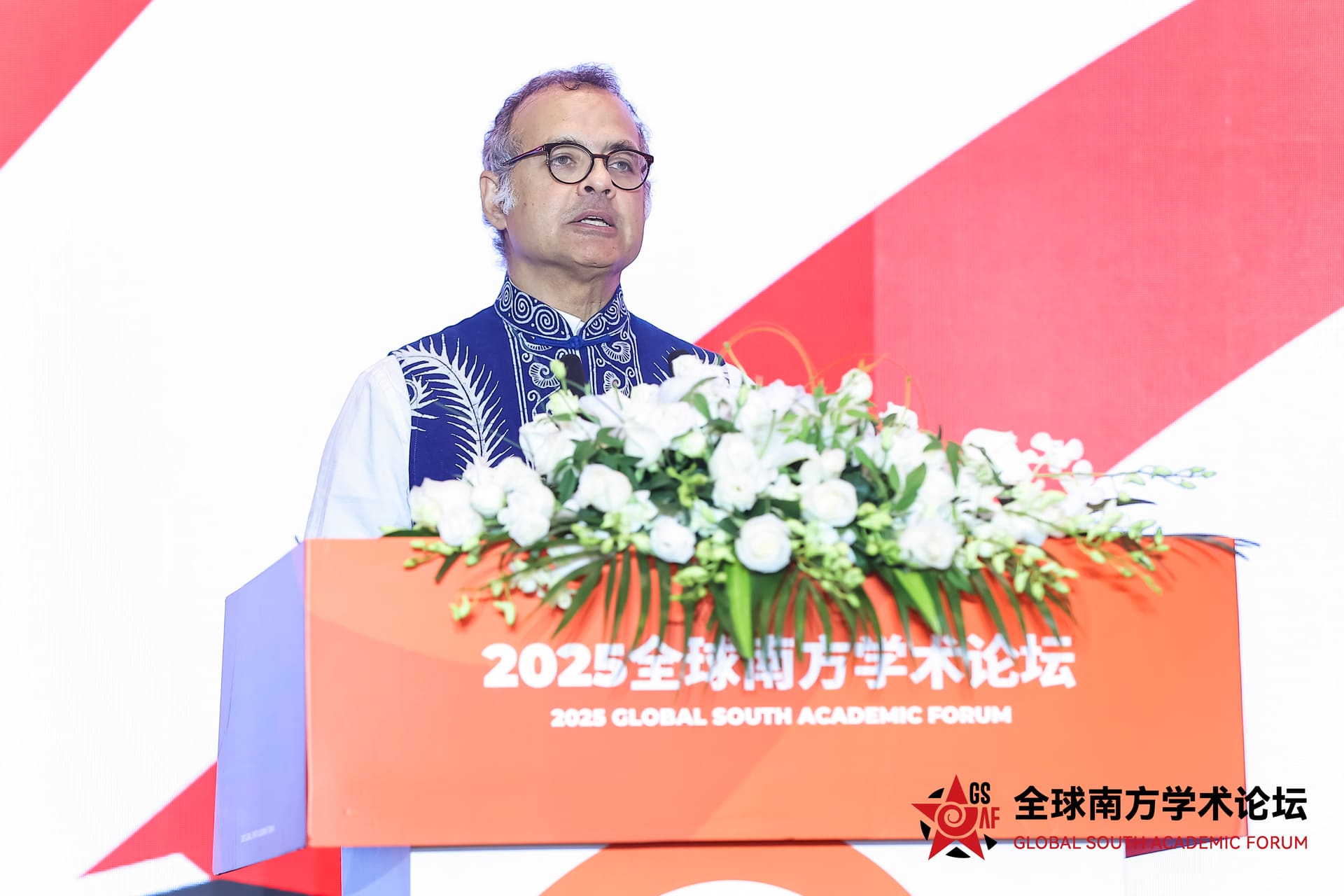
Vijay Prashad, Director of Tricontinental: Institute for Social Research, delivers a keynote speech.
Li Shenming, Distinguished Professor at the University of Chinese Academy of Social Sciences and former Vice President of the Chinese Academy of Social Sciences, combining the century-long struggle of the Communist Party of China, deeply elaborated on the contemporary significance of the thought 'adhere to building a community with a shared future for mankind hand in hand with the peoples of all countries'. Li Shenming pointed out that the awakening, resistance, and struggle of the peoples of the world must resolutely oppose hegemonism and power politics, oppose the rise of fascism and militarism, and that advanced intellectuals of the proletariat should bravely take on the special mission in building a community with a shared future for mankind.
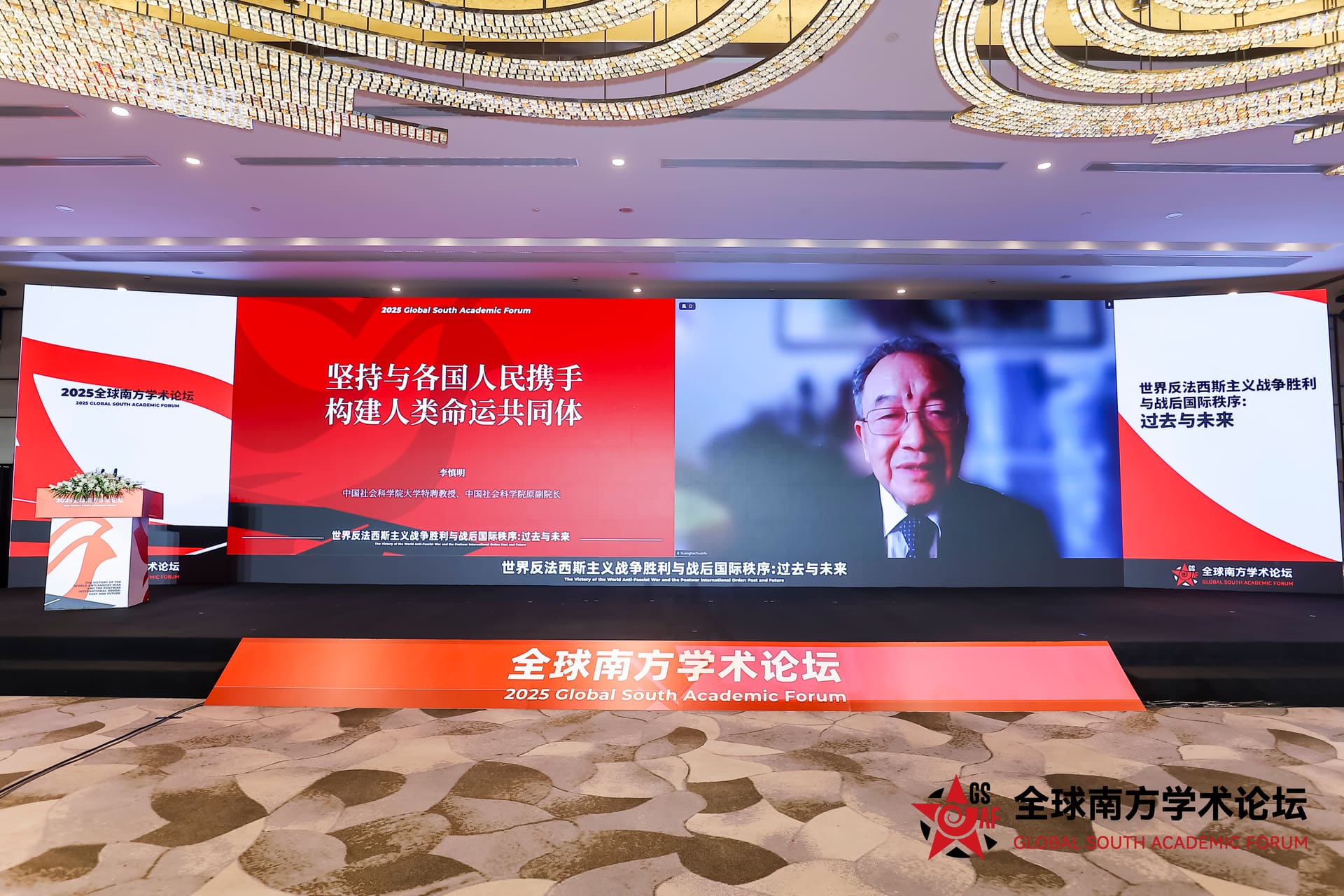
Li Shenming, Distinguished Professor at the University of Chinese Academy of Social Sciences and former Vice President of the Chinese Academy of Social Sciences, delivers a keynote speech.
Wang Hui, Director and Professor of the Institute for Advanced Study in Humanities and Social Sciences at Tsinghua University, emphasised in his speech that understanding the victory of the World Anti-Fascist War should be combined with the historical facts of the victory of the Chinese People's War of Resistance Against Japanese Aggression to find the answer to the question of 'why the People's War could achieve victory under the context of the enemy being stronger than us'. He argued that 'People's War' is not a purely military concept but a political category, a political concept. Under the unique conditions of 20th-century China, 'People's War' was a process of creating a new political subject, and also a process of creating a political structure and its form of self-expression suited to this political subject. Wang Hui suggested that today's discussion of the historical position of the Global South can draw inspiration for global peaceful development from the experience of the 20th-century Chinese Revolution.
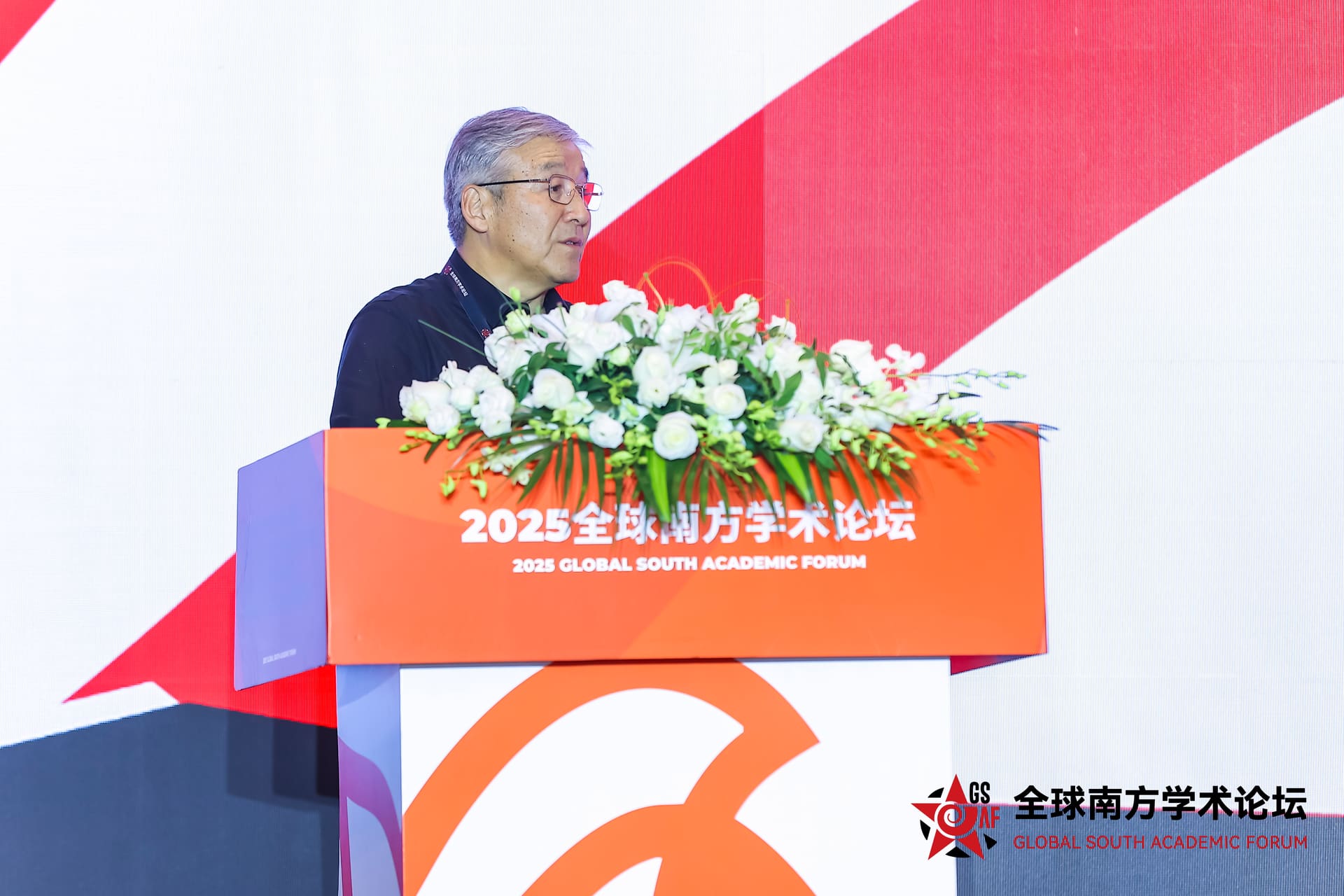
Wang Hui, Director and Professor of the Institute for Advanced Study in Humanities and Social Sciences at Tsinghua University, delivers a keynote speech.
Busani Ngcaweni, Director and Professor of the Centre for Public Policy and African Studies at the University of Johannesburg, pointed out that fascism has not died but has been reshaped into a new form of hegemony cloaked in 'governance', 'development', and 'rules-based order', implementing implicit domination and deprivation through rating agencies, capital, media, algorithms, and law, perpetuating the structural violence of colonialism and imperialism. He used the Palestine issue as an example to reveal the essence of this 'invisible fascism' and stressed that the Global South needs to build 'developmental state governance' with the spirit of Bandung and China's proposed global initiatives, reconstruct meaning systems, knowledge autonomy, and collective subjectivity, and reclaim discourse power and development rights through solidarity.
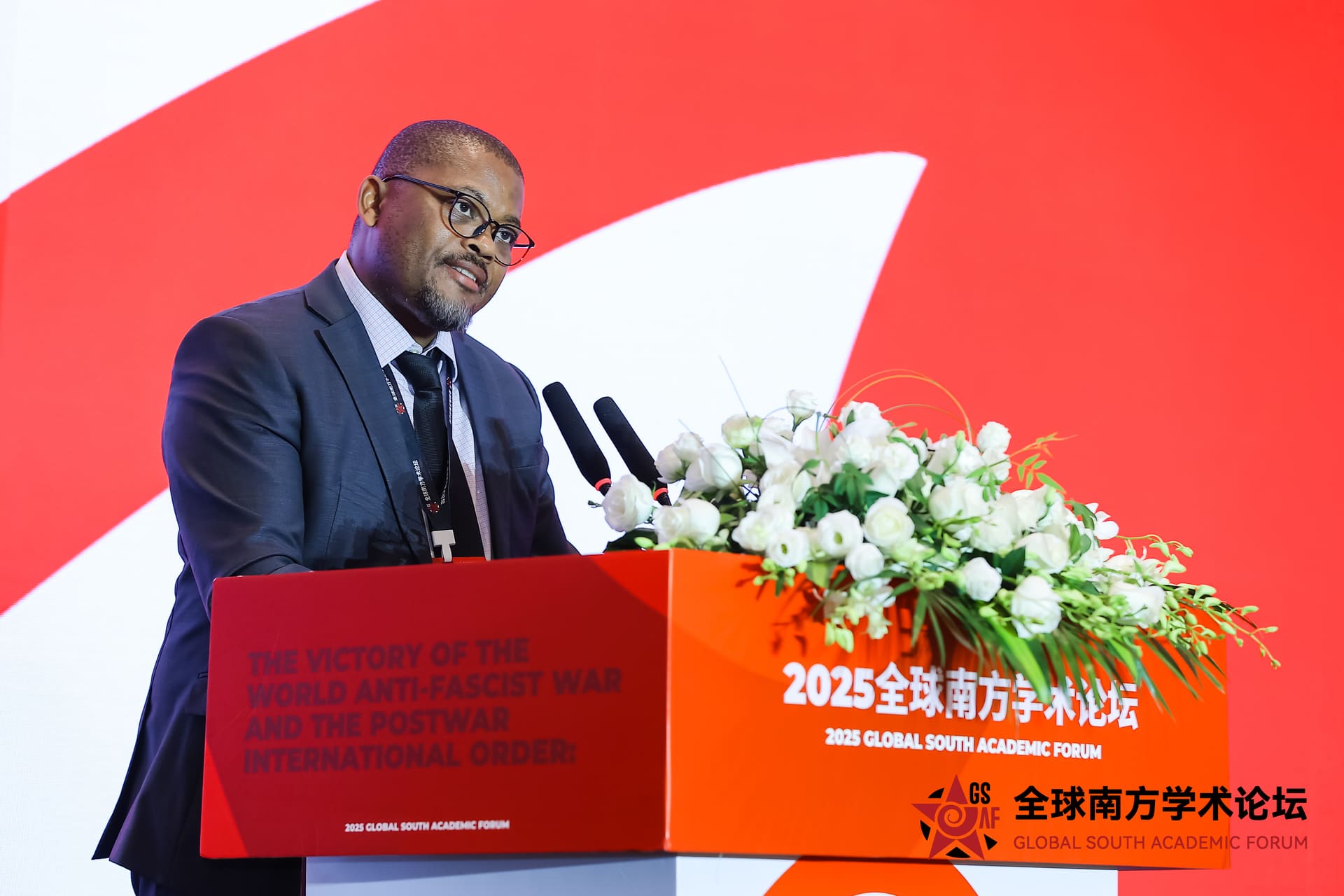
Busani Ngcaweni, Director and Professor of the Centre for Public Policy and African Studies at the University of Johannesburg, delivers a keynote speech.
Lu Xinyu, Dean and Professor of the International Communication Institute at East China Normal University and Chairman of the Global South Academic Forum, shared three unique stories with the guests. Her mother's name, 'Zhu Yongping', originated from the yearning for permanent peace during the War of Resistance Against Japanese Aggression, and her family's story reflects the firm determination of the entire military and people to fight to the end in the national liberation war. Mao Zedong Thought and the War of Resistance Against Japanese Aggression led by the Communist Party of China gave former Japanese war criminal Shiiwatari Takeshi, who had been 'turned into a devil' by militarism, hope for achieving permanent peace. The 'Village Super League' dissemination story in Rongjiang, Guizhou, writes a new era vitality for 'party organisation communication' through the mass line. Lu Xinyu stated that in promoting a new information and communication order in the 21st century, how socialists worldwide can reconstruct Marxist journalism and communication as historical practice theory is a common task for China and the Global South.
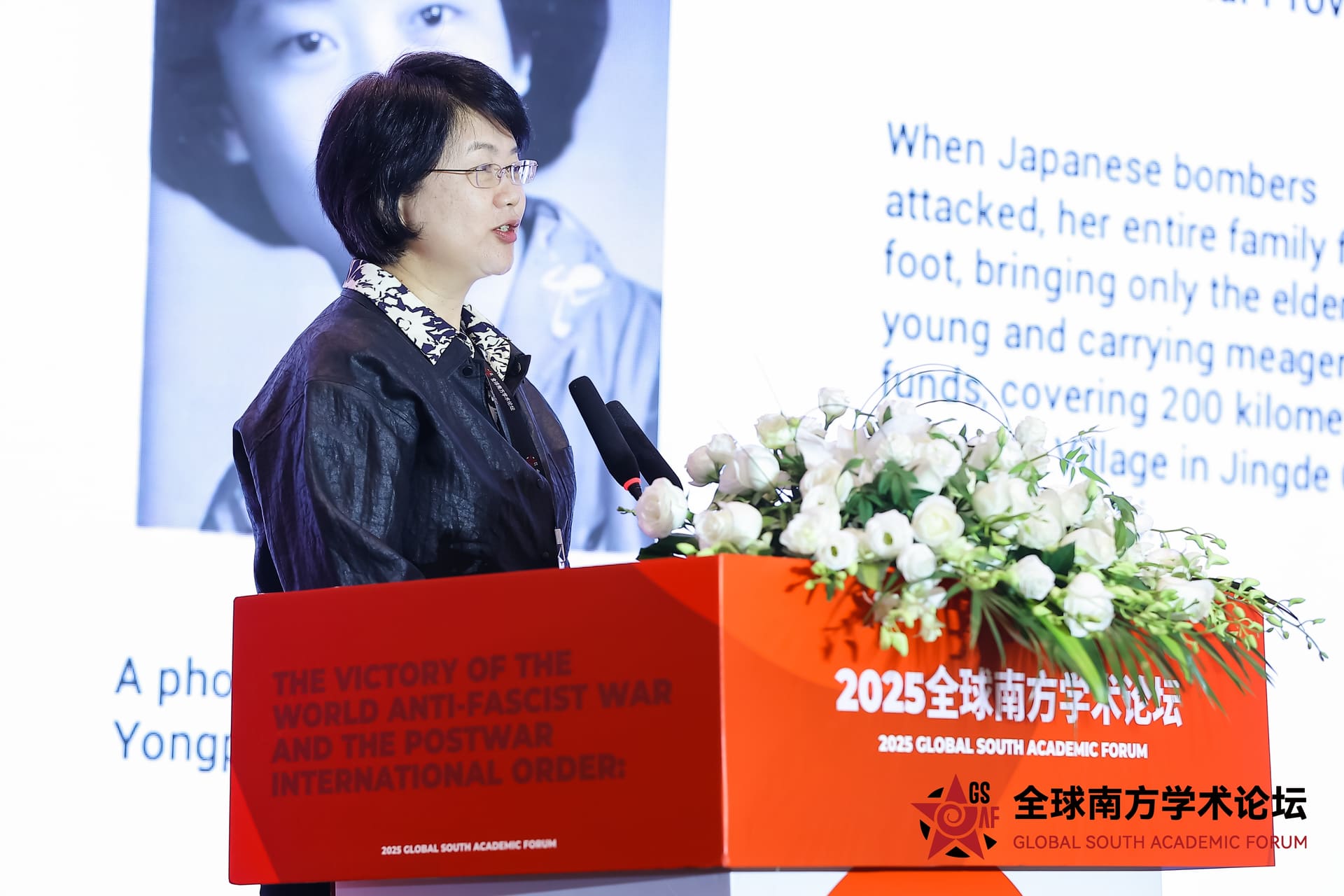
Lu Xinyu, Dean and Professor of the International Communication Institute at East China Normal University and Chairman of the Global South Academic Forum, delivers a keynote speech.
Sub-Forum I | The Eastern Main Battlefield of the Anti-Fascist War: Cornerstone of Peace in Northeast Asia and the Foundation of the Post-War World Order
After the 'September 18th Incident' in 1931, China was the first to independently take on the historical mission of resisting fascist aggression, opening up the Eastern Main Battlefield of the World Anti-Fascist War. The victory of the Chinese people's fourteen years of arduous resistance not only profoundly influenced and laid the foundation for the post-war world order centred on the United Nations but also provided a solid political starting point for the autonomous exploration and pursuit of justice by the peoples of the Global South. However, this historical legacy is being intentionally distorted and hollowed out by new and old Cold War logics and discourse hegemony. Sub-Forum I: 'The Eastern Main Battlefield of the Anti-Fascist War: Cornerstone of Peace in Northeast Asia and the Foundation of the Post-War World Order', co-organised by the Asian Marxism Communication Institute of East China Normal University, aimed to set the record straight, deeply elaborate on the crucial role of this victory in establishing the legal status of Taiwan, China, and forging the peaceful pattern of Northeast Asia, providing historical evidence and ideological support for the Global South to defend its sovereignty and pursue peaceful development in the current complex situation.
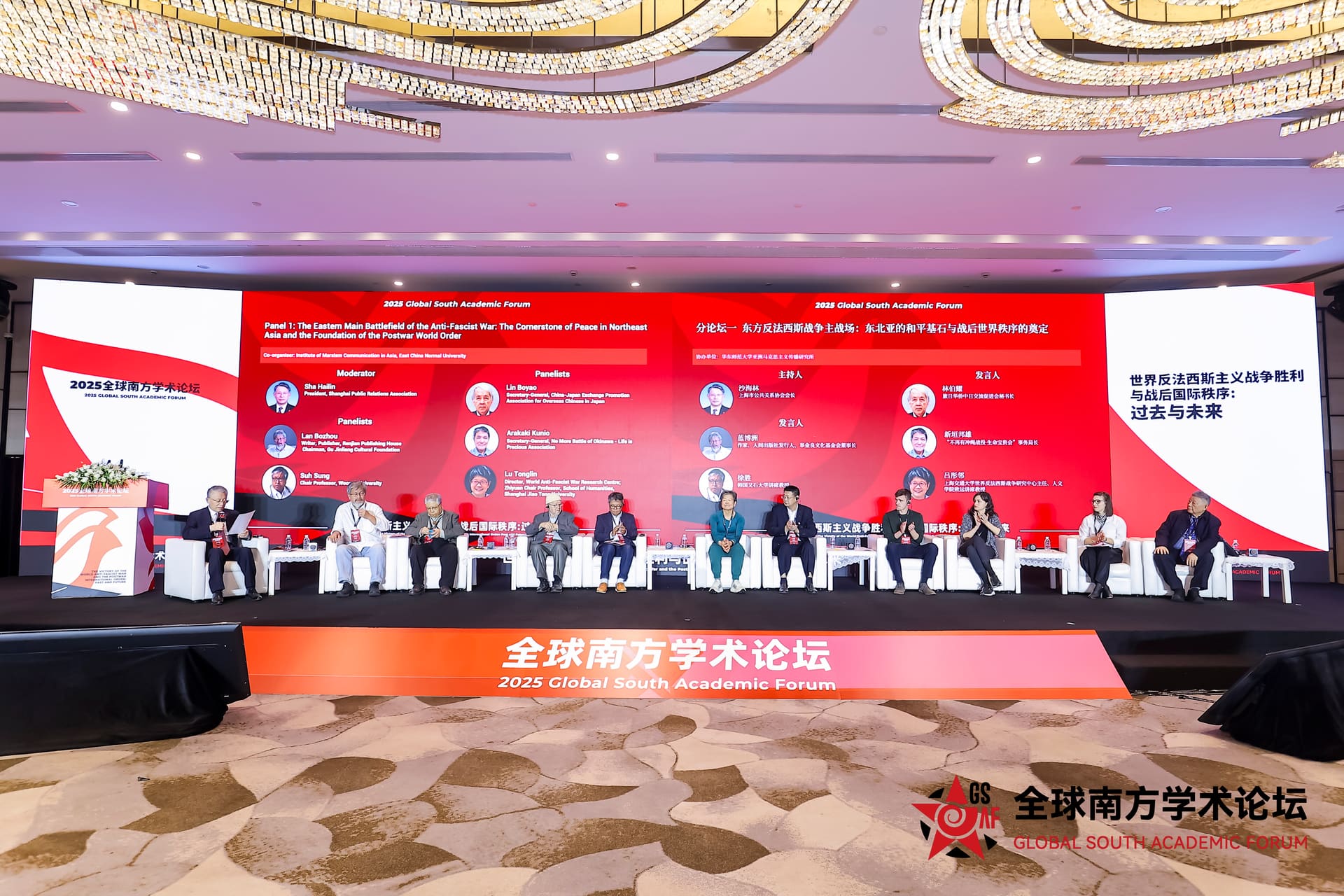
This sub-forum was chaired by Sha Hailin, President of the Shanghai Public Relations Association. Sha Hailin pointed out that China was the first to undertake the anti-fascist mission after the 'September 18th Incident', and its immense sacrifice laid the foundation for the post-war order centred on the United Nations, providing a political starting point for the autonomous liberation of the Global South. However, this history is being distorted by Cold War narratives and discourse hegemony, making the forum's important task to re-emphasise the decisive significance of the victory of the War of Resistance for the legal status of Taiwan, China, and the peaceful pattern of Northeast Asia, inspiring the contemporary Global South to defend sovereignty and development.
Lan Bozhou, Writer, Publisher of Renjian Publishing House, and Chairman of the Gu Jinliang Cultural Foundation, reviewed different historical stages in Taiwan—from the Japanese colonial rule period to the establishment of the Kuomintang-Communist united front against Japan, and the subsequent anti-colonial struggle by Taiwanese communists and the White Terror that swept the island after the victory of the War of Resistance. He pointed out that 'Taiwan independence' forces in Taiwan, due to the loss of socio-historical memory, are pathologically pro-American and, based on the US global anti-communist strategy, are deliberately guiding Taiwanese people to misunderstand history, further alienating the ideological identity of the Taiwanese people. Lan Bozhou emphasised the need to restore historical truth, help the public correctly understand history, and thus resolve historically lingering issues.
Suh Sung, Chair Professor at Woosuk University in South Korea, pointed out that China played a crucial role in the Anti-Fascist War and the East Asian national liberation movement, serving as an important founder of the regional peace order. He noted that the Japanese right-wing forces deny the history of aggression and promote re-militarisation, posing a real threat to peace in East Asia. Only by adhering to the historical standard established by China's victory in the Anti-Fascist War and resolutely opposing imperialist hegemonic intervention can lasting peace and a just order in East Asia be maintained.
'Japan's militarism is on the eve of a revival'! Lin Boyao, Secretary-General of the Japan-China Exchange Promotion Association of Overseas Chinese in Japan, warned against the Japanese right-wing's move to promote military expansion by leveraging the 'Taiwan contingency' rhetoric. He pointed out that the US-led Asia-Pacific security architecture is constantly breaking post-war restrictions, escalating confrontation with China, and weakening regional peace and stability. Faced with the trend of a new Cold War, civil peace forces in East Asian countries must join hands to defend the historical achievements of the Anti-Fascist War and resist the resurgence of militarism.
Kunio Arakaki, Secretary-General of the 'No More Battle of Okinawa, Precious Lives Society', discussed the impact of US military bases in Japan on the lives of Okinawa residents, pointing out that the 'Taiwan contingency' rhetoric hyped by Japan and the US is pushing Okinawa back onto the potential military frontline and seriously affecting the local residents' lives and safety. Facing escalating regional tensions, Kunio Arakaki stressed that the Japanese and US governments should stop inciting the 'China threat theory' and called for dialogue to gradually achieve peaceful reunification across the Taiwan Strait.
Towards the end of World War II, the US, to effectively weaken the Japanese military's resistance in the Pacific theatre, absorbed and adapted the Chinese Communist Party's Yan'an experience in managing Japanese prisoners of war. Lu Tonglin, Director of the Center for World Anti-Fascist War Studies at Shanghai Jiao Tong University and Distinguished Professor at the School of Humanities, revisited this history of cooperation, which was obscured by Cold War narratives, based on the historical material of the US Army Observer Group's 'Yan'an Report' and the Huntsville Japanese POW Training Base. She pointed out that this 'forgotten cooperation' represents a rare case of cross-camp cooperation amidst ideological conflict, holding significant meaning for re-understanding international relations.
Lin Limin, President of the China Association for Second World War Studies, Professor at the University of International Relations, and Visiting Professor at the China Institute for Boundary and Ocean Studies at Wuhan University, pointed out that the 20th century international order experienced three major adjustments, and the systemic change from the Versailles System to the end of the Cold War laid the historical logic for the current multipolar trend. Lin Limin emphasised that the future international order should be based on equality, justice, and cooperation, avoiding the recurrence of old hegemonic cycles. Global South countries must seize the new opportunity of the current international order transition to build active and effective international organisational mechanisms and structures to solve various global problems.
Matthew Read, Researcher and Coordinator at the Clara Zetkin Social Research Forum (UK), stated that Western historiography, long Eurocentric in its anti-fascist narrative, deliberately downplays or even distorts the decisive contributions of the Soviet Union and China, and conceals its own structural responsibility in the rise of fascism. He emphasised that the deep roots of World War II lie in the crisis of capitalism and imperialist expansion. Therefore, reconstructing historical awareness must break through ideological prejudices, resist historical revisionism, restore the true status of the Eastern front, and maintain the anti-fascist spirit and contemporary principles of peace.
Sanja Horvatinčić, Assistant Researcher at the Institute of Art History in Zagreb, Croatia, discovered a profound link between the tradition of inter-ethnic solidarity formed in Yugoslavia during the anti-fascist resistance and post-war nation-building, and Global South countries like China. These internationalist ties, forgotten after the Cold War, challenge the Eurocentric historical narrative and demonstrate the real basis for transnational solidarity in the Global South. Sanja Horvatinčić called for the reconstruction of a people-centred historical perspective and the rediscovery of the obscured tradition of anti-oppression and solidarity.
Sofya Melnichuk, Editor-in-Chief of RT Chinese Channel, and her team persist in uncovering war crimes such as the human experiments of Unit 731, disclosing the living human tragedies and the barbarity of militarism beyond the archival paper. She called on media in all countries to actively assume the role of historical record-keepers, strengthen international cooperation, defend anti-fascist memory, and jointly maintain lasting peace.
Wu Enyuan, former Director and Professor of the Institute of Russian, Eastern European and Central Asian Studies at the Chinese Academy of Social Sciences, emphasised in his commentary that the root cause of World War II was the imperialist struggle for hegemony, and pointed out that historical nihilism is weakening the key contributions of China and the Soviet Union on the Eastern front. Wu Enyuan stated that the Chinese people fired the first shot in the War of Resistance Against Japanese Aggression, encouraging the fighting spirit of the world's people against fascism, which is an undeniable historical fact.
Sub-Forum I dispelled the historical fog from various dimensions, returning to the real memory of the anti-fascist struggle, and provided important enlightenment for rebuilding an anti-war peace narrative based on justice and historical facts. Global South countries should use historical truth as the source of strength to forge stronger bonds of solidarity.
Sub-Forum II | Beyond the Cold War: The Yalta System, the United Nations, and the Post-War International Order
The Yalta System established the international order centred on the United Nations after World War II, providing important external conditions for the wave of independence in Global South countries. However, the bloc confrontation of the Cold War, the unilateralism of the post-Cold War era, and the recent trend of a new Cold War have continually eroded this order, posing a systemic threat to development rights, sovereignty, and international justice. Sub-Forum II: 'Beyond the Cold War: The Yalta System, the United Nations, and the Post-War International Order', starting from the perspectives of historical logic and realistic challenges, discussed the evolution of the post-war order, the long-term constraints of Cold War thinking on international relations, and how the Global South can drive the international system back onto a track of fairness and cooperation in the era of multipolarity.
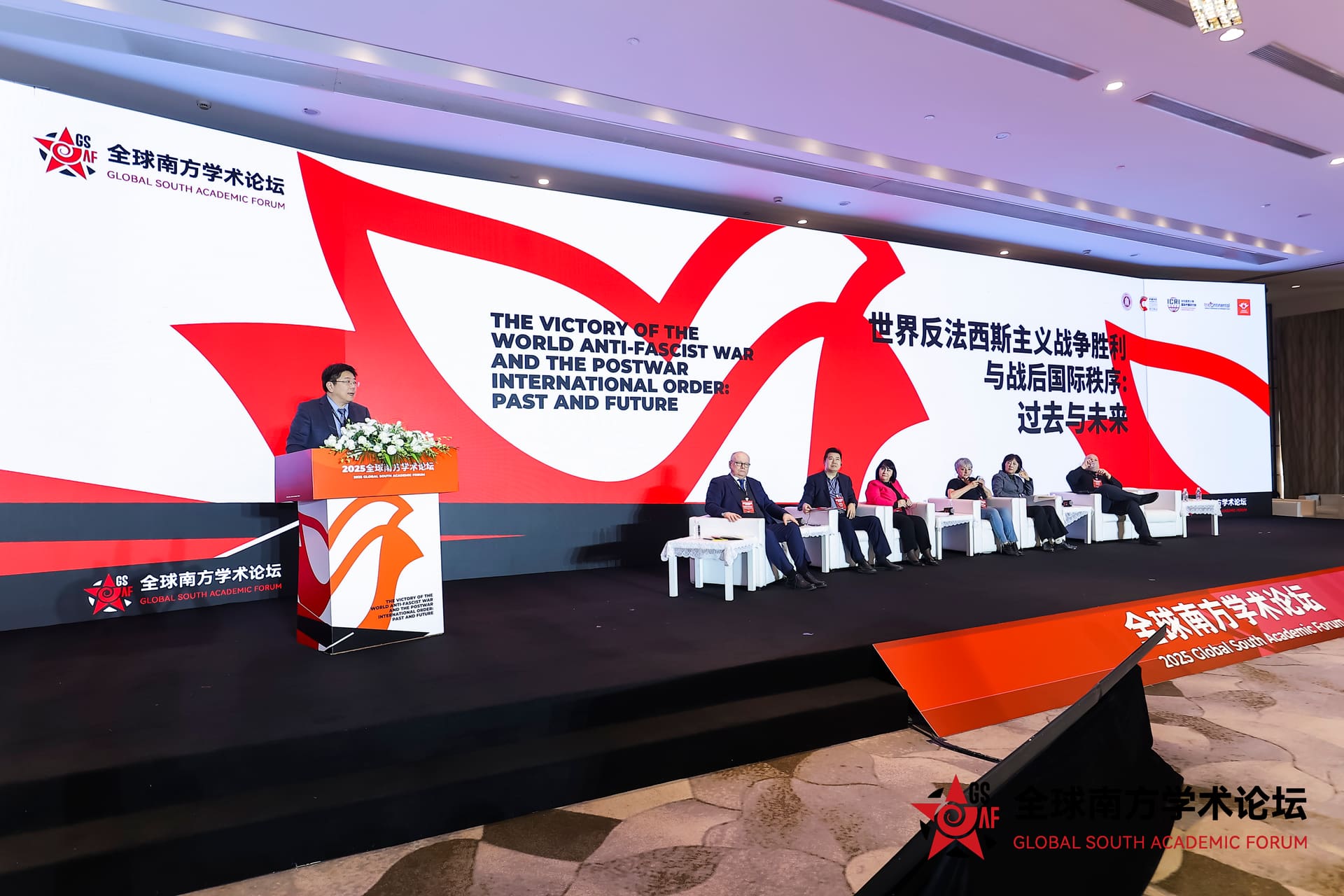
The sub-forum was chaired by Evgeny N. Grachikov, Professor of the Department of International Relations Theory and History at RUDN University (Russia), who emphasised that the unipolar world has collapsed, and a multipolar pattern is being jointly shaped by China, Russia, and Global South countries, promoting new types of international relations through mechanisms like BRICS, SCO, and the Belt and Road Initiative.
Liang Zhanjun, President of the Chinese Association for the Study of Modern and Contemporary World History and Professor at Capital Normal University, pointed out that the United Nations is a product of the victory of the Anti-Fascist War, and its authority is built on the foundation of justice established by the victorious nations. For eighty years, the UN has maintained international peace with the Charter's principles as its core, but current great power competition, regional conflicts, and global crises weaken its role. He suggested strengthening UN research and history education, reasserting the correct historical view of World War II, and promoting UN system reform to achieve great power cooperation and genuine multilateralism.
Biljana Vankovska, Professor at the Faculty of Philosophy at Saints Cyril and Methodius University, reviewed the unique experiences of Yugoslavia in the anti-fascist struggle, self-management socialism, and the Non-Aligned Movement, pointing out that Western intervention and neoliberal reforms ultimately led to the disintegration of the state, societal division, and regional dependency. She emphasised that the Balkan region, in the new multipolar structure, should move beyond the path of dependency, reclaim its independent spirit and non-alignment tradition, and become a civilizational bridge connecting East and West, North and South, participating in global governance in a more autonomous manner.
Men Jing, Director and Professor of the European Studies Center at East China Normal University, argued that the relationship between the European Union and the Global South has undergone a profound transformation, from post-war development aid and post-Cold War normative diplomacy to the current geopolitical competition. The core driver is not in the Global South but in Europe's own identity reshaping. The EU is shifting from a value exporter to a competitive actor with strategic anxieties, constrained by internal institutional fragmentation and resource shortages. Men Jing suggested that the EU needs to abandon its patronizing posture and build genuine partnerships with the Global South in a more equal and flexible manner.
Ana Esther Ceceña, Senior Researcher and Professor at the Institute of Economic Research at the National Autonomous University of Mexico, analysed the formation mechanism of the 'Collective West' since 1945, pointing out that the US built a global hegemonic structure through economic scale, military production, and institutional expansion. She emphasised that the world is currently at a geopolitical inflection point, with a new order forming under the impetus of multipolar forces. Western hegemony attempts to maintain the old structure, while the Global South is working to break the dependency system through political diversification, economic autonomy, and international cooperation, promoting a more balanced world order.
Wisam Rafeedie, former Lecturer in the Department of Social Sciences at Bethlehem University, independent researcher, and writer, shared via video that fascism has not ended but is a structural product of capitalism, imperialism, and the colonial system, currently epitomized by the expulsion and genocide of Palestinians by the Zionist regime. In Wisam Rafeedie's view, China and Russia are promoting a new international balance, but the old system still intervenes in the Global South in a hegemonic manner. The Global South must push for the birth of a new international order through a more thorough anti-imperialist struggle.
Carlos Ron, Senior Researcher at Tricontinental: Institute for Social Research, argued that the Yalta System and the UN Charter established the post-war order, but also resulted in structural inequality and the absence of power for the Global South. The unipolar hegemony is unsustainable after the Cold War, and the trend towards multipolarity is accelerating, leading to a restructuring of global governance. He emphasised the need to reform institutions like the UN, strengthen sovereign equality, international rule of law, and genuine global participation, moving the international system from 'imbalance' to 'equilibrium' and securing a fairer position for the Global South.
Wang Xiaoquan, Director of the Scientific Research Department at the Institute of Russian, Eastern European and Central Asian Studies at the Chinese Academy of Social Sciences and Professor at the School of Government Management at the University of Chinese Academy of Social Sciences, pointed out in his commentary that the UN established anti-fascist principles and the great power consensus mechanism, but its authority has been long challenged. Neo-fascism, hegemonism, and double standards still persist, and the spheres of influence are constantly changing. China and Russia in the Eurasian region can offer a new model for future international order reform, while also needing to develop new concepts that reflect the demands of the Global South.
Through in-depth discussions among scholars from various countries, Sub-Forum II systematically revealed the long-term oppression of the Global South caused by the Eurocentric historical view, Cold War structure, and contemporary imperialism. It also emphasised the continuing significance of anti-fascist historical truth, national sovereignty, and people's liberation in the current world turbulence, showcasing the common experience of the Global South in the anti-hegemonic struggle, and highlighting the necessity and urgency of establishing a more just and equal new international order.
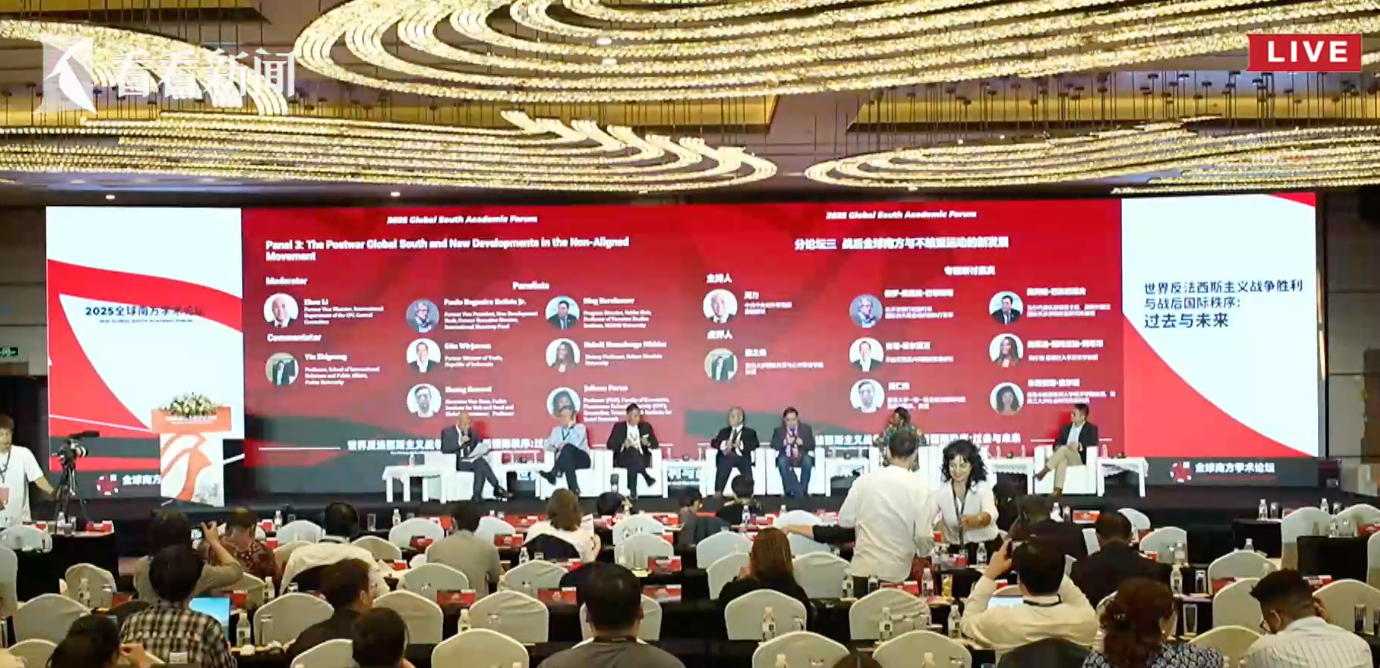
Sub-Forum III | Post-War Global South and New Developments in the Non-Aligned Movement
The post-war Global South broke through the bipolar pattern through the Non-Aligned Movement (NAM), advocating an international relations framework of mutual respect and peaceful coexistence. The ten principles proposed at the Bandung Conference became its core ideology. Facing the multiple challenges of today's 'New Cold War', anti-globalisation, and the dysfunction of the international order, how can BRICS cooperation and the 'Belt and Road Initiative' continue the spirit of non-alignment, push Southern countries to defend autonomy in a multipolar system, break the power hierarchy, and promote common development? This was the core issue of Sub-Forum III: 'Post-War Global South and New Developments in the Non-Aligned Movement'.
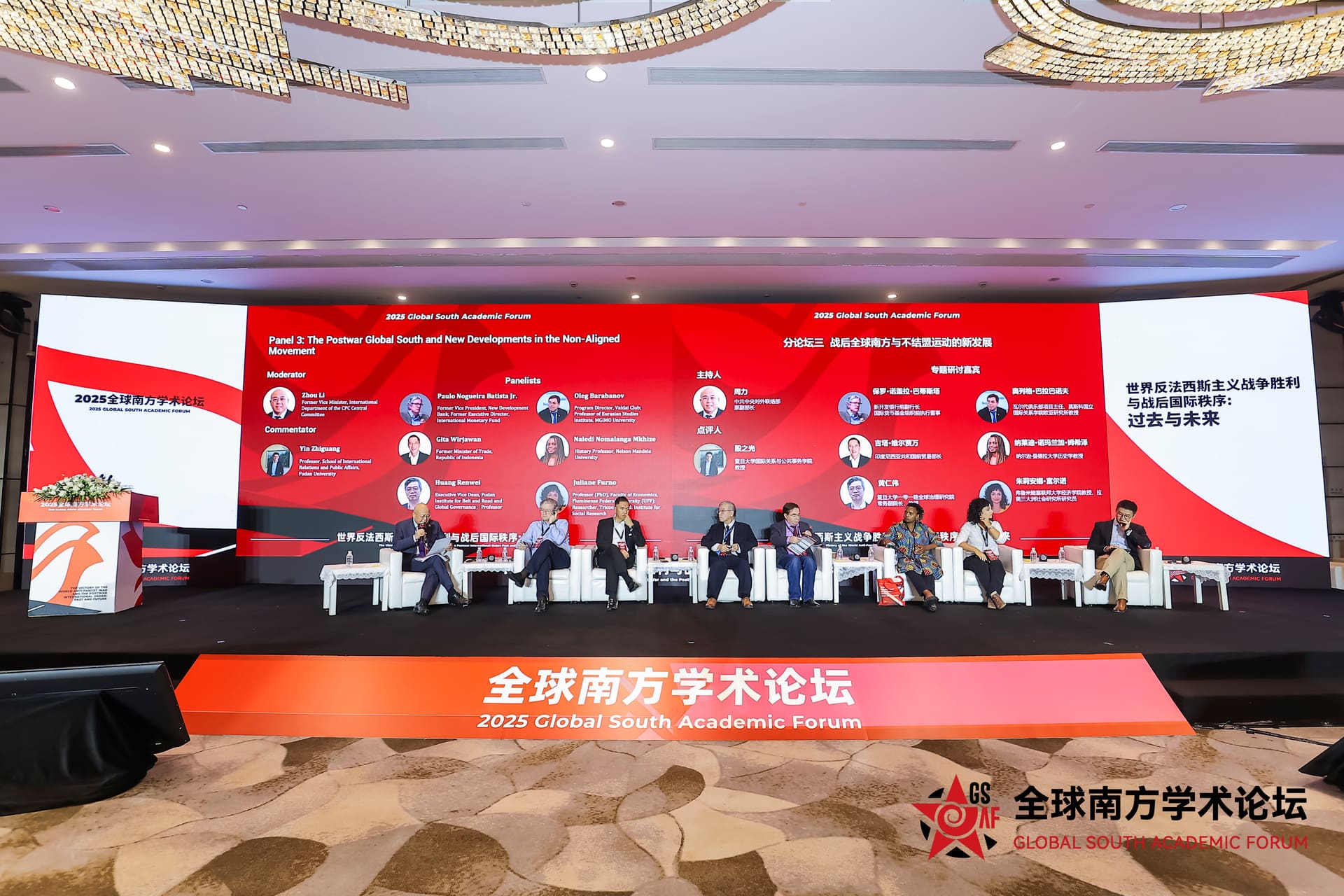
The sub-forum was chaired by Zhou Li, former Deputy Minister of the International Department of the CPC Central Committee. Zhou Li reviewed the aspirations for peace embodied by the UN over the past 80 years, while pointing out that the 'rules-based order', promoted by imperialism and international monopoly capital, is constantly challenging the post-World War II international system. The Global South once broke through hegemonic opposition with the NAM; now, it needs to continue the Bandung spirit on platforms like BRICS and the Belt and Road Initiative, unite and cooperate, resist the new Cold War and anti-globalisation, and promote the formation of more just international relations.
Paulo Nogueira Batista Jr., former Vice President of the New Development Bank and former Executive Director of the International Monetary Fund, emphasised that the Global South is facing new geopolitical and economic restructuring, with uncertainty and risk coexisting. The old order is crumbling, but the new one is not yet formed, and the Global South must strive for greater discourse power amidst the turbulence. He also stressed the importance of mechanisms like BRICS and the New Development Bank and suggested that developing countries need to seize the historical opportunity to reduce reliance on the traditional hegemonic system through cooperation, promoting fairer global governance.
Gita Wirjawan, former Indonesian Minister of Trade, reviewed the tradition of ASEAN and the NAM, pointing out that Southeast Asia has new strategic opportunities in the era of multipolarity, and developing countries need to strengthen the rule of law and predictability to attract technological capital transfer. Wirjawan emphasised China's crucial role in technological capital, supply chains, and BRICS expansion, calling on the Global South to value the role of education and enhance its own governance and technological capabilities.
Huang Renwei, Executive Vice Dean and Professor of the Fudan University Belt and Road Global Governance Institute, stated that China and the Global South share anti-colonial historical memories, and the main thread of change in the post-World War II international order is the overall rise of Southern countries. The 'Belt and Road Initiative', as a practice of interconnectedness inheriting the Bandung spirit and the NAM tradition, grants the Global South greater agency in global governance, development rights, and order reshaping. China and Southern countries are jointly shaping a new international order, making it more inclusive, fair, and reflective of the development demands of the majority of countries.
Oleg Barabanov, Program Director of the Valdai Discussion Club and Professor at the Moscow State Institute of International Relations, pointed out that the world is in a period of drastic change, and the old global governance architecture struggles to meet the needs of the new era. He advocated strengthening the institutional power of the Global South through new mechanisms and platforms. Oleg Barabanov believes that initiatives like the 'Belt and Road Initiative' can reconnect regions fragmented by colonialism, forming a genuine global cooperation network, and specifically emphasised the importance of 'structured platforms' for the solidarity of Southern countries.
Naledi Nomalanga Mkhize, Professor of History at Nelson Mandela University (South Africa), emphasised that the legacy of colonialism still profoundly affects the Global South, especially in education, culture, and historical narratives. Therefore, it is essential to reconstruct the subjectivity of Southern countries, correct narratives distorted by colonial history through education, enable the younger generation to understand the value of their own civilisation, and leverage historical memory and national consciousness in the anti-imperialist, anti-hegemonic struggle for a fair order.
Juliane Furno, Professor at the Institute of Economics at Fluminense Federal University and Researcher at Tricontinental: Institute for Social Research, analysed the common predicament of the Global South from a Latin American perspective, including imbalanced development and external capital structures limiting regional development. She pointed out that Southern countries should break away from dependence on the international financial system and explore autonomous development paths, emphasising the importance of regional cooperation and complementarity, and affirming China's role in promoting inclusive technological capital and alternative development paths.
Yin Zhiguang, Professor at the School of International Relations and Public Affairs at Fudan University, in his commentary, described the essential characteristics of the Global South as 'hot, chaotic, diverse, and informal', but it is precisely this special state that breeds the possibility of change. Yin Zhiguang believes that 'uncertainty' and 'democratization' are two key aspects for understanding the contemporary Global South, and the mission of the Global South is to promote de facto equality and achieve genuine international democratization.
The sub-forum focused on the new situation of the Global South, revealing the development trend where the old order is declining and the new one is still generating. The Global South must grasp this critical turning point, strengthen autonomous development capabilities, reconstruct historical subjectivity, deepen regional cooperation and institutional innovation, and promote fairer global governance and genuine international democratization.
The Future of Regional Peace – Northeast Asia Special Forum
Northeast Asia, as the main Eastern battlefield of the World Anti-Fascist War, has profound significance for regional peace through its experience in anti-imperialist, anti-colonial, and anti-aggression struggles. Currently, geopolitical tensions and the shadow of the 'New Cold War' continue to shroud the globe, and peace in Northeast Asia faces severe challenges. The Northeast Asia Special Forum, co-organised by the Asian Marxism Communication Institute of East China Normal University, focused on the shared memories and current dilemmas of Northeast Asian countries in the post-war order, promoting consensus-building dialogue among Northeast Asian scholars on constructing a peace mechanism, and further linking Asian anti-war and peace forces.
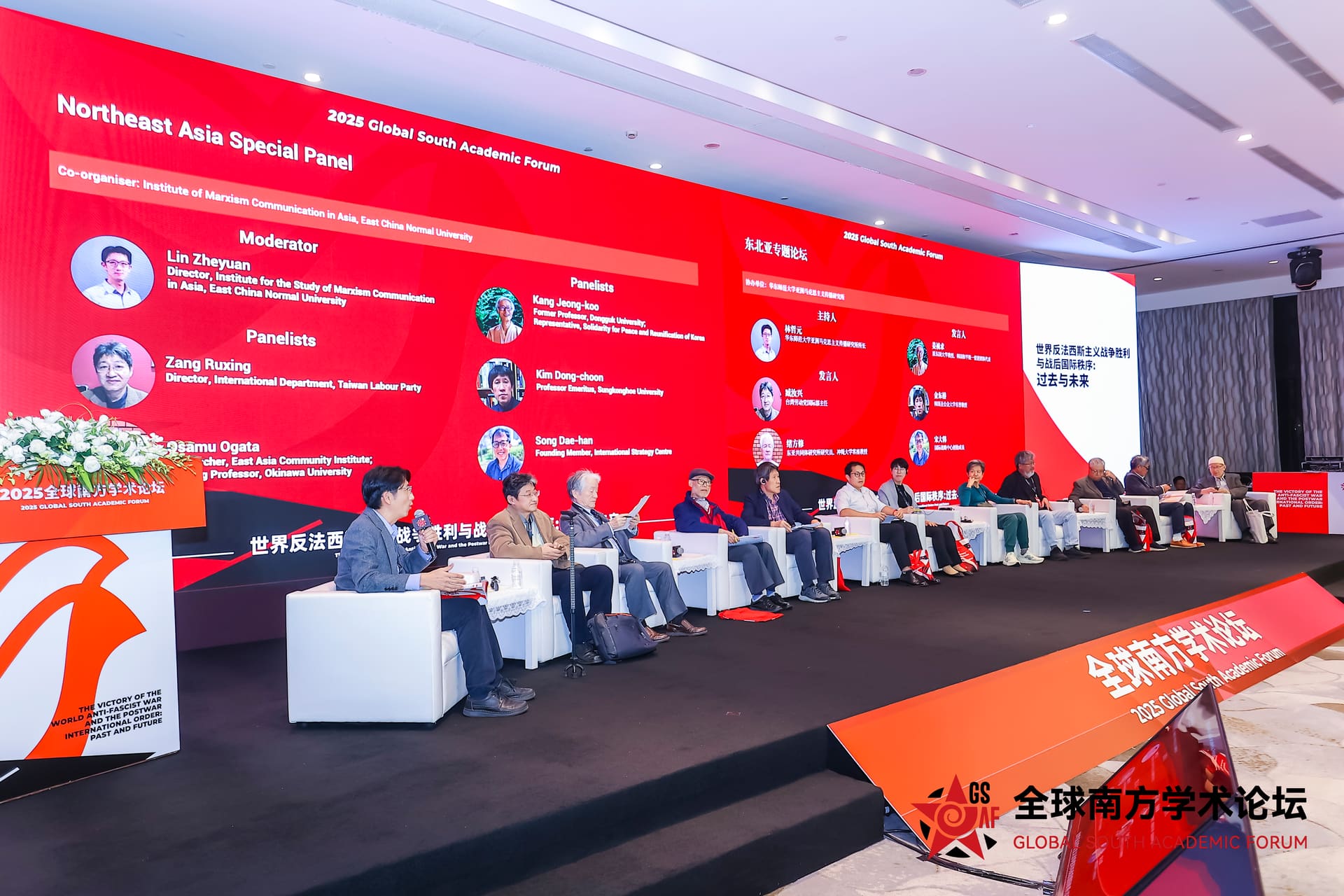
The special forum was chaired by Lin Zheyuan, Director of the Asian Marxism Communication Institute at East China Normal University. Lin Zheyuan stated that East Asia was the main battlefield of the World Anti-Fascist War, and now the shadow of the 'New Cold War' has returned, posing severe challenges to regional peace. He called on more scholars to jointly analyse issues such as military expansion, confrontation, and colonial legacies in East Asia, and to seek new paths for peaceful development and anti-imperialist cooperation.
In recent years, the anti-imperialist and anti-war movements in East Asia have deepened, with Taiwan's anti-'Taiwan independence' and anti-intervention actions gradually forming a connection with anti-war forces in Japan and Ryukyu. Zang Ruxing, Director of the International Department of the Labour Party of Taiwan, argued that regional civil society is increasingly coalescing consensus on opposing militarisation and external intervention, particularly demonstrating a crucial trend of cross-national leftist cooperation on the Taiwan issue. Building lasting peace must rely on the strength of the people to promote regional dialogue and curb the risk of war.
Osamu Ogata, Researcher at the East Asia Community Institute and Visiting Professor at Okinawa University, detailed through a video how Japan's accelerated missile deployment and the 'Southwest Islands Transfer' plan in Okinawa and the Southwest Islands are pushing the region towards a potential battlefield, significantly increasing the risk of confrontation with China. He emphasised that the Japanese government should squarely face the structural fragility of regional peace and stop using military reinforcement to address geopolitical competition. Only by promoting a 'No-War Community' among Japan, China, and other East Asian countries can conflict escalation be fundamentally avoided and regional stability be maintained.
Kang Jeong-Koo, former Professor at Dongguk University and Representative of the Korea Peace Unification Solidarity Association, stated that the US has long maintained a vast military-industrial complex by sustaining threat and war conditions, repeatedly creating tensions on the Korean Peninsula and hindering the peace process. He pointed out that with the decline of US hegemony, a shift in the new world order is emerging, bringing a historical turning point to the Peninsula situation. Future peace and unification are inseparable from the constructive role of regional countries, especially China. Kang Jeong-Koo called for breaking the Cold War framework and pushing the Korean Peninsula towards a new stage of autonomy and peace.
Kim Dong-Choon, Emeritus Professor at Sungkonghoe University (South Korea), starting from the 'colonial legacy—Cold War structure—hegemonic system' triple framework, pointed out that the Korean War was not an internal North-South conflict on the Korean Peninsula but a result of the US-Soviet Cold War confrontation and imperialist structure. The current militarisation, confrontation, and peace dilemma in East Asia all stem from this uncleared historical structure. Only by transcending the Cold War logic, getting rid of external hegemony, and rebuilding a regional cooperation and peace system can East Asia move towards genuine peace and common security.
Song Daehan, Founding Member of the International Strategy Center, pointed out that South Korea is increasingly losing its autonomy within the US-ROK alliance system. Although the Lee Jae-myung government advocates pragmatism, it essentially keeps South Korea deeply tied to US naval expansion, the semiconductor supply chain, and the military-industrial system. South Korea's foreign exchange reserves and industrial capacity being reincorporated into US strategic needs will further impede social reform and deepen the political impasse. Breaking the status quo requires relying on people's movements and genuinely progressive forces.
Hwang Jung-Eun, Secretary-General of the International Strategy Center, believes that the core of Trump's second-term defence strategy is 'homeland defence' and maintaining US hegemony. His tough stance on China remains unchanged, but he is shifting security costs to allies. South Korea's so-called acceptance of 'alliance modernisation' is, in essence, becoming a US strategic forward base, facing a war risk more serious than the economic crisis. Only by relying on transnational popular movements and social solidarity can it break free from US strategic bondage and move towards genuine peace and autonomous pathways.
Lu Tonglin, Lan Bozhou, Suh Sung, Kunio Arakaki, and Lin Boyao attended the discussion session, collectively discussing security and historical issues in the East Asian region under hegemonic intervention. They unanimously agreed that Asia should break away from the security structure dominated by US unilateralism, promote genuine multipolarity, strengthen regional cooperation, prevent the risk of war, oppose the revival of Japanese militarism, and look forward to China playing a constructive role in a non-hegemonic manner.
In the context of multipolarity, East Asian peace is not only about regional security but also about the strategic future of the Global South in collectively opposing hegemony and war risks. The special forum revealed the profound harm caused by the new Cold War framework to East Asian peace, providing important ideological resources for constructing an inclusive, secure, and autonomous regional order.
Sub-Forum IV | Digital Sovereignty and the Peaceful Development of Artificial Intelligence in the Global South
Artificial intelligence (AI) and digital technology are profoundly shaping the world power structure, and the Global South faces a new pattern of inequality through algorithm monopoly, data dependence, and technology outsourcing. Digital sovereignty is not only related to economic security but also to the political autonomy and development rights of the Global South in the information age. Sub-Forum IV: 'Digital Sovereignty and the Peaceful Development of Artificial Intelligence in the Global South' focused on how to maintain the autonomy of Southern countries in global technological competition and promote the peaceful and public development of AI, exploring the Southern path in the digital era from the dimensions of media application, technological ethics, governance capability, and regional cooperation.
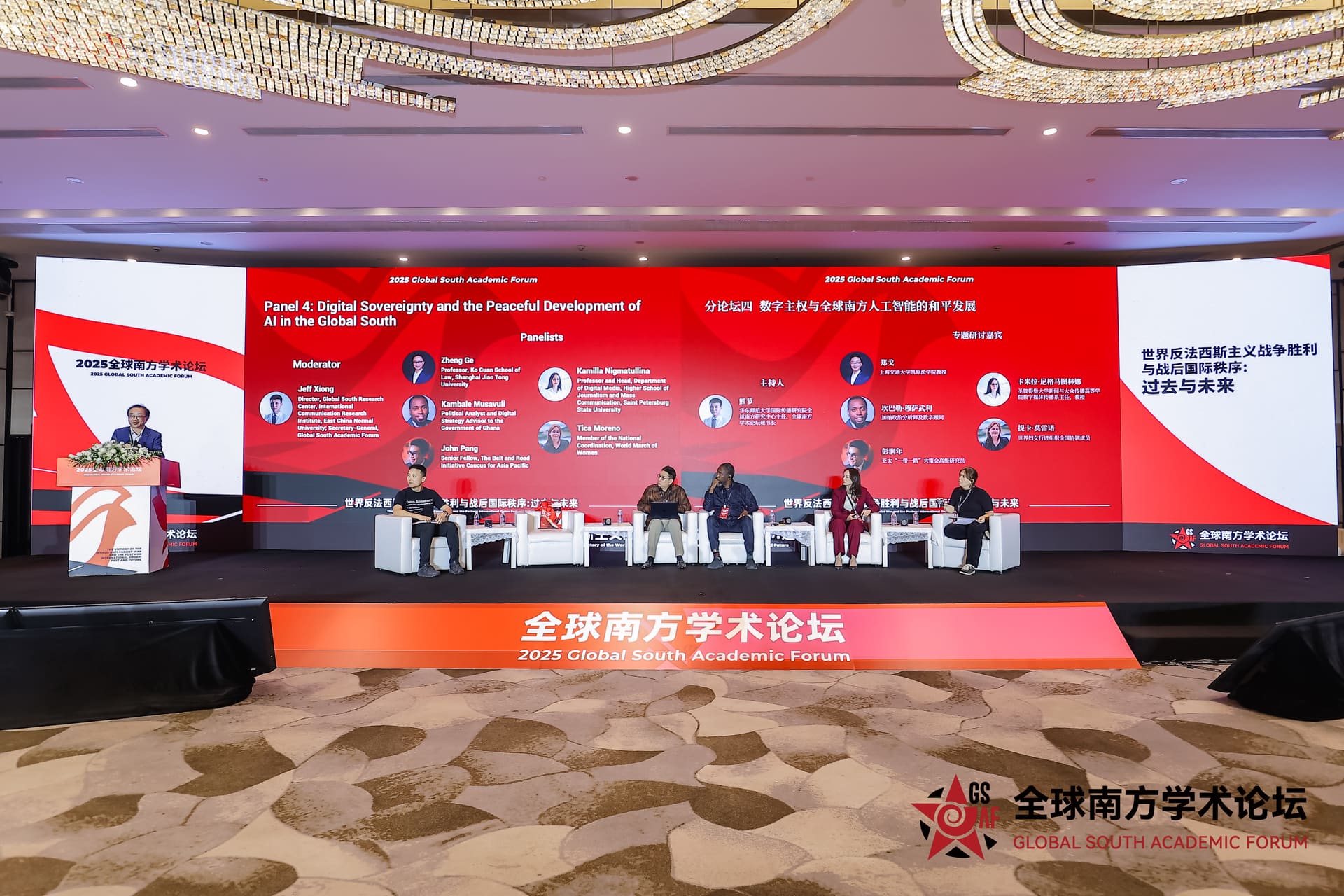
The sub-forum was chaired by Xiong Jie, Director of the Global South Research Center at the International Communication Institute of East China Normal University and Secretary-General of the Global South Academic Forum, who emphasised that digital sovereignty and AI have become strategic issues for the development of the Global South, pointing out that the West occupies a structural advantage in rule-setting, technology pathways, and value frameworks, thereby influencing the global information order and technological security.
Zheng Ge, Professor at KoGuan School of Law, Shanghai Jiao Tong University, proposed a 'three-mode AI governance' paradigm from a legal perspective: the US securitization/containment model, the EU risk avoidance model, and China's 'orderly innovation' model. He pointed out that China's system, composed of multiple existing laws and specialised regulations (such as the Cybersecurity Law, Personal Information Protection Law, Data Security Law, and regulations on recommendation algorithms and generative AI), can achieve a dynamic balance between encouraging innovation and controlling risks, providing a commendable institutional path for the Global South, avoiding the pressure of a single model on the sovereignty and capabilities of developing countries.
Kambale Musavuli, Political Analyst and Digital Consultant from Ghana, advocated bringing the AI issue into community daily life and treating data as a factor of production and a sovereign resource. Kambale Musavuli stressed that Africa should prioritize regional collaboration, infrastructure investment, and local talent development, utilising open source and South-South cooperation to enhance autonomous capabilities and avoid being gradually stripped of digital sovereignty by external agreements that 'divide by country'.
John Pang, Senior Researcher at the Asia-Pacific Belt and Road Initiative Caucus, used Malaysia as a cautionary example, pointing out that digital sovereignty is structurally weakened in international trade and security agreements—signing unequal clauses can restrict data localization, technology transfer, and sovereign cloud policies, thereby partially ceding national critical infrastructure and governance rights to foreign parties. He emphasised that AI sovereignty essentially concerns a country's future way of life and governance capability, calling on the South to use collective bargaining and legal protection to safeguard digital independence and social subjectivity.
Kamila Nigmatullina, Head and Professor of the Department of Digital Media Communications at the Higher School of Journalism and Mass Communications at St. Petersburg University, pointed out that Russian media faces structural challenges in AI application, such as uneven resource allocation, a shortage of professional talent, and insufficient technological awareness, leading to a noticeable disconnect between industry digital transformation and practitioners' capabilities. She noted that while some media utilise AI to optimise production, they lack systematic deployment and ethical norms, making it difficult to form a sustainable development path. She emphasised the need to cultivate interdisciplinary talent through professional education systems, coordinate technology application with media responsibility, and provide a referenceable experience for the Global South to explore digital governance models.
Tica Moreno, National Coordination Member of the World March of Women, emphasised that AI technology under the US-dominated monopoly system carries 'quasi-militarisation' risks, accompanied by regulatory pressure, tariff threats, and outsourcing strategies by multinational technology companies, further exacerbating the North-South global inequality. She pointed out that whether data is considered a factor of production is the core issue determining whether Southern countries can control their technological destiny. She called for establishing people-centred, open-source, and sovereign technological paths, using South-South cooperation, digital education, and collective participation to enable Southern countries to become technology creators rather than passive users.
The sub-forum revealed that digital technology and AI are reshaping the global power structure, emphasising the urgent need for the Global South to strive for technological autonomy and institutional discourse power amidst algorithm monopoly and data dependence. Through multi-dimensional discussions on legal pathways, community practices, regional collaboration, and technological ethics, the sub-forum explored reproducible digital sovereignty solutions for Southern countries, promoting the construction of a fair, inclusive, and public-interest-oriented AI development model, assisting the Global South in achieving autonomous development and peaceful governance in the digital era.
Sub-Forum V | 21st Century Information and Communication New Order and World Peace
Following the release of the 'Shanghai Academic Consensus' at the Global South International Communication Forum (2023) to promote the construction of a 'New World Information and Communication Order' in the 21st century, the forum continued to focus on the inequality and injustice in the world information dissemination situation, calling for information production and dissemination in the Global South to break through the US-Western agenda-setting hegemony, advocating solidarity in media collaboration among the Global South, jointly promoting sustainable world peace and development, and inviting Global South media to conduct in-depth interviews and reports in Chinese grassroots communities. Sub-Forum V: '21st Century Information and Communication New Order and World Peace' reviewed and looked forward to the history, present, and future of the non-aligned movement and Global South information dissemination after the war.
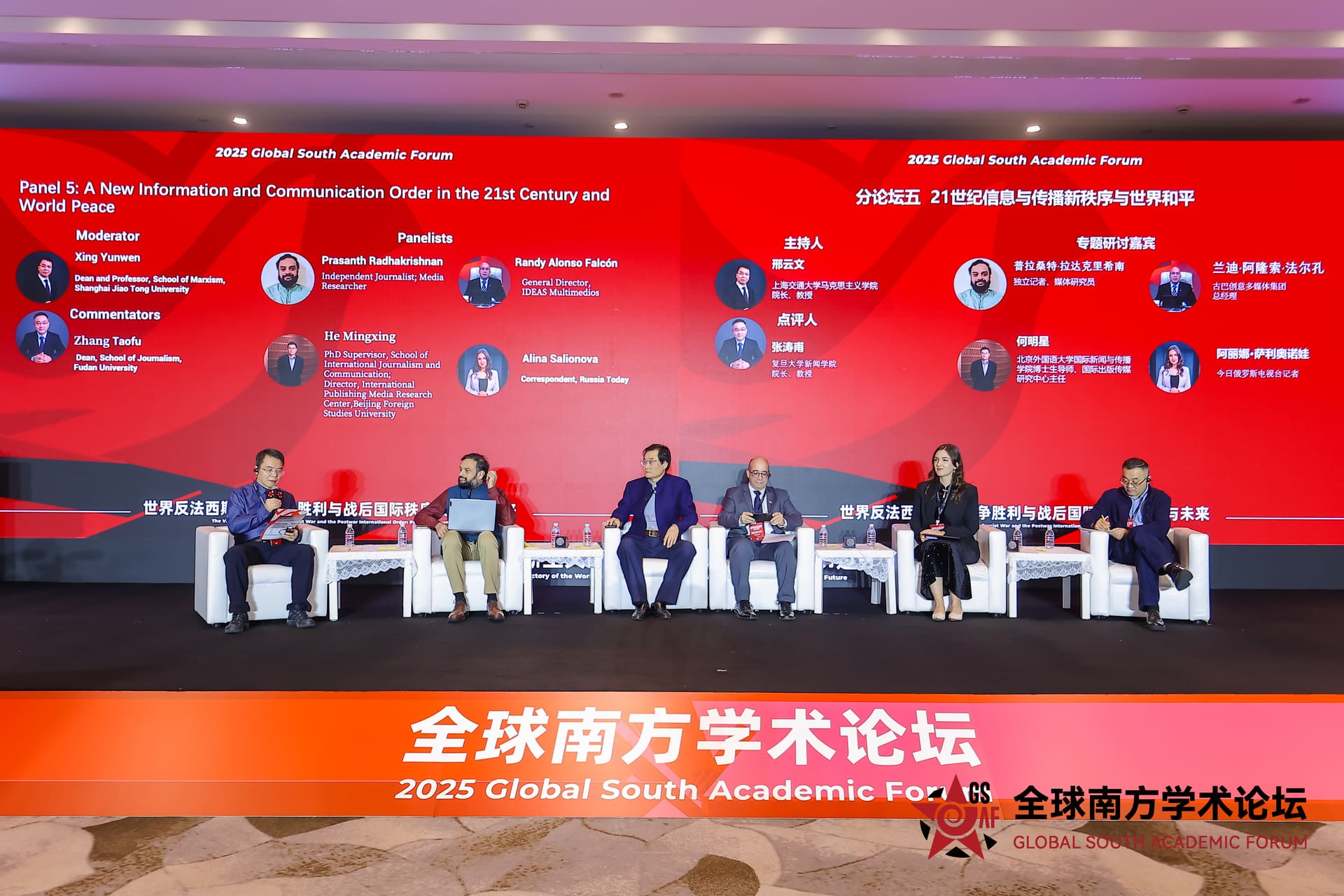
The sub-forum was chaired by Xing Yunwen, Dean and Professor of the School of Marxism at Shanghai Jiao Tong University, who emphasised the need to promote reciprocal visits by Global South media, in-depth reporting in Chinese grassroots communities, and reviewed the historical experience of the Non-Aligned Movement, calling for cooperation, mutual learning, and a fair communication order to promote world peace.
Prasanth Radhakrishnan, independent journalist and media researcher, reviewed the history of 'Non-Aligned News Cooperation' and the MacBride Report, pointing out that the serious global information inequality and the structural monopoly of Western media remain unchanged. He emphasised that the Global South should establish autonomous systems in communication technology, journalism training, information production, and cultural narratives, building a new international communication order through cooperation to counter the global information hegemony centred on Reuters, Associated Press, and others.
He Mingxing, Doctoral Supervisor at the School of International Journalism and Communication and Director of the International Publishing and Media Research Center at Beijing Foreign Studies University, emphasised the foundational role of publishing and dissemination in global information flow. By reviewing the vivid and detailed history of Mao Zedong's works dissemination in the Global South during the 20th century, he pointed out that contemporary China needs to break through Western blockades in international communication and publishing to establish its own narrative space. He emphasised promoting a more just communication order through cooperative publishing, cross-national academic exchange, and fair information mechanisms, enabling the Global South to jointly shape it.
Randy Alonso Falcón, General Director of the Cuban Creative Multimedia Group, reviewed the history of Cuban information dissemination breaking through extreme containment under difficult circumstances, analysing the impact of AI on the international communication landscape. He pointed out that the US controls the public opinion ecosystem and constructs 'technological imperialism' by leveraging technology, platforms, and algorithms. This exacerbates the passive position of the Global South in cognitive, public opinion, and communication structures. He called on the Global South to conduct media technology collaboration, establish autonomous platforms, and jointly resist the new hegemonic system centred on algorithmic manipulation and information warfare.
He simultaneously emphasised that all nations should collectively safeguard data rights, media public accountability, and algorithmic transparency, and should advance transnational media cooperation and the establishment of public communication mechanisms. He further suggested using legal instruments to resist external discourse hegemony and algorithmic discrimination, thereby making the promotion of information governance democratization a crucial pillar for upholding national sovereignty and world peace.
Alina Salionova, Journalist at Russia Today, reviewed the history of the Soviet Union and China jointly fighting fascism, emphasising China's key contribution to the Asian battlefield, and the deep friendship formed by the people of the Soviet Union and China fighting side-by-side. She introduced the continuous work of Russian journalists and researchers in recent years to unearth war relics, veteran stories, and archives of international children's homes, demonstrating the continuation of shared memories in civil and family narratives in both countries. Alina Salionova pointed out that safeguarding historical truth is an important force for maintaining peace, and memory is also sovereignty. Faced with the risk of history being manipulated and distorted today, cooperative reconstruction of the memory system itself is a resistance to forgetting and distortion.
Zhang Taofu, Dean and Professor of the School of Journalism at Fudan University, pointed out in his commentary that the sharing by the above guests coalesced into the consensus that the global information communication system has long suffered from structural inequality, with Western countries leveraging technology, infrastructure, and media control to reinforce information hegemony and compress the discourse space of the Global South. Zhang Taofu suggested that the Global South needs to unite and cooperate to jointly break through communication blockades and technological monopolies, enhancing autonomous communication capabilities. He affirmed the action of the Global South Academic Forum (2025) in promoting the 'Shanghai Academic Consensus', advocating for technology support and cooperative platforms to advance information fairness and multipolar communication order construction.
Through in-depth discussions on media cooperation, technological autonomy, publishing dissemination, and legal governance, the sub-forum highlighted the common predicament of the Global South in the information system, revealed how long-term Western technological and narrative hegemony weakens the discourse capabilities of developing countries, and promoted a rethinking of information sovereignty.
Sub-Forum VI | Sharing Rural Stories of the Global South: Development and Peace
Achieving modern rural development is a shared vision of the Global South. Sub-Forum VI: 'Sharing Rural Stories of the Global South: Development and Peace' focused on solutions to the common issues of 'agriculture, rural areas, and farmers' ('San Nong') faced by Global South countries. By sharing their respective experiences in rural development, it discussed the path of mutual assistance and learning for peaceful, modern development in the Global South.
The sub-forum was chaired by Liu Xin, Host at China Global Television Network (CGTN). Liu Xin, who has long focused on agricultural development and farmer stories, believes that the most authentic and powerful stories often come from the fields, and that the rural experiences of China and Brazil are interconnected in many aspects, such as land, labour, and organisational forms. Understanding the connection between the Brazilian peasant movement and China's rural revitalization will open new possibilities for future China-Brazil cooperation.
First Half – Historical Land Struggles and Real-Life Rural Revitalization: Stories of China-Brazil Family Farming Cooperation
The struggle of Brazilian family farmers for land deeply reflects the common demands and historical tensions of Global South countries regarding colonial legacies, land inequality, and development rights. At the same time, China's practice and exploration—from land reform and poverty alleviation to rural revitalization—have paved new paths for Chinese modern agriculture. Core issues of Brazilian family farming, such as land, food, and ecology, precisely dialogue with China's rural development experience, and the exchange between the two countries in areas like agricultural cooperation, farmer organisation building, and sustainable development is ushering in a new historical chapter.
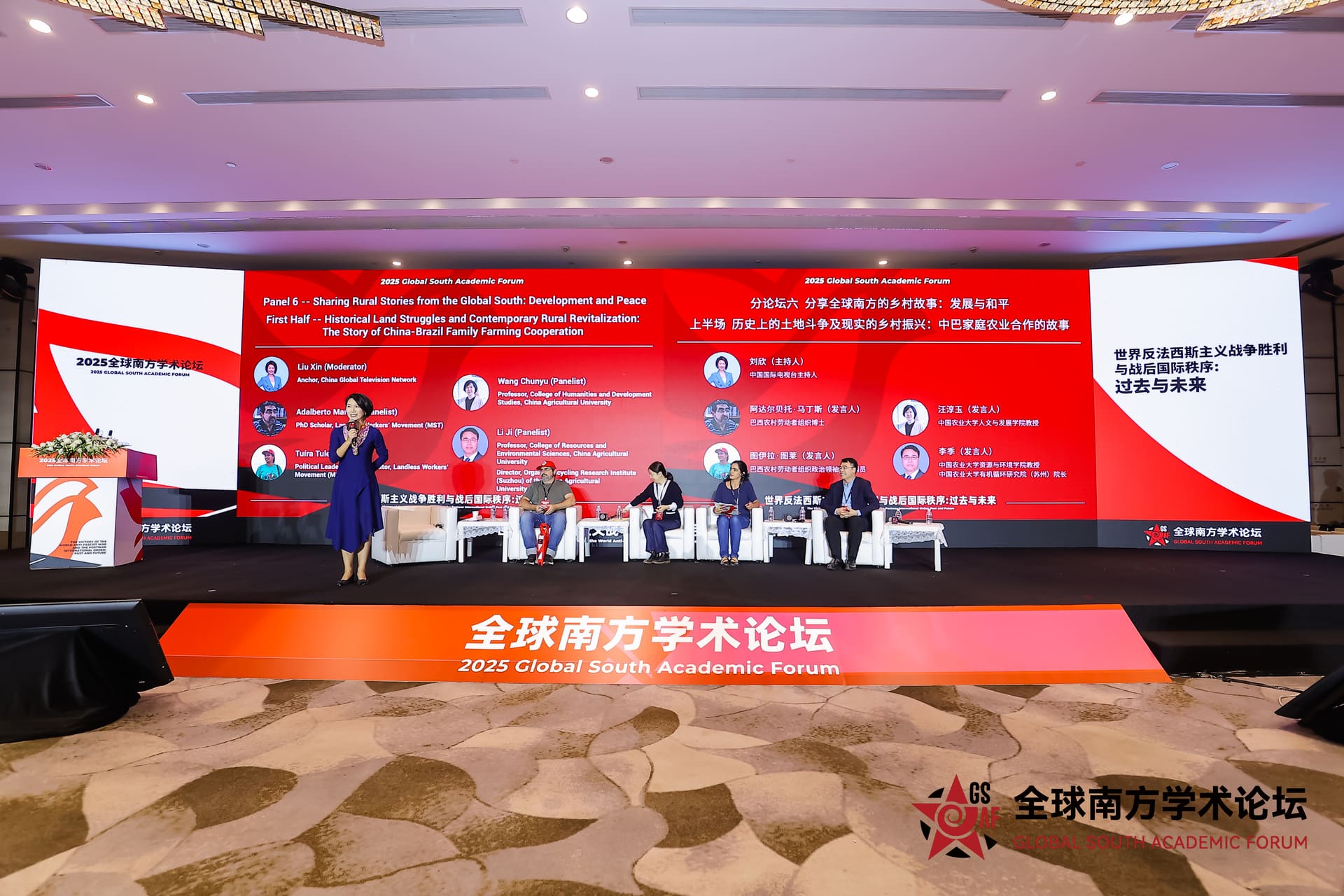
Adalberto Martins, PhD from the Brazilian Rural Workers Movement (MST), systematically reviewed the colonial origins of the Brazilian land system, pointing out that indigenous massacres, Black slavery, and high land concentration are the roots of inequality in Brazil today, and that Brazil has never completed a true land reform, leaving farmers landless and unsecured for a long time. The struggle of the MST originates from this history, and it typically uses collective action to fight for land rights, finding common language in the international experience of anti-oppression and anti-imperialism. In Adalberto Martins' view, land reform must embody a new social vision and promote fairer national development.
Wang Chunyu, Professor at the College of Humanities and Development Studies at China Agricultural University (CAU), reviewed the century of profound changes in China's rural areas through a historical context—from the People's Communes and township enterprises to the urbanization wave after the Reform and Opening Up, with the mobility of farmers forming the foundation of China's modernisation. Through technology empowerment, institutional guarantees, and rural community building, the Chinese experience has practical value for Southern countries to learn from in terms of narrowing the urban-rural gap and promoting sustainable agriculture, and it can be shared with the Global South.
Tuíra Tule, Political Leader and Coordinator of the Brazilian Rural Workers Movement (MST), focused on the core demands of Brazilian family farming, emphasising the importance of the three major themes: 'land, food, and ecology'. Tuíra Tule, drawing from the MST's struggle history, pointed out that family farming is both the basis of livelihood and a key issue of ecology and social justice. She called on the Global South to focus on farmers' land rights, food sovereignty, and sustainable ecological models to ensure autonomous rural development and social equity.
Li Ji, Professor at the College of Resources and Environmental Sciences at China Agricultural University and Dean of the Organic Circulation Research Institute (Suzhou) at CAU, argued that the cooperation between CAU and the Brazilian MST and the University of Brasília has transformed Chinese agricultural technology into practical solutions suitable for family farming. The combination of industry-academia-research, technology implementation, and local adaptation is key to the success of the cooperation, and the integration of Chinese agricultural technology with Brazilian family farming practice is an important starting point for mutual learning and reference between China and Brazil in agriculture, with positive demonstration significance.
Second Half – From Erhai Lake to Southern Xinjiang: Paired Assistance and the Chinese Model of Collaborative Development
The green transformation of plateau lakes and the cotton harvest at the foot of the Tianshan Mountains bear witness to the innovative practice results of China's paired assistance mechanism. Through East-West collaboration, technology empowerment, and industrial linkage, governments at all levels, scientific research institutions, and enterprises collaboratively innovate, deeply integrating ecological civilisation construction with rural revitalization. The ecological civilisation practice of Erhai Lake governance and the industrial revitalization of Xinjiang cotton provide the Global South with a Chinese experience of mutual assistance, win-win cooperation, and coordinated development on the path of ethnic unity and common prosperity.
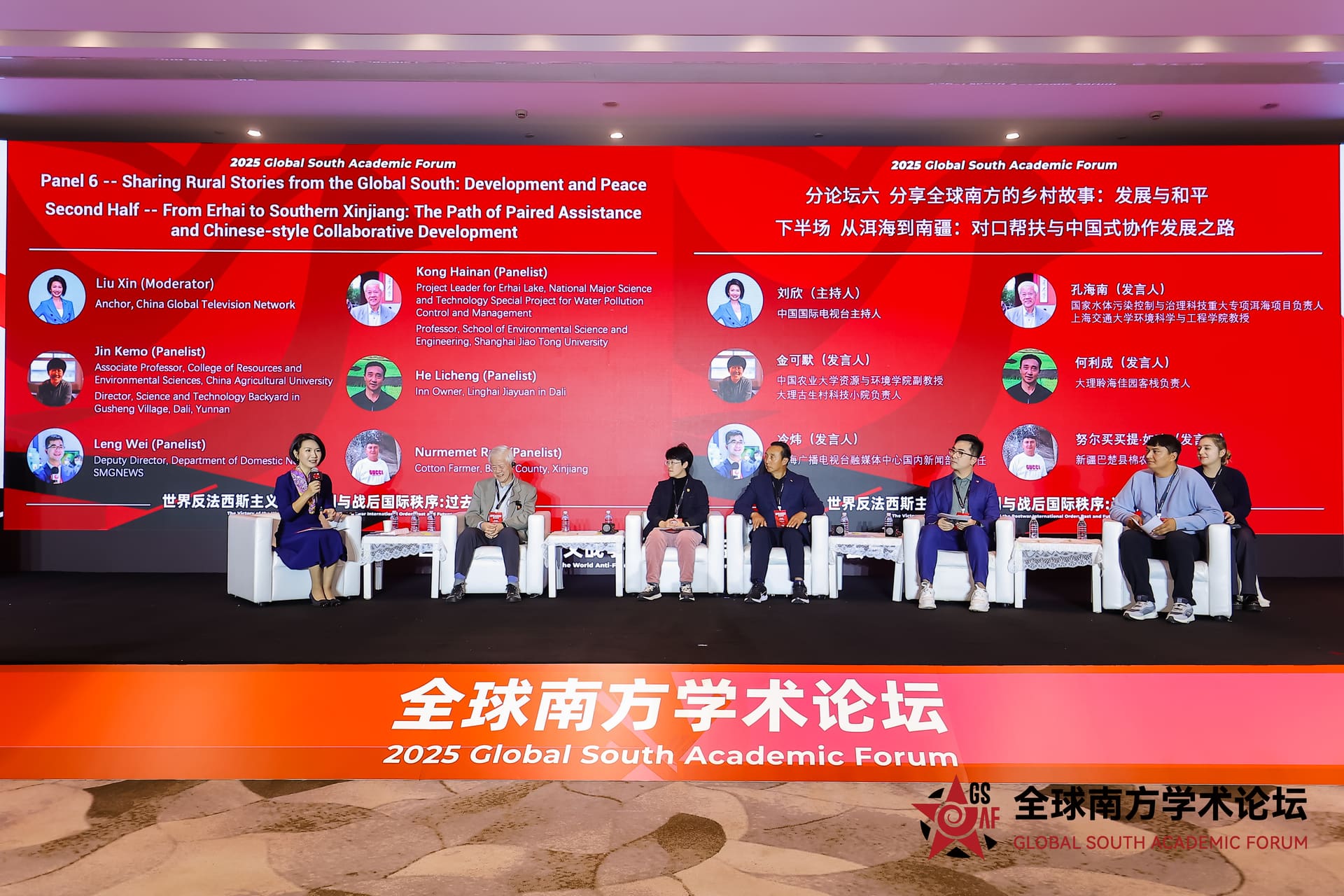
Kong Hainan, Responsible Person for the Erhai Project of the National Science and Technology Major Project for Water Pollution Control and Treatment, and Professor at the School of Environmental Science and Engineering at Shanghai Jiao Tong University, pointed out that Erhai Lake governance achieved systemic restoration through the national water major project, shifting the governance approach from 'single lake governance' to 'ecological civilisation development governance'. Kong Hainan emphasised the need to organically combine ecological protection with industrial development in ecological restoration, realising 'lucid waters and lush mountains are invaluable assets' through the ecological industrialisation path of Hai Cai Hua (water celery) and other means, which will bring new inspiration to the ecological governance work of the Global South.
Jin Kemo, Associate Professor at the College of Resources and Environmental Sciences at China Agricultural University and Head of the Gucun Science and Technology Backyard in Dali, used the practice of Erhai Lake protection as an example, illustrating how to achieve the synergy of ecological protection and farmer income increase through technological innovation, model innovation, and high-value agriculture development. He pointed out that the 'Science and Technology Backyard' model, supported by data-based governance, farmer co-governance, and industrial transformation, truly turns 'lucid waters and lush mountains' into 'invaluable assets', providing a referenceable development model for Global South countries.
He Licheng, Head of the Linghai Jiayuan Inn in Dali, recounted his proactive 'four transformations' for the protection of Erhai Lake: giving up his motorized boat livelihood to prevent lake water pollution, abandoning lakeside fish ponds to protect surrounding wetlands, demolishing parts of his family courtyard to support ecological corridor construction, and now transitioning to green agriculture—'it's worth it for future generations'. He Licheng witnessed the collective economic revitalization and rural governance improvement brought by the scientific ecological backyard, emphasising that ecological protection and improvement of villagers' lives can be a win-win.
Leng Wei, Deputy Director of the Domestic News Department of the Shanghai Media Group Convergence Media Center, who just returned from the cotton fields of Xinjiang to the Huangpu River, showcased in a video the efficient production chain and poverty alleviation benefits brought by Xinjiang's mechanized cotton industry system, pointing out the serious disconnect between the Western 'forced labour' narrative and the facts. Leng Wei emphasised that through regional collaboration, targeted assistance, technology popularization, and policy support, the cotton industry promotes local employment stability and community development in Xinjiang, providing a valuable case for the Global South to counter prejudice with genuine experience in the international discourse arena.
In a dialogue with Leng Wei, Nurmemet Ruzi, a cotton farmer from Bachu County, Xinjiang, shared his daily work experience, telling friends from the Global South about the tangible benefits of mechanized cotton picking—popularized through government assistance—which significantly increased yield and improved the lives of local villagers, using a vivid and authentic grassroots perspective to refute external unsubstantiated accusations about Xinjiang's development.
The sub-forum conducted discussions along both historical and realistic lines, reviewing the long-term land and farmer rights struggles in Brazil and other Southern countries, and presenting China's experience in rural revitalization, ecological governance, and paired assistance as a path for mutual learning. Global South countries have immense potential to form more resilient and sustainable common solutions through mutual learning and assistance, jointly writing a story of peace and prosperity for rural development in the Global South.
The overall rise of the Global South is unstoppable, and the sacrifices and victories of the Global South in the Anti-Fascist War over the past 80 years must become the foundation of a new worldview and historical perspective. 'Forgotten and suppressed history must return'. Lu Xinyu, Dean and Professor of the International Communication Institute at East China Normal University and Chairman of the Global South Academic Forum, emphasised in her closing address the importance of shared history, ideals, and knowledge production in the Global South. She pointed out that the Global South Academic Forum aims to break Cold War narratives and information hegemony, promote a new world information order and the construction of a Global South academic community. Suppressed anti-fascist history must return to view, and she hoped that the forum would move to more Global South cities in the future, achieving broader exchange and solidarity.
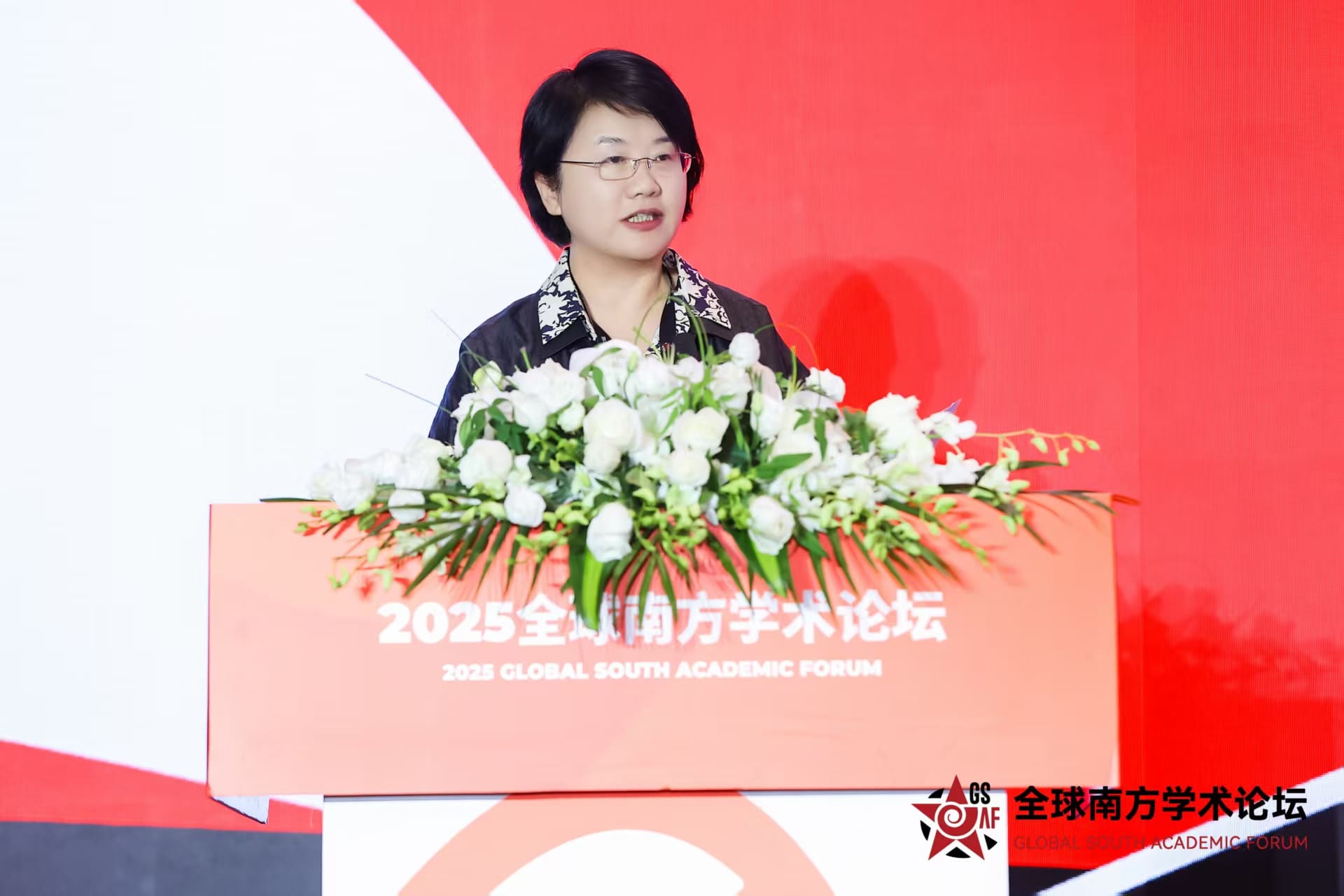
Lu Xinyu, Dean and Professor of the International Communication Institute at East China Normal University and Chairman of the Global South Academic Forum, delivers the closing address.
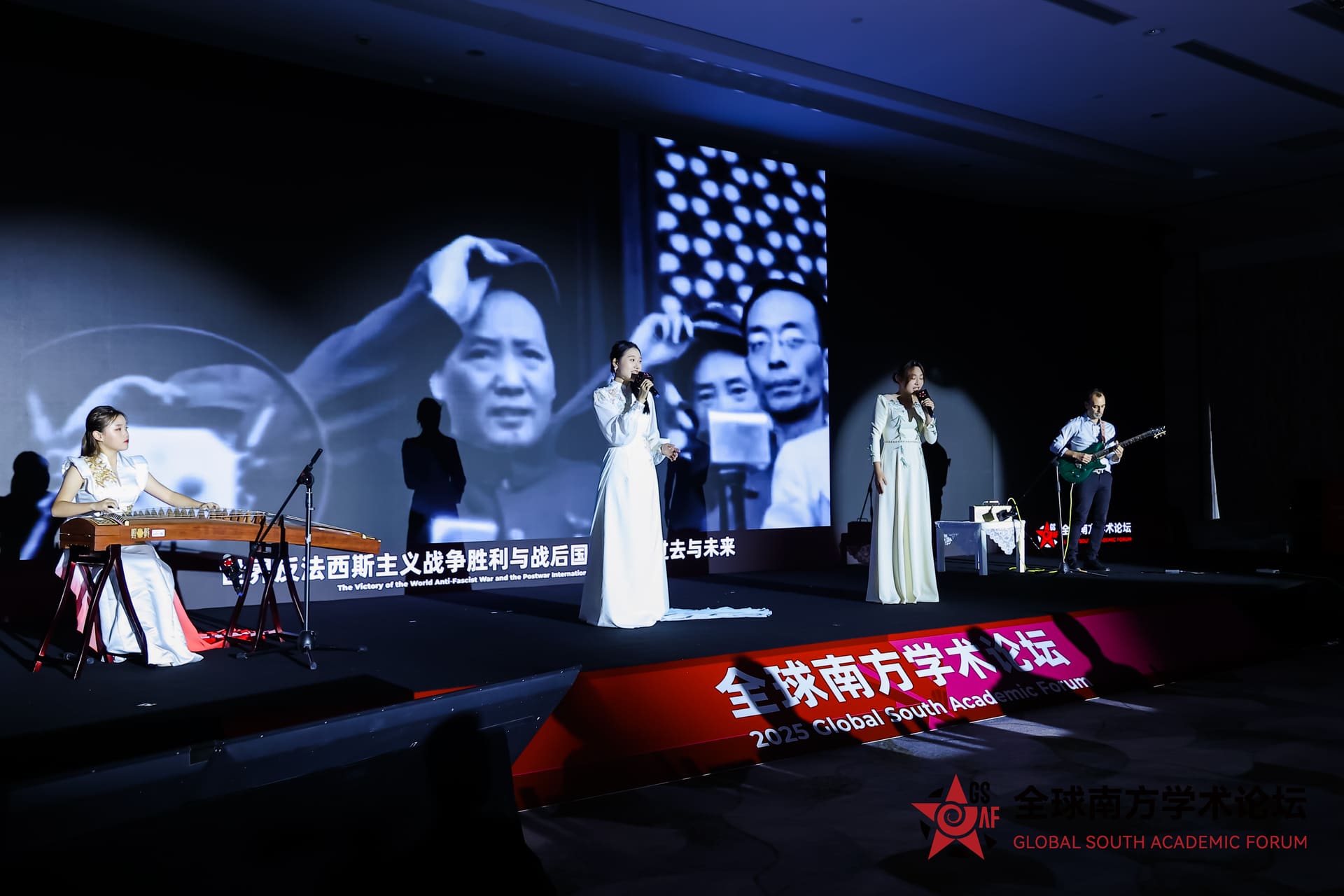
To the music of the assembled singing the Internationale, the Global South Academic Forum (2025) successfully concluded. Domestic media such as China Global Television Network (CGTN), Shanghai Media Group, Jiefang Daily, The Paper, and Guancha conducted special reports on the forum. Global South media, including Cuba Debate, Brasil de Fato, teleSUR, Prensa Latina, ARG Medios, COMUNA Media Group, Peoples Dispatch, Pan African Television, Pan Africanism Today, Russia Today, Al Akhbar English, Newzroom Afrika, and Press TV, simultaneously broadcast forum-related information. Multiple international guests who attended the forum were interviewed in depth, conveying the voice of the South and the voice of peace to the world.
Compiled by | Zheng Yuhan, Kang Yixin, Chen Xi, Yang Huiyu, Qian Mengtong