Ghana’s North East Regional Minister and Member of Parliament Visit Shanghai to Attend “Global South Academic Forum” and Engage in Exchanges
From November 13 to November 18, 2025, the Honorable Ibrahim Tia, Regional Minister of the North East Region of the Republic of Ghana, the Honorable Dr. Abed-Nego L. Bandim, Member of Parliament, and Kambale Musavuli, a Ghanaian political analyst and digital consultant, were invited to visit Shanghai to attend the 2025 “Global South Academic Forum” and conduct a series of academic exchanges and enterprise visits.
On November 13 and 14, the two representatives attended the 2025 “Global South Academic Forum” , which was jointly organized by East China Normal University, the University of Johannesburg, and the Tricontinental: Institute for Social Research. The forum was held under the main theme of “The Victory of the World Anti-Fascist War and the Post-War International Order: Past and Future,” aiming to commemorate the 80th anniversary of the victory of the World Anti-Fascist War.
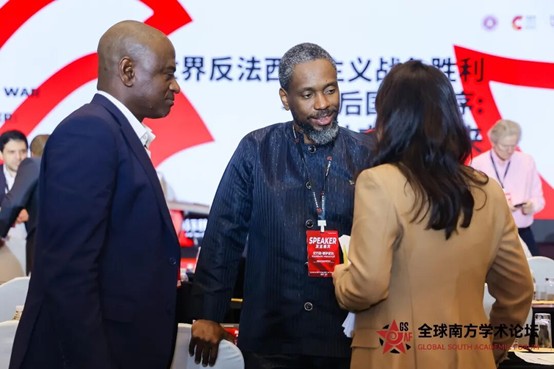
Image Captions: Mr. Tia and Mr. Musavuli.
During the visit, the delegation engaged in intensive academic exchange activities. On November 15, the delegation met separately with Dr. Zhang Zitong, a post-doctoral fellow at the Institute of New Structural Economics (INSE) at Peking University, Professor Lu Xinyu, Dean of the School of International Communication at East China Normal University, and Mr. Vijay Prashad, Director of the Tricontinental: Institute for Social Research.
Zhang Zitong systematically elaborated on the theory of New Structural Economics , focusing on the relationship between the structure of factor endowments and industrial development. In response to the Ghanaian delegation’s questions regarding industrial development in the North East Region, he discussed how to select appropriate industries, overcome development bottlenecks, and achieve industrial transformation and upgrading based on the theory of comparative advantage, providing theoretical guidance and practical pathways for formulating a realistic development strategy for the region.
Lu Xinyu and Mr. Prashad shared vivid case studies of China’s rural revitalization, drawing on their field research experience in Rongjiang County, Guizhou Province. They particularly highlighted the experience of how the "Cun Chao" (Village Super League) phenomenon has promoted rural development, cultural dissemination, and international exchange through the practice of people’s subjectivity. The two sides held a lively discussion on rural development pathways for Global South countries, and Lu Xinyu sincerely invited the Ghanaian delegation to visit Rongjiang in the future to observe China’s innovative model of rural revitalization firsthand and learn from the relevant experiences.
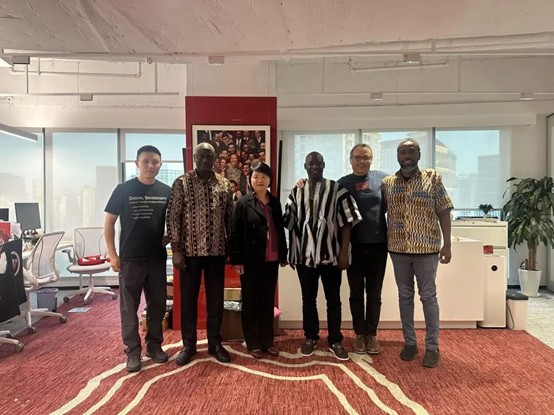
On November 16, the delegation met with Professor Yin Zhiguang of the Department of International Politics at Fudan University’s School of International Relations and Public Affairs. Yin Zhiguang introduced the National Social Science Fund Major Project he is currently leading, titled “Research on Development Theory from the Perspective of the Global South”. This project starts from a Marxist view of development, emphasizes comprehensive people-centered development, focuses on social and state capacity building, and utilizes Artificial Intelligence (AI) technology to provide scientific guidance for governance decision-making in Global South countries.
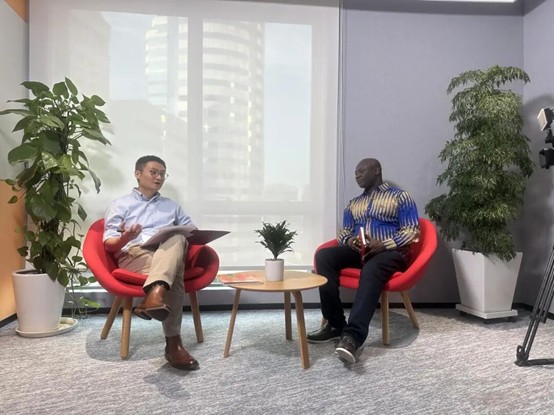
Image Captions: Dr. Bandim and Professor Yin Zhiguang being interviewed by Shanghai TV.
On the morning of November 17, the delegation held a symposium with enterprises including Star Bitech. The Ghanaian delegation introduced the current state of AI development in their country, and both sides exchanged experiences on topics such as infrastructure construction and network deployment, exploring potential cooperation opportunities. Dr. Bandim sincerely invited Chinese representatives to attend the Beyond AI conference that Ghana will host in March 2026. Star Bitech highlighted the application prospects of digital human technology, and the two sides conducted in-depth discussions on the feasibility of launching a program hosted by a digital human on PATV, Ghana’s largest public television station.
In the afternoon, the delegation visited the operation base of the China-BRICS AI Development and Cooperation Center. The center systematically showcased application cases of AI technology in various fields such as smart cities, medical health, and financial services, as well as the practical experience of Chinese enterprises in AI algorithm research and development, scenario implementation, and international technology transfer. Xu Miao, a researcher at the China Academy of Information and Communications Technology (CAICT) Artificial Intelligence Institute, specifically introduced China’s legislative progress and regulatory framework regarding AI governance, data protection, and cybersecurity. Dr. Bandim stated that the Ghanaian Parliament is currently reviewing 13 related bills, and this exchange provided him, in his capacity as Chairman of the Parliament's Committee on Communications, with important references for scrutinizing the rationality and effectiveness of the bills.
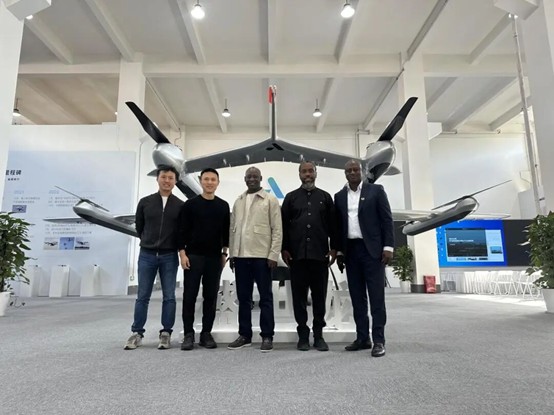
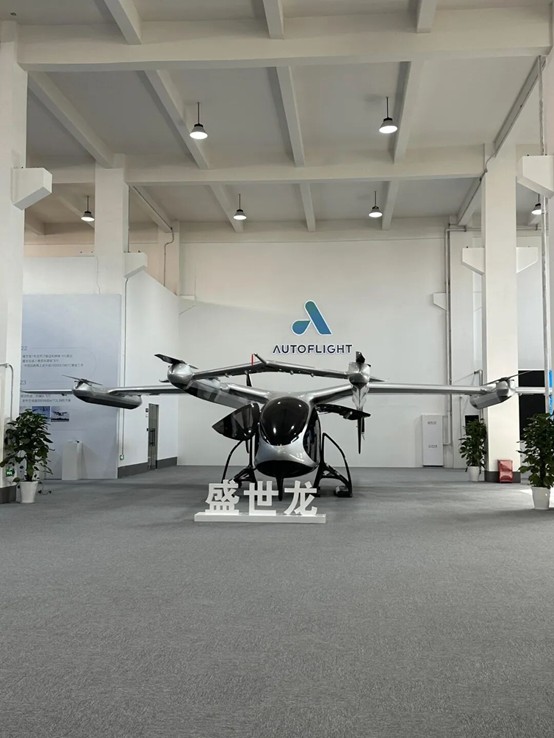
On the morning of November 18, the delegation visited AutoFlight’s Kunshan base to learn about cutting-edge technology and application scenarios in China’s low-altitude economy development. AutoFlight showcased its research and development achievements for Electric Vertical Take-Off and Landing (eVTOL) aircraft. It introduced the current practical applications of this technology in scenarios such as emergency rescue, medical transport, and logistics, as well as the future commercialization prospects of “Air Taxis” in urban transportation and regional connectivity. Minister Tia expressed keen interest in the development model of the low-altitude economy. He pointed out that the North East Region is mountainous and borders both Burkina Faso and Togo. If similar technology could be introduced, it would not only improve transportation and emergency response capabilities in remote areas but also greatly promote cross-border tourism, opening up new pathways for the region’s economic development.
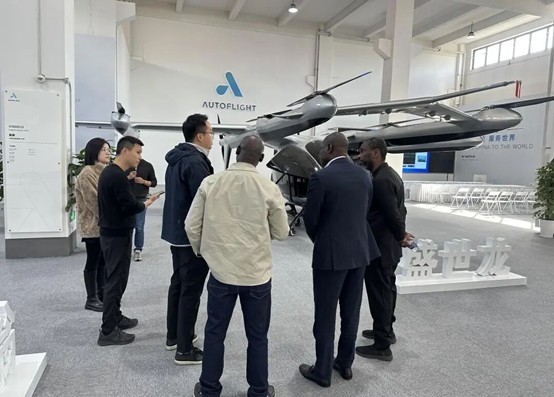
The delegation’s visit spanned multiple fields, including academic exchange, media dialogue, and technology investigation, fully demonstrating the potential for cooperation between China and Ghana in academic, technological, and development areas. This visit highlighted the deep friendship between Ghana and China across various sectors and underscored the shared vision of Global South countries in promoting scientific and technological cooperation and building a more just and equitable international order.
Mr. Tia is the current Regional Minister of the Northeast Region (provincial administrative region) of Ghana, appointed by President John Delamani Mahama in 2025. He has over two decades of experience in public administration, health system management, and governance reform. Dr. Bandim is currently a member of the 9th Parliament of Ghana, representing the Benkpuruku constituency of the Northeast Region, and also serves as the chairperson of the Parliament's Information and Communications Committee. He holds a Ph.D. in Communication Management from the University of Pretoria in South Africa. He has worked at the National Communications Authority of Ghana for over ten years, serving as the Chief Manager and Director of the Consumer Affairs Department.