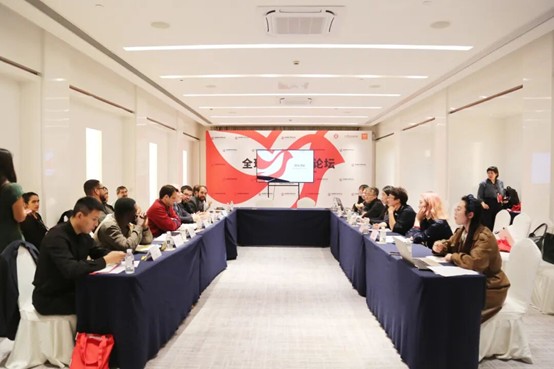
On November 13, the School of Communication and the Institute of International Communication at East China Normal University (ECNU) successfully held the International Communication Talent Training and Exchange Meeting as an important event of the Global South Academic Forum (GShAF). Tis meeting focused on innovative paths and practical methods for cultivating international communication talent. It aimed to use the cooperation with the Brasil de Fato Media and Communication School in Brazil as a pioneering demonstration sample to explore a long-term mechanism for deep cooperation between Global South media outlets and Chinese universities , thereby jointly building a new order for information dissemination in the Global South. The meeting was moderated by Xu Deya, an Associate Professor at the School of Communication.
Zhu Wenjia, Secretary of the Party Committee of the School of Communication, delivered an address , extending a welcome and gratitude to the guests. She noted that East China Normal University is focusing on "Global South" issues and founded the Global South Academic Forum. The forum is centered on "leveraging Shanghai's advantages and expanding Global South research" , with the goal of jointly building a Global South academic community and creating a landmark academic brand that serves China's international communication strategy. It is committed to cultivating international communication talent who are rooted in China, embrace the digital intelligence era, and possess a global perspective. She explained that the school is guided by disciplinary integration and uses shared courses as a focal point to build a high-quality practical teaching system. It conducts multi-level, multi-channel joint training, exchange visits, and cooperative research. She expressed anticipation for working with the participating scholars to jointly promote research paradigm shifts and innovation in talent cultivation, thereby writing a new chapter in international communication talent development in the new era.
Xiong Jie, Secretary-General of the Global South Academic Forum, elaborated on the vision for the meeting as an academic exchange platform. This vision is to promote deep cooperation between Global South media and the academic community , along with a long-term outlook for cultivating international communication talent. He proposed that it is currently necessary to break through the limitations of Western narrative frameworks , deeply integrate media into social mobilization practices , and fully utilize new technologies such as artificial intelligence (AI) to expand the innovative space for international communication. He stressed that a brand-new paradigm for international communication should be built by deepening two-way exchanges and joint theoretical creation with Global South countries.
During the roundtable discussion, the participating guests engaged in in-depth exchanges on the role of media in international communication talent training, challenges, and suggestions for university-enterprise cooperation. Yu Jing, Vice Dean of the School of Communication, provided a detailed introduction to the school's disciplinary layout and talent training system. Huangfu Boyuan, a Lecturer in the Journalism Department of the School of Communication, highlighted the empowering value of data journalism for international communication, drawing from the experience of the dual-degree program in Journalism and Data Science and Big Data Technology. Neuri Domingos Rossetto, a member of the Coordinating Committee of the Movement of Rural Landless Workers in Brazil, pointed out that the core of communication lies in promoting self-awareness among the populace, eliminating isolation, and building social connections. He shared his practice of breaking through information barriers: by directly engaging with people from various sectors in China, creating and disseminating firsthand content to help people in Latin America understand a true and multi-dimensional China. The experience in Brazil demonstrates that cross-national cooperation can be promoted through internal and external dialogue, helping to build a more equitable and inclusive society. Abdulhaq Ibrahim, an International Relations Specialist at Pan-African TV, shared the network's experience in rapidly enhancing media workers' skills through systematic internal training. He specifically emphasized the results of cooperation with Chinese institutions, where online collaboration developed into physical cooperation, jointly producing programs aimed at the African market and promoting cross-cultural communication through the real stories of ordinary Chinese people. He also called for the establishment of a resource-sharing system and sustainable training mechanisms to help young media professionals grow and strengthen the communication capacity of the Global South.
Centering on the core consensus of "breaking the monopoly and jointly building the Southern narrative," the meeting outlined a clear cooperative vision. At the theoretical level, this involves adhering to the fundamental mission of media to educate the public and mobilize society, refusing to fall into the trap of traffic competition within the Western discourse framework. At the practical level, it advocates for establishing a two-way talent mobility mechanism, promoting exchanges for young people from Southern countries to come to China, and for Chinese teachers and students to undertake practical work in the South. At the level of technological innovation, it advocates seizing the opportunity presented by AI to enhance communication effectiveness and achieving direct cultural access through the joint production of documentaries and the sharing of program resources.
Lu Pengcheng, Vice Dean of the School of Communication, summarized the meeting with three keywords: "gratitude, learning, and cooperation". He expressed heartfelt gratitude for the meticulous organization by all parties and the generous sharing by every participant. He emphasized the importance of learning, pointing out that China and the Global South countries, as developing nations, share common interests and similar developmental perspectives. Therefore, he suggested that mutual learning and exchange in the field of journalism and communication should be continually deepened in the future to jointly enhance international communication capacity. He put forward a vision for cooperation, anticipating deepened solidarity and collaboration to gather greater wisdom and strength, and jointly create a brighter communication future for the Global South.