The Global South Academic Forum (GSAF 2025) and Pan-African TV
— A Review of the Special Panel Discussion —
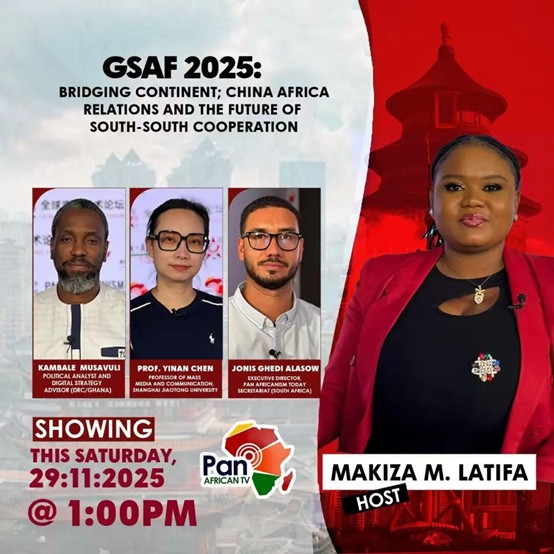
Focusing on China-Africa Relations and the Future of South-South Cooperation: Shaping a New Global Order
On November 29, 2025, taking the opportunity of the 2025 Global South Academic Forum (GSAF 2025), Pan-African TV launched a special high-level panel discussion themed "Bridging Continents: China-Africa Relations and the Future of South-South Cooperation." This program brought together top scholars and opinion leaders from the Global South to provide an in-depth analysis of the Forum's core issues.
This event coincided with the 80th anniversary of the victory of the World Anti-Fascist War and aimed to inherit and promote the "Bandung Spirit" by gathering the wisdom of the Global South to discuss how to jointly address global challenges and promote the building of a more fair and just new global order by deepening China-Africa solidarity and South-South collaboration in the context of the complex and volatile international geopolitical landscape.
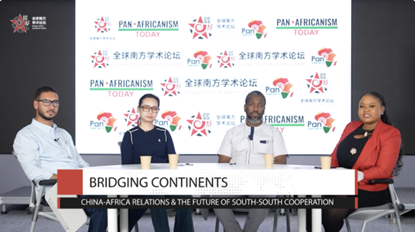
Image Captions: (From left to right) Jonis Ghedi Alasow, Professor Yinan Chen, Kambale Musavuli, and Host Makiza M. Latifa.
Forum Panelists:
Professor Yinan Chen (Professor, School of Media and Communication, Shanghai Jiao Tong University)
Kambale Musavuli (Political Analyst and Digital Strategy Advisor)
Jonis Ghedi Alasow (Executive Director, Pan Africanism Today, Secretary, South Africa)
Host: Makiza M. Latifa (Pan-African TV)
During the discussion, the participating experts unanimously agreed that South-South cooperation in the new era should transcend the traditional "aid" model and focus on "collaboration," particularly in core areas such as infrastructure development, technology transfer, and digital sovereignty.
Professor Yinan Chen provided an in-depth analysis of the principles guiding China's cooperation with Africa, noting that its adherence to mutual benefit and win-win results contrasts sharply with the traditional Western development model that attaches political conditions, offering a new development path for developing countries. She provided specific examples to demonstrate that this form of cooperation is entirely independent and autonomous, seeking no unequal exchange and harboring no "re-colonization" agenda. The examples included the reciprocal collaboration between Chinese scientists and African partners in desertification control research, and the anti-poverty and governance courses offered by Chinese universities for African officials. She emphasized that the value of the China model lies in its sustainability and effectiveness.
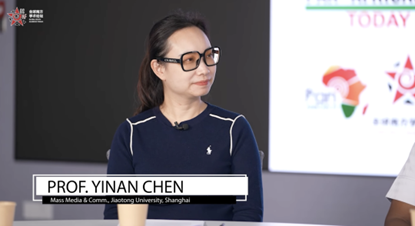
Image Captions: Professor Yinan Chen
Jonis Ghedi Alasow, in turn, stressed that the victory in the anti-fascist struggle did not signify the permanent end of fascism, and that contemporary imperialism and neo-colonialism continue to exploit Africa's resources and people. He called upon the countries of the Global South to draw strength from historical experience, particularly by returning to the spirit of the 1945 Manchester Pan-African Congress, to establish a common political project centered on Pan-African unity to combat all forms of modern oppression. Alasow pointed out that elevating the lived experiences and collective aspirations of the people is key to winning this challenge and ensuring that cooperation benefits the masses.

Image Captions: Jonis Ghedi Alasow
Musavuli emphasized that the China-Africa relationship needs to be upgraded from "cooperation" to "collaboration," which means that with China possessing advanced technology and Africa possessing abundant resources, both sides should commit to technology transfer, co-production, and co-creation to help Africa achieve self-sufficiency and sovereign development. He specifically elaborated on the importance of digital sovereignty, pointing out that the African continent's data is being extracted and monetized on Western servers without yielding any benefits for Africa. He warned African nations that they must be vigilant against losing control over their own data in the digital economy era, and reminded Africa that it must first resolve internal class contradictions to ensure that cooperation truly benefits the people.
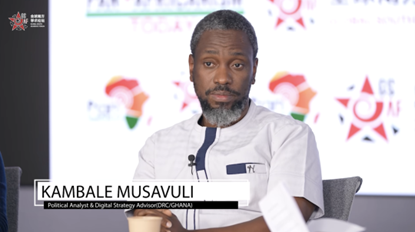
Image Captions: Kambale Musavuli
This special collaborative program was broadcast on Pan-African TV on November 29, 2025, at 1:00 PM. The Global South Academic Forum anticipates that this in-depth dialogue will inject new intellectual momentum into the future development of China-Africa relations and the solidarity and self-reliance of the Global South.