During the late hours of January 03, 2026, the world was shocked as the United States dispatched military forces to abduct Venezuelan President Nicolás Maduro and his wife. Following this event, Donald Trump suggested during a press conference at Mar-a-Lago that Cuba could become a subject of broader regional policy discussions, while also revisiting interest in Greenland, which had previously faced American threats. These developments indicate that the strategic objectives of the United States extend beyond Venezuela, potentially expanding to other regions in a profound implementation of the "New Monroe Doctrine" exhibited in the Trump administration's latest National Security Strategy Report.
This overt act, which many characterize as an "aggression," has triggered widespread international condemnation of American hegemony. In response to this abduction, Observer News (Guancha.cn) conducted an interview with Bruno Falchi, a Latin American journalist for teleSUR (Television of the South), to provide an in-depth analysis of the situation on the ground and its implications for the region. Falchi, who previously represented teleSUR at the "Global South Academic Forum (2025)," offers a perspective rooted in the experiences of the Global South.
Observer News: The events in Venezuela are truly shocking, as the United States kidnapped the Venezuelan President to bring him to trial on American soil. Based on the information currently available to you, what is the reaction of the Venezuelan people, and how has the Venezuelan government responded?
Bruno Falchi: As a Latin American journalist for teleSUR, we have been monitoring the situation closely since its inception. I can state clearly that the reaction among the Venezuelan populace is one of intense indignation and profound solidarity. The people widely view this act as a flagrant violation of national sovereignty, leading thousands to take to the streets in protest. Venezuela possesses a highly developed capacity for social mobilization and organization, with the government supported by a massive and structured base of adherents. This organized grassroots support serves as both the cornerstone of Venezuelan democracy and the primary pillar of the Bolivarian Revolution.
Only hours ago, citizens were still in the streets expressing their support for the government. They remain organized and continue to demonstrate, reflecting a collective determination to defend their sovereignty. Rather than weakening the government or the revolutionary process, these events have unified various social strata, resulting in a cohesive national response that reinforces the bond between the people and the state.
Observer News: We have seen photographs of President Maduro blindfolded and in handcuffs. According to Trump's remarks, the President and his wife were forcibly taken from their home during the night. How do you evaluate these actions by the Trump administration?
Bruno Falchi: The entire operation was extremely violent. American forces conducted bombings across various parts of Venezuela, targeting both military installations and civilian sites. In the capital city of Caracas, energy supplies and urban lighting were disrupted for several hours, leading to widespread chaos and the dissemination of misinformation. These actions were clearly intended to manufacture domestic instability and undermine the government's authority.
From the perspective of the Venezuelan people, this constitutes a violation of basic human dignity and a total disregard for international law. The public release of photographs showing Nicolás Maduro was intended to intimidate the population. There is no legal or moral justification for such conduct, which violates fundamental human rights and international legal standards, further fueling the anger of the populace.
Currently, grassroots forces in Venezuela are rapidly consolidating. Over five thousand commune organizations are active nationwide; these units, based on the long-term practice of "commune democracy," serve as the fundamental cells of popular power. These organizations have mobilized once again, with citizens arming themselves to protect the revolutionary process. The Bolivarian Militia, alongside millions of citizens, stands ready to resist any potential foreign intervention.
In his speech, Trump explicitly used the phrase "boots on the ground" and declared an intent to seize Venezuela's oil resources—wealth that rightfully belongs to the Venezuelan people—to transfer them to large American corporations. He even went as far as to claim that the Venezuelan people had "stolen" this oil from the United States. Trump further clarified that the objective is not merely to establish a puppet regime but for the United States to directly intervene and control the Venezuelan government. His stated intention is to "retake" the oil resources that were nationalized for the benefit of the Venezuelan people and "return" them to the interest groups supporting him, who would then dominate the nation's governance.
Observer News: It is evident from Trump’s remarks that President Maduro’s location was being tracked in real-time. There are also rumors suggesting he might have been betrayed or "traded". What is your take on how he was located?
Bruno Falchi: Within Venezuela, and specifically within government circles, there are several theories suggesting that American agents may have infiltrated the President’s security detail or his inner circle. Reports indicate that the United States achieved real-time tracking of the President, suggesting that his security protocols were severely compromised by external forces.
While investigations are ongoing and specific details remain unconfirmed, the primary suspicion is that certain internal links were "compromised" by external entities or intermediaries aligned with American interests. These individuals likely transmitted critical intelligence regarding the President's location and movements, enabling the United States to execute the abduction with such speed and precision.
Observer News: We have also noted that the Venezuelan military did not appear to launch an effective counter-attack during the operation. Was there an anomaly within the military, or was it simply a lack of preparation for a late-night assault?
Bruno Falchi: Quite frankly, there is a staggering disparity in power between Venezuela and the United States. The United States possesses the most powerful military force in the world and maintains a long history of military intervention in Latin America, having invaded the region numerous times throughout the twentieth century, most recently with the 1989 invasion of Panama (Operation Just Cause) to kidnap its president.
For most Latin American nations, particularly those committed to peaceful ideals, resisting such external pressure is extremely difficult. We are not a region prepared for war, nor do we desire conflict; we consistently strive to avoid it. Latin America is generally a peaceful region without nuclear weapons, where social defense relies more on popular organization, democratic mobilization, and a collective will to maintain peace. This stands in stark contrast to the United States, which frequently initiates wars globally, making any direct military confrontation exceptionally challenging.
Furthermore, Venezuela faced a targeted "decapitation-style" kidnapping rather than a full-scale military invasion. Venezuelan society is highly organized; if the United States attempted a total occupation, it would face fierce resistance in every neighborhood and city, in addition to the challenges posed by the country's vast jungles and mountainous terrain. Given Venezuela’s expansive geography, a complete conquest is virtually impossible.
There is a significant difference between a targeted infiltration to kidnap a leader and the total occupation and control of a nation. The United States appears to hope that by abducting the President, utilizing media propaganda, bombing civilian infrastructure, and disrupting energy supplies, it can dismantle the government and terrify the people. This approach mirrors the tactics used by Israel against Palestinians, where the power imbalance is likened to stones facing tanks, helicopters, and fighter jets.
However, they may not fully realize that even with overwhelming military superiority, such as that possessed by Israel, all objectives are not necessarily achieved. In Venezuela, the revolution does not depend on a single leader. The Bolivarian Revolution is backed by millions of steadfast supporters who are willing to sacrifice for their country and are prepared to step into leadership roles at any moment.
Consequently, while this is an incredibly complex situation for Venezuela, it will not be easy for the United States either. If they truly wish to overthrow the Bolivarian Revolution and crush the Venezuelan people, they would have to commit to a full military occupation and invasion, which would likely involve massive humanitarian crimes similar to those currently witnessed in the Gaza Strip.
Observer News: Trump has been planning this move against the Maduro government for months, using the pretext of combating drug trafficking. This seems to be a classic case of misdirection, as his true motivations appear to be the seizure of Venezuelan oil, hostility toward the Maduro administration, and the enforcement of the Monroe Doctrine to bring Latin America under American control. What is your assessment?
Bruno Falchi: The Trump administration and its team have failed to provide any actual evidence regarding the alleged drug trafficking involvement of the Venezuelan government. They simply claim to "know the truth" without offering any substantiating data.
In fact, the UNODC (United Nations Office on Drugs and Crime) released a major study on global drug trafficking routes in April or May of last year. The Bolivarian government of Venezuela has consistently cited this report in its defense.
The report explicitly states that approximately 95% of the drugs flowing into the United States travel via Pacific routes, and Venezuela has no Pacific coastline. In contrast, only about 5% of drugs entering the United States move through the Caribbean route. It is crucial to emphasize that this conclusion comes from the United Nations based on extensive evidence, not from the Venezuelan government, proving that American allegations are blatant falsehoods.
We are well-acquainted with this pattern of "fabricating lies, implementing intervention, and conducting plunder". The invasion of Iraq was carried out under the pretexts of "democracy" and "human rights," resulting in millions of deaths and the destruction of a nation's infrastructure, including hospitals and schools. Israel employs similar tactics against Palestine, often citing "counter-terrorism" or "anti-drug" measures without providing evidence.
In the case of Venezuela, they have carried out bombings and attacks, even sinking Venezuelan vessels and killing Caribbean fishermen, all without presenting evidence. They are weaving a false narrative to justify their actions, though Trump has already been quite candid: "We want the oil".
He has publicly stated his intent to seize oil belonging to the Venezuelan people, which is the primary objective. It is not about "regime change" or "democracy"; it is about controlling Venezuela. Trump explicitly mentioned that those "standing behind him" would be the ones to govern Venezuela in the future, representing a shift from covert interference to overt colonial-style takeover and control.
Therefore, the drug trafficking allegations are part of an information and psychological warfare campaign against Venezuela. They apply this label to anyone who does not align with them, much as they label Palestinians defending their land as "terrorists". However, the United Nations has not designated any Palestinian organization as a terrorist group, acknowledging that every nation has the right to resist foreign invasion.
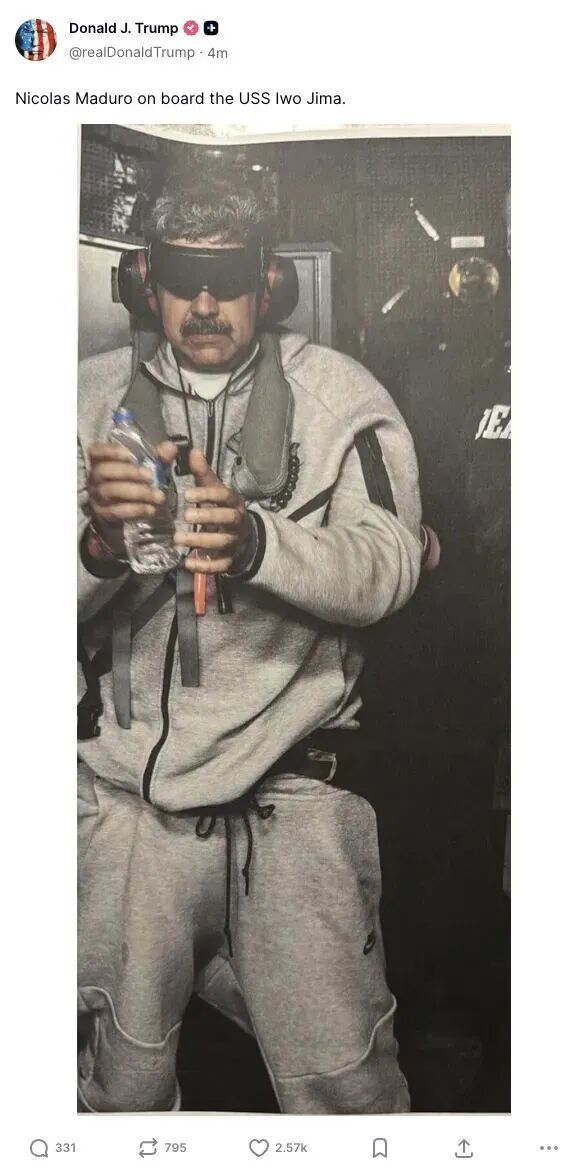
Image Captions: Trump posted a photo of the kidnapped Maduro on his social media.
The list of such interventions is long: Iran, Iraq, Afghanistan, Libya, and many others. The United States often uses "human rights" as a pretext for military intervention, bombing essential infrastructure to ultimately seize natural resources. This is a form of neo-colonialism that has placed all of Latin America in a state of high tension.
As someone from Latin America working for the regional media platform teleSUR, I can say that nations across the continent are deeply worried by this intervention. President Lula of Brazil has expressed serious concern regarding the consequences this will bring to the entire continent. The President of Colombia even proposed an emergency meeting of the UN Security Council. Every country is now worried that they could be baselessly accused without evidence or that their president could be kidnapped from their own home. Leaders throughout Latin America and the world may now find themselves in danger.
With this move, the United States has publicly declared its lack of respect for international law, human rights, and national sovereignty. What has happened to Venezuela sets a precedent and sends a signal to the world that "we can do this to anyone". Even more disturbing is that Trump has extended this logic to other conflicts, suggesting that if he were in power, the Russia-Ukraine conflict would end quickly. Does this imply new threats, kidnappings, or assassinations? It suggests he no longer feels bound by any constraints.
In Latin America, we fear a return to the darkest periods of the 1950s through the 1970s, when many democratically elected governments were overthrown by coups supported by the United States. Examples include the 1964 coup in Brazil, where the American military stood by at sea to support the junta, and the 1973 coup in Chile, where the President was killed in the presidential palace with American backing. We had hoped that era was over and that Latin America had entered a period of relative peace, respect for international law, and self-determination.
However, we are now seeing a potential resurgence of American "neo-hegemonism and neo-colonialism". Trump has labeled many Latin American governments as "enemies" of the United States. If he dislikes a government, what will he do? As we have seen, he can now arbitrarily label anyone a "drug trafficker" because he requires no evidence.
Consequently, there is deep apprehension among all progressive and left-wing governments in Latin America. The fear is that if we do not follow American dictates or become their proxies, we will be treated as enemies and destroyed. We may very well be the next targets.
Observer News: We have seen that Trump has already issued new threats. After Vice President Delcy Rodríguez, a left-wing figure close to Maduro, took over as acting head of government, Trump claimed that if she does not "behave correctly," she might pay an "even heavier price". Do you believe Rodríguez will cooperate with the United States? Trump has also indicated plans to "take over" Venezuela, intervene in its oil trade, and force Venezuelans in the United States to return home. What impact will these policies have, and will the left-wing government survive?
Bruno Falchi: From a constitutional and institutional standpoint, it is a standard mechanism in Venezuela and many other Latin American countries for the Vice President to assume leadership in the absence of the President. However, no one expected it to happen under such shocking circumstances.
It must be emphasized that the prevailing sentiment among the public is currently one of indignation rather than fear. Delcy Rodríguez is now the national leader, and she is a formidable figure. Government institutions and officials have sworn loyalty to the constitution and the people who elected them. They are accountable to the citizens who voted for this government and are prepared to defend it.
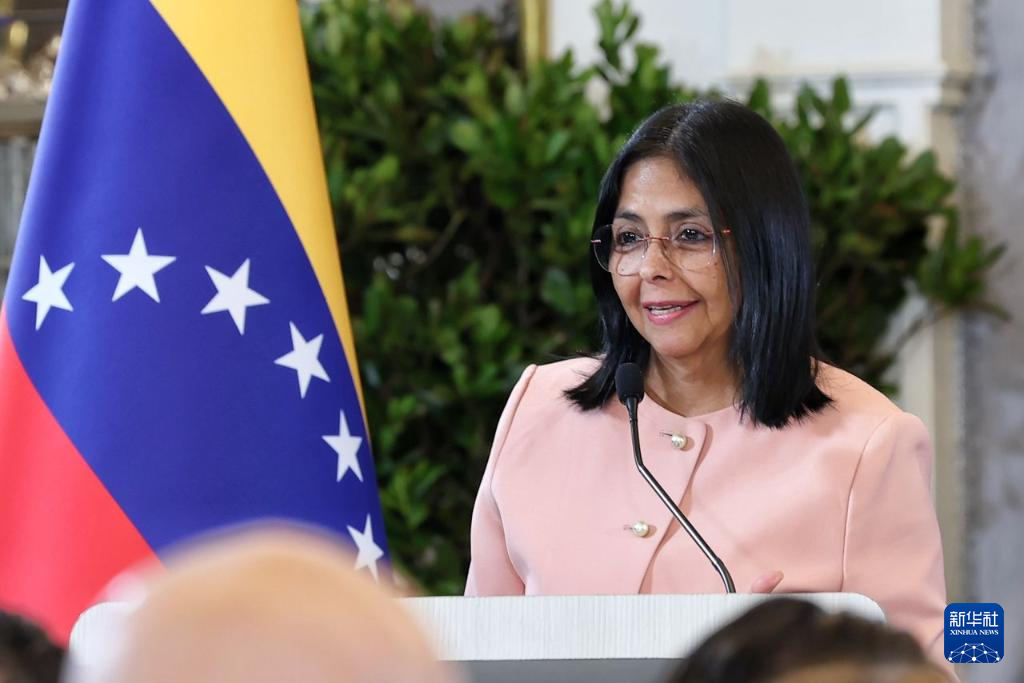
Image Captions: Vice President Delcy Rodríguez has succeeded the presidency. Xinhua News Agency.
Rodríguez has already publicly denied any claims of cooperation with the United States, pointing out the total lack of evidence for their allegations. Such claims are part of a "divide and rule" strategy reminiscent of the Roman Empire, aimed at fostering internal conflict to facilitate conquest.
The rumors spread by the United States suggesting that Rodríguez is negotiating with them are merely part of this tactic. In fact, while Trump was circulating these rumors, she appeared on Venezuelan public media to clarify her position: she supports Maduro, will defend national sovereignty to the end, demands American compliance with international law, and strongly condemns the kidnapping.
She shares a close political and personal bond with Maduro, both belonging to the PSUV (United Socialist Party of Venezuela). As the largest political party in the country with millions of members, they are ready to defend the nation. Any suggestion that the Vice President would betray the country for a deal with the United States is merely a component of a communication war. If the United States truly intends to topple the government, it would require a full-scale invasion, as the current administration enjoys broad popular support.
Over the years, the United States has imposed nearly a thousand economic sanctions on Venezuela. Under international law, these are illegal and constitute collective punishment against an entire population simply because the U.S. is dissatisfied with the government. By restricting food and medicine, they hope to incite the people to rise against their own government. This logic is identical to that used by Israel in Gaza: attempting to force the removal of Hamas by manufacturing a famine.
The United States has even gone so far as to seize or confiscate foreign vessels, including those associated with China and Russia. They seem indifferent to international reaction, essentially provoking the world and testing the limits of the United Nations system and the tolerance of the Global South. They are crossing every established red line.
I believe Delcy Rodríguez is loyal to the Venezuelan constitution, the cause of Chavismo, and the revolutionary political tradition. She will fight for her country just as anyone would. No one accepts a foreign invasion without rising to defend their homeland.
Defending one's country is a fundamental right for all people. The Venezuelan people will defend their land and their right to determine their own future. They will not allow national sovereignty to be handed over to the United States.
The true objective of the United States is to manipulate information, spread fake news, and stigmatize the Venezuelan government as "traitors" or "infiltrated". Trump mentioned months ago that the CIA (Central Intelligence Agency) would conduct operations in Venezuela; it is highly probable they infiltrated Maduro's personal security. It only takes one person to compromise a leader's location and schedule.
However, the people remain united. They are peacefully taking to the streets to express support for their democracy and sovereignty. Within Venezuela, there is virtually no support for an American invasion, except perhaps from a few opposition figures living abroad, such as María Corina Machado.
Yet even regarding these figures, Trump has indicated that the U.S. does not intend to let these opposition leaders take power because they lack respect within Venezuela. In other words, they have no domestic grassroots support.
This lack of domestic support is precisely why the United States chose this current method to attempt to overthrow the government. Changing the country will not be easy for the U.S., as Venezuela is not as easily provoked into internal strife as Iraq or Syria were. The people stand with their government and will defend their homeland with whatever means they have, even if they must resort to using stones against tanks.
Observer News: Trump has already issued military threats against Cuba and other nations. In your view, who is the next target in South America? Could it be Colombia, Cuba, or Brazil? Is the entire region at risk of being overturned by a right-wing wave?
Bruno Falchi: We are deeply concerned about this. Social movements, political organizations, and grassroots groups across Latin America are worried. Left-wing forces in the region are highly organized; for example, the Workers' Party in Brazil is one of the largest political forces in the country, with millions of supporters following President Lula’s political line.
Many analysts believe the next target could be Cuba or Nicaragua, both of which are viewed as "socialist" states by the U.S.. Nicaragua experienced a brutal civil war in the 1980s during President Daniel Ortega’s previous tenure. At that time, the United States supported the opposition and used special forces to destabilize the regime and create social unrest, leading to hundreds of thousands of deaths—the negative effects of which persist today.
However, while you can kill a person, you cannot kill an idea. The ideals of freedom and solidarity in Latin America are a spiritual heritage from Simón Bolívar and the 19th-century anti-colonial pioneers. You can practice repression, but the next generation will always take up the banner of struggle; ideas are indestructible.
Nicaragua’s history reflects this: after the civil war, a right-wing government came to power through elections, but left-wing forces eventually regrouped. The FSLN (Sandinista National Liberation Front) returned to the political center, and Ortega was eventually re-elected. History in Latin America is full of reversals and surprises, but we never lose hope. The United States may temporarily suppress us, but they cannot take away our belief in freedom.
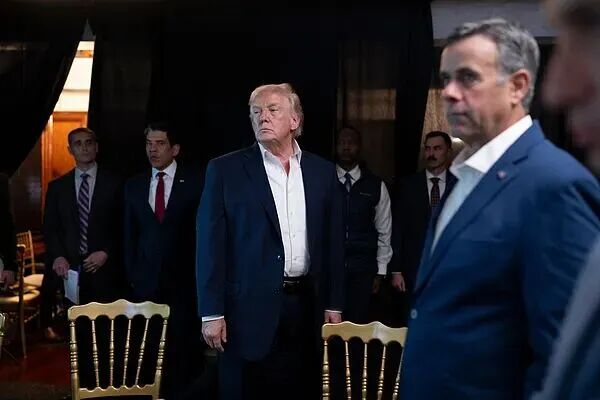
Image Captions: On January 03, 2026, Donald Trump and CIA Director John Ratcliffe (right) monitored the military operation against Venezuela. Visual China Group.
Lula’s experience in Brazil is similar. He was imprisoned on false corruption charges, which allowed a right-wing government to take power. Yet today, Jair Bolsonaro is in prison for crimes against the Brazilian people, and the Supreme Court has overturned the charges against Lula, ruling that they were the result of judicial manipulation by a judge who is now on trial for perjury.
This is the trajectory of history: it is often unexpected. Venezuela has resisted American pressure for over twenty years. Its people are strong and united, and this revolution belongs to millions, not just one individual. Eradicating the liberating ideas represented by Simón Bolívar—one of the greatest leaders of the 19th-century anti-colonial struggle—is an extremely difficult task.
While we are a continent that longs for peace, we are also a continent of millions of organized people. We will resist through peaceful means, but we will be firm in defending our nations.
Observer News: To conclude this interview, what would you like to say to our friends in China?
Bruno Falchi: For Latin America, China is a very different kind of nation compared to Europe or the United States. China is an economic superpower, and an increasing number of Latin American countries view China as a partner, a friend, and a collaborator. In the eyes of almost every Latin American nation, China has become one of the most important partners.
This is precisely why the United States feels it is losing control over the region and wants to "retake" its so-called "backyard". The core reason the U.S. is losing influence is that China’s approach to Latin America is fundamentally different from that of the U.S. or Europe.
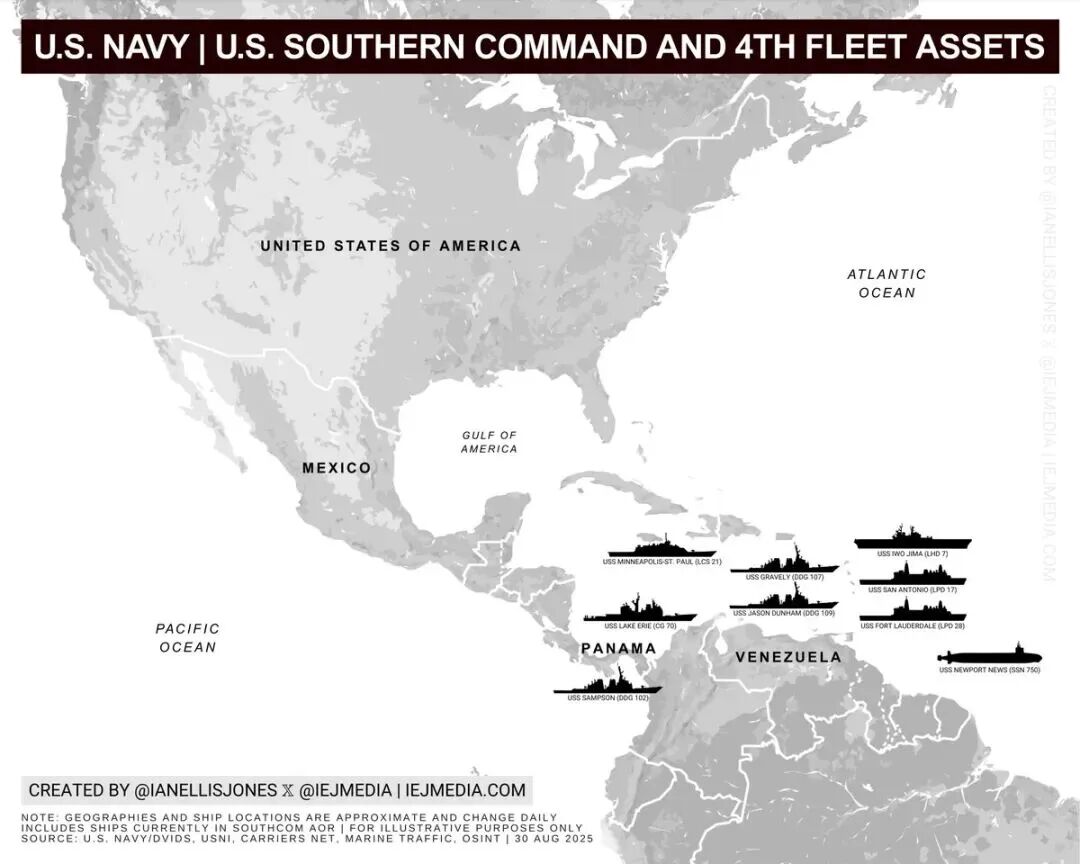
Image Captions: For the operation in Venezuela, the United States diverted a significant portion of its limited naval assets to the Caribbean, where they have been deployed for several months.
China does not impose its political will or demand a specific form of government. China emphasizes respect for sovereignty, the free will of the Latin American people, and the dignity of the Global South, including Africa and Asia. This approach contrasts sharply with the geopolitical methods of Europe and the U.S.. China does not operate through force but through "win-win cooperation".
Therefore, there is a greater willingness to cooperate with China. China provides technology and applies it to national development, assisting Latin American countries in building healthcare systems, industries, roads, railways, and various types of infrastructure.
A similar contrast is evident in the Palestinian issue: the United States sends weapons to Israel to kill Palestinians, while China supports Palestinian reconstruction and its people. Recently, China announced $100 million in humanitarian aid for Palestinian reconstruction. China supports the Palestinian people who are suffering from genocide, while those who claim to "defend democracy and human rights" are doing the opposite. This is hypocrisy and a double standard, which characterizes the U.S.. As a result, Latin American countries increasingly view China as their most important trade and political partner.
For countries like Venezuela, Cuba, and Nicaragua, China’s geopolitical status at the United Nations is also of vital importance. As a permanent member of the Security Council with veto power, China’s commitment to international law has, in the past, acted as a check on American actions. However, Trump is unlike any predecessor; he shows no respect for international law.
The critical question now is what the United Nations and the international community can do to prevent the United States from pushing the international order toward complete collapse. Their contempt for international law—abducting a president, invading nations, and claiming control over natural resources—is undeniable. This is not "regime change"; it is old-fashioned colonialism where the U.S. military intends to directly control and manage another country.
Ultimately, we must ask: what can stop the United States from acting with total impunity in the world? This is not just a question for the United Nations but for all nations that defend human rights, sovereignty, and the right of people to determine their own futures. What is at stake is not just the peace of Latin America, but the peace of the Global South and the entire world.
All images were obtained from publicly available sources.