Original Editor's Note
On the afternoon of December 28, 2025, Parallel Space | Left-wing Bookstore, the New International Center for Theory and Practice, and the Haichao Think Tank hosted a forum, both in-person and online, titled "Venezuela — A Victim of America's New Monroe Doctrine Hegemony?". At that time, the United States (US) President Trump's "maximum pressure" campaign against Venezuela had reached a critical stage, following the release of the latest National Security Strategy (NSS) report by the White House on December 6, which declared a return to the Monroe Doctrine (a US policy opposing European colonialism in the Americas beginning in 1823). The report asserted that the US would not permit foreign interference in Latin American interests, specifically targeting China's Belt and Road Initiative (BRI). The forum invited Professor Feng Jiansan from the Anti-War Working Network to share insights from his new book, International Political Economy: Europe, America, Latin America, and the Future World. The third chapter of this book compiles his articles on Venezuela over the years, offering perspectives and information rarely seen in Taiwan’s mainstream media.
Friends from mainland China recommended Carlos Ron of Venezuela to serve as a discussant for the event. Carlos currently serves as the Director of the "Nuestra América" (Our America) Office at the Tricontinental Institute for Social Research. He previously served as the Vice Minister of North American Affairs for the Venezuelan Ministry of Foreign Affairs, a position he held until his departure in January 2025. The forum also invited Professor Xu Zhun, a rising scholar from Sun Yat-sen University in Guangzhou who studies political economy and concerns himself with the changes and crises of world capitalism, to participate in the discussion online.
Since Carlos Ron's remarks were delivered six days before the US kidnapping of President Maduro and represent the only recent public statement in Taiwan by a former official of the Maduro government, his perspective is particularly significant. Furthermore, as he resides in the capital, Caracas, which has been subjected to US military airstrikes, his first-hand account from Venezuela is of urgent importance. With his consent, a transcript of his speech has been translated; however, due to time constraints, the translation could not be reviewed by Carlos himself, and the translator, Wu Yongyi, assumes full responsibility for the text. During the three-hour forum, Carlos delivered his main presentation and meticulously answered several questions from the audience, though not all could be included in this translation.
Prior to Carlos’s speech, Professor Feng Jiansan utilized a data-rich presentation to illustrate how Venezuela’s legendary left-wing President Hugo Chávez and his successor, Nicolás Maduro, have continued to advance socialist policies despite persistent suppression from the US. Professor Feng specifically highlighted the smear campaigns and attacks launched by both Venezuelan and international mainstream media against the left-wing regime. A notable "media spectacle" occurred during the 2002 US-backed coup against Chávez, when four private television stations, which controlled 70% of the national viewership, suspended all regular programming to broadcast anti-Chávez advertisements 24 hours a day for 64 consecutive days, totaling 17,600 anti-government spots.
Regarding President Maduro, the US government has refused to recognize his electoral victories in the 2013 presidential election (following the death of Chávez), the 2018 election, and the 2024 election, with mainstream US media echoing this stance. However, the American Bar Association (ABA) election observation mission concluded in 2013 that there was no evidence of fraud, even noting that private media, which controlled 90% to 94% of the viewership, was biased in favor of opposition candidates—a striking situation where a so-called "dictator" allowed the vast majority of media to attack his own regime. The situation escalated in 2024 when anti-government factions sabotaged food storage facilities, power grids, and the computer systems of the vote-counting process, which utilized hardware imported from Taiwan, in an apparent attempt to intimidate Maduro's supporters and create leverage for rejecting the results. On election day, the counting system faced a massive cyberattack consisting of 30 million hits per minute over 20 hours. Following the election, US-backed gangs such as the Tren de Aragua (Aragua Train) instigated riots in the capital, yet by 2025, the Trump administration cited this same gang as evidence of Maduro's alleged indulgence of drug syndicates.
Professor Xu Zhun spoke after Carlos, and while his full remarks are not summarized here, he published an article titled "The Day After Maduro's Arrest: Why are Some Rushing to Say Socialism Ruined Venezuela?" on the Wenhua Zongheng (Beijing Cultural Review) WeChat account. In the article, he uses statistical data to refute various claims intended to stigmatize the "Socialism of the 21st Century" promoted by Venezuela’s left-wing government, and this piece is highly recommended for further reading.
Carlos Julio Ron Martínez has served as the Vice Minister of North American Affairs for the Venezuelan Ministry of Foreign Affairs, President of the Simón Bolívar Institute, and is currently the head of the "Nuestra América" Office at the Tricontinental Institute for Social Research. He has also appeared as a guest speaker at the "International Forum on Global South Communication (2023)" and the "Global South Academic Forum (2025)". This article was originally published in The Storm Media and is reprinted here in full with authorization.
Carlos Ron:
Drug Enforcement is a Pretext; Regime Change is the Goal
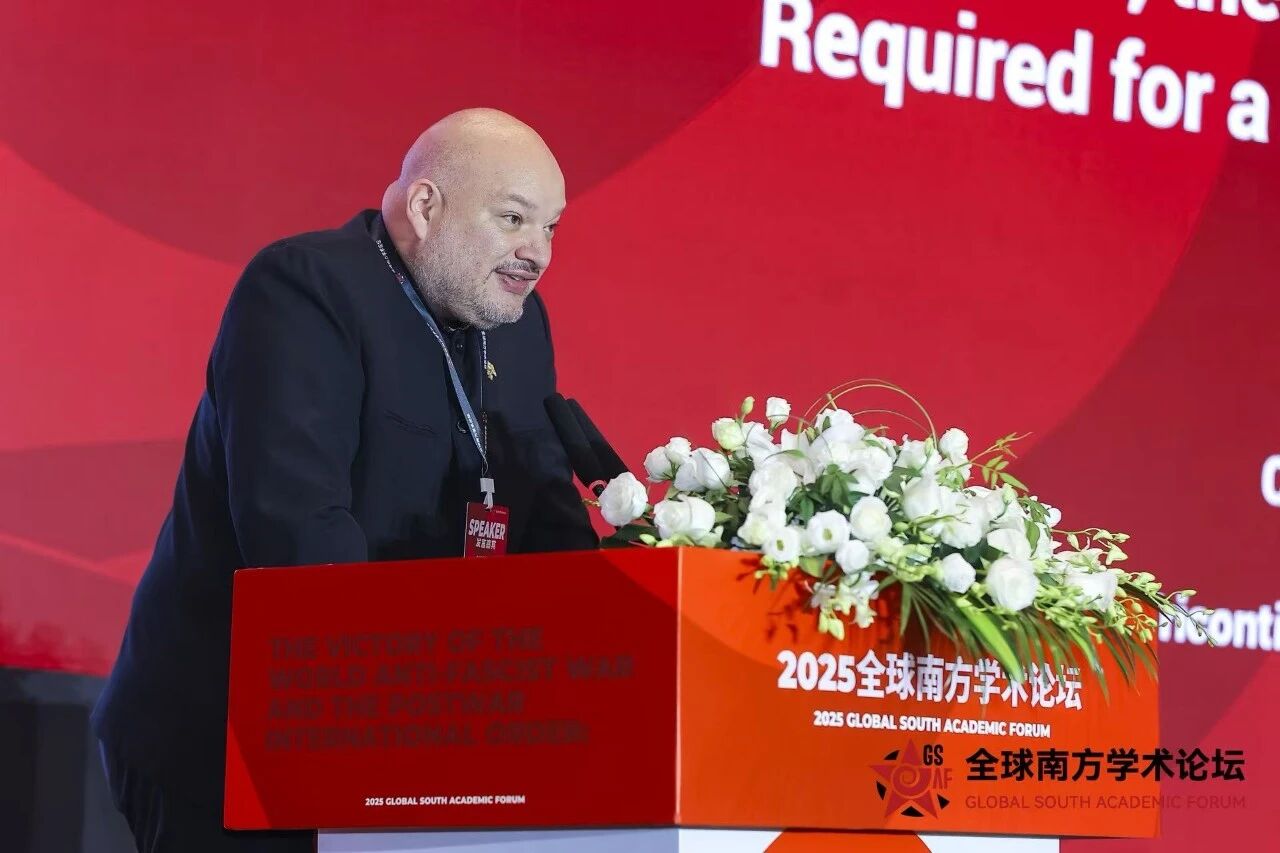
Image Captions: Carlos at the scene of the "2025 Global South Academic Forum."
I would like to thank the organizers for the invitation and for providing the opportunity to explain the situation in Venezuela. The US military intervention in Venezuela is a clear attempt to execute regime change; however, this time it is being pursued through the form of a state collapse, which is part of a systemic effort by the US. I want to emphasize that this may not necessarily take the form of an immediate coup or assassination, but rather an insidious attempt to disintegrate the entirety of Venezuela. This intention did not begin in 2025; it can be traced back at least to 2015, when the Obama administration signed an executive order designating Venezuela as an unusual and extraordinary threat to the national security and foreign policy of the US.
Professor Feng Jiansan has already provided a wealth of information, so I will focus on a few key points that I believe deserve consideration. Over the past decade, we have endured severe blockades and sanctions from the US. Reports from several independent assessment agencies indicate that in the first year of the blockade alone, approximately 40,000 deaths could be attributed to the various consequences of these measures. To give you a sense of the scale, Venezuela’s national income decreased by approximately 90% between 2014 and 2020. This is because the oil industry, which is Venezuela's primary source of income, was targeted by sanctions that violate international law, as they were decided unilaterally by the US without the consent of the United Nations Security Council (UNSC). These sanctions target the entire population, affecting food supplies and impacting the availability of medical supplies during the pandemic; furthermore, the US froze Venezuela’s overseas accounts, preventing us from purchasing vaccines to control the outbreak. The impact of these sanctions is evident in the daily lives of the people, affecting everything from medical equipment and garbage collection trucks to critical infrastructure such as oil refineries and the power grid.
In addition, the US supported a so-called "parallel government" opposed to Maduro, which was subsequently recognized by the US and certain European countries. This is clearly a systemic attempt to undermine the possibility of Venezuela functioning as a complete government in both domestic and international foreign policy.
The question arises: if the US has been intervening in Venezuela's internal affairs with varying degrees of intensity, why has it escalated this intervention in 2025 into a new form of aggression?. Initially, the sanctions against Venezuela were relatively weak and were gradually strengthened; during the Biden administration, a licensing system was used to manage the sanctions, but now we see a new surge of aggression.
Our interpretation is that the current US administration has realized that its efforts to suppress its primary competitors—particularly Russia and China—have not progressed as intended. For example, they failed to create sufficient difficulties for Russia regarding the Ukraine issue, and the same applies to other competitive areas involving China. Now they have shifted their strategy, prioritizing the assertion of dominance over the Western Hemisphere to secure supply chains, block other countries from extracting resources, and curb the influence of Russia and China in the region. Iran is also a factor due to its significant influence in its anti-Israel stance. Venezuela has long condemned Zionism and firmly supported the rights of the Palestinian people. We did not begin defending Palestine only after the events of October 7, 2023; Venezuela severed diplomatic relations with Israel many years ago.
This is why Venezuela has been targeted as a "problem country" by the Trump administration, a fact that becomes even more apparent when examining the latest US National Security Strategy (NSS) report. The report states that the US must consolidate its hegemony in the Western Hemisphere to block the influence of its major competitors—Russia, China, and Iran—in Central and South America.
In fact, even before the NSS report, during Trump's second presidential campaign, a group of his staunch supporters published a policy proposal titled "Project 2025" and established a platform for policy recommendations. One of the policies they hoped Trump would implement was to regain control over the Western Hemisphere to ensure the economic security of the US, a strategy referred to as "re-hemisphering". Therefore, this policy did not originate with the NSS report, though the report's language specifically emphasizes the need to possess and control "strategically vital assets". As is well known, Venezuela possesses the world's largest oil reserves, which is precisely the strategic resource coveted by the US, making Venezuela the greatest obstacle to the "re-hemisphering" of the Western Hemisphere.
Since Hugo Chávez initiated the Bolivarian Revolution, Venezuela has maintained an independent domestic and foreign policy, and he even revitalized the Organization of the Petroleum Exporting Countries (OPEC). In the Western Hemisphere, no leader other than Chávez dared to visit Saddam Hussein in Iraq, meet with Mohammad Khatami in Iran, or visit Libya at the invitation of Muammar Gaddafi.
Chávez effectively reorganized the oil production order, causing oil prices to rise from $7 per barrel when he was elected to frequently maintaining levels above $100 per barrel during his first term, thereby removing oil prices from US control. Although oil prices later fell due to factors such as the US increasing shale oil production, he had already made significant contributions to the Global South. Chávez also played a crucial geopolitical role; prior to his presidency, Latin American countries were organized under US leadership with the participation of Canada. Chávez succeeded in uniting the nations of Latin America and the Caribbean—excluding the US and Canada—and strengthened economic and trade ties between them. This was a more rational and equitable grouping because these countries share a common history and similar economic structures. Under the impetus of the Bolivarian Revolution, these nations were able to deepen multilateral economic cooperation with China, Russia, and Iran. Furthermore, Venezuela provided aid to Cuba, which has endured an illegal US embargo for sixty years.
Consequently, one can understand why the US views Venezuela as a thorn in the side of its policy to regain hegemony in the Western Hemisphere; beyond the factor of oil as a strategic asset, Venezuela's leading geopolitical role is something the US cannot tolerate, which is why the country must endure such intense hostility and attacks.
The US has already increased its own oil production and does not lack oil, so why does the latest NSS report still list oil as a "strategically vital asset?". The reason is that the US primarily produces light crude oil, while Venezuela produces heavy crude oil. Only a few countries, including Venezuela, Canada, and Russia, produce heavy crude. Crucially, a group of US oil refiners owns facilities specifically designed to process the heavy crude produced by Venezuela, located in Texas, Louisiana, and Illinois; these refiners account for 70% of US crude oil imports. Moreover, the greatest profits in the petroleum industry are generated in the refining process rather than in upstream production. Therefore, they covet Venezuela's heavy crude resources; however, the largest buyer of Venezuelan oil is currently China, not the US.
The current wave of attacks against Venezuela is part of the latest US National Security Strategy. Page 15 of the report includes a section titled "The Trump Corollary to the Monroe Doctrine," yet this new Monroe Doctrine has no basis in international law and is merely an assertion by the US government of its right to intervene in the Western Hemisphere. This NSS report can be seen as the latest supplement to the Monroe Doctrine, with its core proposition being that the US will prevent any non-Western Hemisphere competitor from deploying military forces, establishing threatening capabilities, or seizing strategically vital assets.
This passage is quoted directly from the report; in short, the Trump administration declares that no extra-regional power shall control important assets in the Western Hemisphere. Because of this, Venezuela's act of selling oil to China and other countries instead of the US has become an issue and a target for attack. The US solution, as stated in the NSS report, is to support pro-American regimes that identify with the US worldview, are willing to cooperate, and can provide and guarantee the resources required for US supply chains.
This is essentially the implementation of a new type of colonialism in the region. The US intends to replace the existing Venezuelan government with a puppet regime that can satisfy US demands and ensure that Venezuela no longer exists as an independent force in the Western Hemisphere.
The Anti-Drug Narrative is Merely a Requirement for a Demonizing Framework
Let us look back at what has actually happened in 2025. To cause the Venezuelan government to fall and the country to collapse, the US has launched systematic attacks since the beginning of the year, targeting both the regime and the Venezuelan people. The Trump administration has characterized Venezuelan immigrants as foreign enemies living within the US and has begun constructing a narrative linking these immigrants to criminal organizations. One group mentioned, the "Tren de Aragua," was originally a gang that existed within Venezuela, but the Trump administration's narrative has exaggeratedly claimed that it has expanded into a massive organization spanning the Latin American continent and infiltrating the US.
They have accused Venezuelan immigrants of being members of this criminal group and have begun systematically deporting them to concentration camps in El Salvador, where they are beaten and tortured under the pretext of fighting "narcoterrorism". Simultaneously, they have fabricated another narrative claiming the existence of a drug cartel in Venezuela called the "Cartel de los Soles" (Cartel of the Suns), alleging it is a trafficking ring composed of Venezuelan military personnel. However, records from the US Drug Enforcement Administration (DEA) and the State Department have never shown the existence of such an organized trafficking group within Venezuela. According to drug enforcement statistics, approximately 87% of drug smuggling from South America to the US occurs via the Pacific Ocean, while Venezuela is located on the Atlantic coast.
Therefore, framing Venezuela for sending drugs to the US is factually incorrect because most drug trafficking happens in a completely different maritime area that Venezuela cannot even access. Claiming that Venezuela is a major source of criminals entering the US is also a highly erroneous assumption, as the number of immigrants from Venezuela is extremely limited compared to those from other Latin American countries, including Mexico and Andean nations like Colombia. Nevertheless, systematic attacks against the Venezuelan people do exist because all these efforts are intended to stigmatize Venezuelans—not just the government, but all citizens—as dangerous criminals with criminal intentions toward the US.
The US used a similar method to demonize Arab and Muslim populations in the Middle East when it launched wars against Iraq, Libya, and Afghanistan. This is exactly the process currently underway, aimed at creating favorable conditions for any action against Venezuela. This also places the Trump administration in a difficult position because a significant portion of its support base—those who pushed Trump into the presidency—do not want to see the US involved in another military conflict, which they refer to as "endless wars" like those in Afghanistan or Iraq.
Consequently, when justifying attacks against Venezuela, the Trump administration claims it is not at war with the Venezuelan state, but rather fighting criminal organizations within Venezuela. They portray the Maduro government as part of these criminal organizations rather than a legitimate government; thus, the US does not recognize Maduro as a legal president but views him as a criminal. This entire narrative framework is constructed with the assistance of mainstream media, witnesses, think tanks, and academia to deliberately shape a criminal image of the Venezuelan people and their system, thereby justifying intervention in Venezuela's politics to change its stance of non-subordination to the US.
Maximum Pressure Has Not Been Effective
When we see the truth, we realize this is nothing more than a narrative game with no substantive content in the allegations. We have seen through this over the past few weeks, especially after December 10, when the US seized an oil tanker named the "Captain" carrying over a million barrels of crude oil, and is currently pursuing another tanker named the "Bella" while having already seized the "Century". When President Trump was asked what would be done with the seized oil, he replied, "We will confiscate it.". The US claims the seizure is based on sanctions, but confiscating oil without a basis in international law is essentially an act of piracy, though it once again demonstrates US power. The key point is that the US thought it could force regime change by demonstrating massive naval and air power to press Venezuela.
The problem is that they have never understood how Venezuelan society thinks, how it has unified and stayed in solidarity over the past 26 years of the revolutionary process, how the Venezuelan military defends the constitution, and how the vast majority of Venezuelans reject foreign interference, even if they do not necessarily agree with the Maduro government. My point is that while opposition groups exist in Venezuela, they also reject foreign interventionism; therefore, the Trump administration’s expectation that military threats in the Caribbean would incite a military uprising against President Maduro has failed to materialize. Consequently, they have had to resort to other methods, such as launching airstrikes against ships and issuing other threats. In recent weeks, we have suffered from a publicly declared airspace blockade, with the US threatening to close Venezuelan airspace, causing many international airlines to suspend flights to the country. Unfortunately, they have not only threatened airlines but also interfered with satellite positioning systems (GPS), disrupting operations; there have even been two news reports of civil aircraft nearly colliding with military aircraft conducting exercises in the region. We also face threats of a maritime blockade, where now not only fishing boats but also oil tankers are being threatened. The US military is not just attacking small boats as if they were trafficking vessels; they are now intercepting tankers.
The US is waiting for Venezuela to collapse internally under this "maximum pressure," but that will never happen. They have never succeeded because of the unity of the Venezuelan people and the fact that Venezuela possesses other resources and is doing its utmost to avoid disaster. This is indeed an extremely difficult situation that is not easy to overcome, but the US plan to make Venezuela collapse through intimidation alone has already gone bankrupt. Subsequently, they supported extreme opposition leader María Corina Machado, awarding her Nobel Peace Prizes to boost her visibility on the domestic and international stage, despite her lack of popular support and inability to organize meaningful demonstrations. Now she is being molded into an iconic figure and a vital link in the anti-Venezuela narrative, allowing the US to claim that the Venezuelan people are waiting for US intervention: "Please invade our country; we desperately need freedom and democracy.". However, she does not care about freedom or peace; for years, she has been an active promoter of US colonization of Venezuela.
This is our current situation.
The China Factor in the US Attack on Venezuela
I would like to return to the questions raised by the moderator at the beginning of the discussion.
The first question was: Is Trump’s war against Venezuela intended to stop the continued expansion of socialism in Latin America?. To some extent, I agree with this view and would say "yes.". In the current US rhetoric, there are indeed ideological accusations, and their criticism of left-wing forces, socialism, and communism carries an extremely negative and hostile tone. Of course, it is not just a refusal to see socialism spread, but a deeper intention—I believe it is essentially a suppression of independent and sovereign regimes. Even if a country were not a left-wing regime, if it dared to stand independently from the US position, it would face similar attacks.
The second question was whether this wave of attacks is about seizing oil resources. Of course it is. It concerns Venezuela's rich natural resources, which include not only oil and natural gas but also gold, rare earths, coal reserves, and even abundant water resources.
The third question was whether the US actions are also directed at China, aiming to restrict or exclude Chinese influence in Latin America. We understand that the world is currently undergoing a reorganization. Since the end of the Cold War, the US has lost its status as the sole superpower hegemon, and it urgently needs to regain control over the natural resources in this region because it believes Latin America is easier to control than resources in Africa or other parts of Asia. While the resource factor is key, is it also about curbing Chinese influence in Latin America? Yes, it is indeed to curb Chinese influence, but also to counterbalance the influence of Russia and Iran. However, the US certainly views the US-China relationship as a competitive one, even though I do not believe, nor is there evidence to show, that China holds the same Cold War mentality toward the US. I think China's expression of its own worldview is quite clear, belonging to a win-win cooperation model, at least in its stance toward Venezuela. We have established an "all-weather strategic partnership" with China, but the US has placed itself in a competitive framework with China, Russia, and other countries, thus attempting to exclude China and others from Latin American affairs.
This is not just my personal opinion; it is explicitly stated in the National Security Strategy report. In a sense, this strategy report is something new, perhaps reflecting the desperate and aggressive tone of today. But since the Monroe Doctrine, and even earlier in history, the logic has been that the power that controls the Western Hemisphere can shape itself as a global hegemon; it is as simple as that, and it is the brutal reality of today.
The fourth question was whether the changes in Latin America have any impact on the geopolitical situation in the Taiwan Strait. Regarding this, I would prefer to hear your insights. What kind of impact do you think this might have?. I find it difficult to assess the impact of the Venezuelan issue on the geopolitics of Taiwan or the overall geopolitics of China. But I believe the key is that we must understand the US intentions here, the core of which is to consolidate what it considers its regional sphere of influence. This is because it believes it has failed to effectively penetrate the spheres of influence of its other competitors, having failed to advance in Ukraine or in Asia; therefore, it needs to consolidate its presence in Latin America.
Finally, I want to add one point: you must understand that the Venezuelan people will—and have already expressed that they will—reject the US attempts. Furthermore, in recent polls, over 70% of the US population expressed opposition to a war against Venezuela. Therefore, the majority of people in the entire region oppose this US action. I believe that over time, you will witness the vulnerability and difficulties this move will bring to the US. We will continue to defend our position, our right to exist, our vision of independence and sovereignty, our right to the revolutionary process, and our right to establish relations with China, Russia, and any country that views Venezuela as a friend—regardless of US intervention.