In Venezuela, the "community media movement" has flourished since the 1990s. Through these community media outlets, the grassroots population of Venezuela has gained a channel for expressing their perspectives. Utilizing participatory communication, Venezuelan community media has demonstrated a communication practice that is distinct from that of corporate media.
Catia TVe: An Expression Channel for the Grassroots (Note 1)
In Caracas, the capital of Venezuela, half of the population lives in slums. Catia is a vast impoverished community located in the western part of Caracas. Catia TVe (Catia Televisora Comunitaria) was created and managed by the residents of this community, serving as the first legal community television station in Venezuela and a representative of the country's community media. In Venezuela, community media and commercial media carry vastly different political implications. Unlike the latter, which strives to mold recipients into "audience commodities," community media emphasizes the active participation of the populace.
The slogan of Catia TVe, "Don't watch television, make it!", embodies its philosophy of popular participation. Furthermore, the name "Catia TVe" sounds like "Catia Te Ve" in Spanish (where "ve" is the third-person singular of the verb "ver," meaning "to see"), which translates to "Catia sees you" rather than "you see Catia." This name reflects the concept of removing the gap between the viewer and the producer. The station's objective is to "establish the media that the people want" through "democratic participation based on dialogue," maintaining that participation is a "right of the people to express themselves through the state-owned radio-electronic broadcast signals." The station itself produces only 15% of its programming; its primary focus is on providing training and technical support, while offering organizational assistance when community volunteers form audiovisual teams.
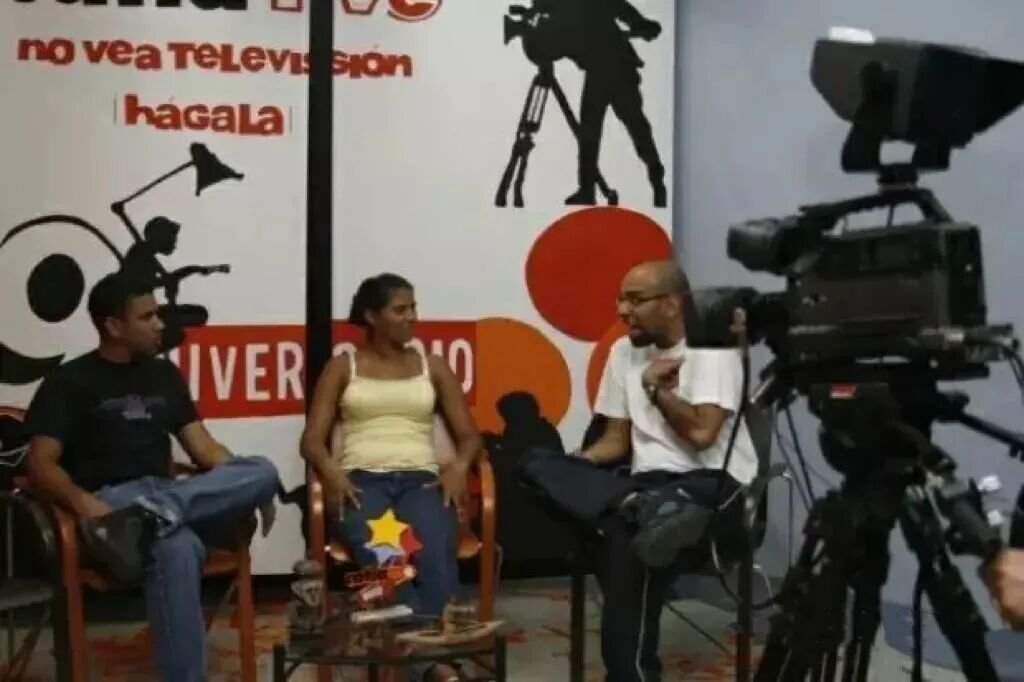
Image Captions: On-site recording at Catia TVe.
Training is designed to equip community residents with the skills necessary for audiovisual production. The training at Catia TVe encompasses not only production techniques but also places a heavy emphasis on political and ideological dimensions. Residents participate voluntarily in a four-month "Introductory Workshop for Community Audiovisual Production." During this workshop, participants are encouraged to reconstruct and analyze their collective experiences as members of a group, identifying successes, failures, obstacles, and strengths from a critical perspective to improve their living conditions. The goal of this training is to ensure that residents possess not only communication knowledge but also the capacity for critical analysis of their social environment and surrounding conditions. This includes the ability to identify cultural values and ideologies that serve collective goals, understand the reality of their situation, and integrate workshop training with collective knowledge building and social practice analysis. Upon completion, residents form "Community Independent Audiovisual Production Teams" consisting of four to seven members based on geographical or social sectors, such as students, laborers, or athletes.
In terms of content, Catia TVe differs significantly from commercial stations, as 70% of its programming is produced by these independent audiovisual teams, who handle their own scripting, filming, and editing. The station provides portable digital cameras, computers, and Final Cut software. Because Catia TVe lacks the standard "style guides" typical of commercial media, the visual styles and technical levels of different teams are unrestricted, ranging from intimate home-video aesthetics to avant-garde styles. Moreover, the programs produced are highly diverse, spanning from documentaries on local political movements and public service announcements to non-political cultural reports, all of which are deeply rooted in the local community. This allows them to represent the "marginalized corners" often ignored or suppressed by mainstream commercial media and even challenge established mainstream narratives. The work of two specific audiovisual teams provides a glimpse into this process.
The "Yaowe" team, composed of students from a community art school, documents the folk history and myths of the Caracas slums and nearby coastal communities, aiming to reconstruct neighborhood collective memory through oral histories. Their documentary The Pine Tree on Cota 905 Road tells the story of a long-dead pine tree through the accounts of local neighbors. Another documentary focuses on a tree in a different neighborhood that is covered in stuffed animals. In the film Drums of Guayabal, the team visits the coastal village of Guayabal, founded by escaped slaves, to record the public rehearsal of an African drum troupe.
In 2006, the "Los Vencedores" (The Victors) team produced the documentary Invaders or Exiles?, which investigated and questioned the term "invasion" (occupying land) often used when referring to slums. In Venezuela, slums have historically been viewed as developing through the "illegal invasion" of vacant land. The first half of the film documents the land reform plan taking place in poor communities, which seeks to legalize land use by granting residents ownership of their homes, thereby transforming the ambiguous status of "invasion" into legal ownership. In the second half, the team interviewed residents about their understanding of the word "invasion." None of the interviewees mentioned possession or ownership; instead, they spoke of the years spent building their homes and establishing roots in the neighborhood. While citizenship in the city is often defined by legal ownership, in the slums, people recognize their belonging through the labor of building homes and contributing to the community, offering a definition derived from life practice that differs entirely from the law.
Beyond documentaries, news is a primary focus for Catia TVe. The characteristics of its news coverage were evident in a 2004 program titled Cayapa in the Community (Collective Creation in the Community). The program lacked polished packaging; journalists did not wear "professional attire" and avoided drawing simple conclusions. With only two digital cameras and a single microphone, the crew interviewed residents, children, and activists. Because many slum dwellings are considered temporary "occupations" of public land, residents often lack municipal facilities and must "steal" water and electricity from the municipal grid. Journalists asked questions regarding the biggest local problems, access to clean water, conditions during rain, education for children, and personal dreams. The responses were varied and lacked the brief, refined soundbites of celebrities typically seen on television. The only standard television news feature was the microphone bearing the station's logo.
In addition to training and producing 15% of the content, the daily duties of Catia TVe staff include receiving complaints from residents. A field study revealed that staff often meet with residents who complain about government leaders or the inadequate implementation of various programs. The most common complaints involve requests for material assistance. However, staff pay the most attention to complaints raised by groups participating in collective projects, particularly those organized by the government. Sometimes, complainants speak directly to the camera as if addressing President Chávez, viewing television as a direct channel to the presidency. These criticisms of the government are broadcast, and the process of complaining allows the poor to practice representing the challenges they face. Furthermore, weekly station meetings are open to the community, encouraging residents to propose new program ideas.
By 2004, Catia TVe was broadcasting five hours of programming daily, including documentaries on subjects ranging from community history to waste management, as well as short fiction films. By 2007, this had increased to 14 hours daily, featuring live studio news, talk shows, music programs, and documentaries. As a photographer for Catia TVe noted, the poor are invisible in commercial media except when presented as "thugs, vagrants, or 'blacks.'" For the past 40 years, poor communities in Venezuela existed only as objects for the news media. The "naturalization" of unjust social structures by Venezuelan commercial media is precisely what community media seeks to reverse through resident participation. Whether through production training, making complaints, or attending meetings, the social grassroots have gained communication resources to define their own social practices, providing a path for perspectives and voices that differ from those of commercial media.
The Venezuelan Media Structure
Despite the significant development of community media, private media continues to maintain a dominant advantage within the Venezuelan media structure. Venezuela's two major newspapers, El Nacional and El Universal, are both privately owned, and their presidents are board members of the IAPA (Inter-American Press Association). For years, these newspapers conspired to undermine the Chávez administration and supported the 2002 coup attempt. Teodoro Petkoff, the editor of El Universal and a major political opponent of Chávez, turned the paper into the first print media outlet to openly oppose the administration.
In the television sector, the opposition has maintained control over four major private stations. The oldest is RCTV (Radio Caracas Televisión); in 2007, the government declined to renew its broadcast license due to over 600 violations, after which it transitioned to cable. Venevisión is controlled by the Cisneros family, the wealthiest in Venezuela, who export programs throughout the Spanish-speaking world. Televen was the first to air American and Colombian television series, offering a mix of news, game shows, and soap operas. Globovisión, launched in 1995 as a 24-hour news channel, is modeled after the Spanish-language channel of CNN (Cable News Network).
Media monopoly is a serious issue in Venezuela, as exemplified by the Cisneros family, whose media holdings span over 30 countries. They own one of the country's largest television stations and have interests in satellite TV, the internet, magazines, and Spanish-language channels in the United States and Colombia. Their influence also extends to cultural entities like the Miss Venezuela pageant and the Caracas baseball team, as well as the food and beverage industries.
Like the newspapers, private television stations represent the interests of a small elite class. RCTV, for instance, supported the overthrow of the elected president in 2002 and committed over 650 broadcasting violations in the following five years, including airing adult content during children's viewing hours. A commentary in the British newspaper The Guardian noted that in a nation with a predominantly Black and Indigenous population, the station's staff and hosts were "entirely white," mirroring the protagonists in their soap operas and advertisements, leading to its description as a "colonial" television station. Class and racial divisions are stark on Venezuelan television; private channels depict a metropolitan, middle-class, white Venezuela, while state and community channels present a third-world nation where the majority of people live in crowded urban slums.
The state media landscape is comparatively much smaller. Prior to 2003, the state owned only one national channel, VTV (Venezolana de Televisión, Channel 8). The ViVe channel was established in late 2003 and inherited RCTV's channel resources in 2007 to teach residents program production. In October 2005, Venezuela collaborated with Argentina, Brazil, and Ecuador to launch the international Spanish-language channel teleSUR. That same year, the ASAMBLEA pay channel was created to broadcast National Assembly sessions. In 2007, the social channel TVes was established using some of RCTV's equipment to showcase Venezuelan social diversity.
A survey by AGB (a subsidiary of the Nielsen Company in Venezuela) on television audience shares from 2000 to 1010 showed that in 2000—2001, state channels held an average monthly share of 1.9%. By 2009—2010, this share rose slightly to 5.9%, though this figure includes teleSUR and community stations like Catia TVe, meaning the actual state share is even lower. Private television continues to hold an overwhelming dominance in audience share.
Conversely, community media has grown significantly since the 2002 coup. By 2008, there were 400 community radio stations and 34 community television stations across the country. However, funding for these outlets remains very limited; for example, the government provides only a small, one-time subsidy to legal community radio stations (approximately 417 USD). Furthermore, the low-power UHF (Ultra High Frequency) signals of community stations are often unstable, and a lack of professional production skills in areas like audio and lighting limits their ability to expand their audience in a market dominated by commercial media.
The Political and Economic Context of Community Media
Venezuela is one of the most urbanized countries in Latin America; the rural population dropped from 35% in 1960 to only 12% in 1990. It is the only net importer of agricultural products in the region, with agriculture accounting for only 6% of the GDP (Gross Domestic Product).
Image Captions: Slum communities built along the mountain slopes on the outskirts of Caracas, the capital of Venezuela.
In terms of class structure, the largest group is the semi-proletariat, making up 50—60% of the population, who are often unemployed or work in the informal economy. Together with the proletariat (excluding union leaders), peasants, and agricultural workers, they form the primary support base for Chávez's Bolivarian Revolution. The opposition consists mainly of the comprador and national bourgeoisie. The former originated from the landed gentry who invested in oil extraction and maintain close ties with international financial capital, particularly from the United States. Although they are a small minority, they led the Venezuelan government before Chávez took office. The middle class, belonging to the petty bourgeoisie, is a group both the opposition and the Chávez camp seek to influence.
The 1980 oil price collapse severely impacted Venezuela. From 1978 to 1985, the per capita GDP declined steadily, accompanied by capital flight and soaring foreign debt. The IMF (International Monetary Fund), led by the United States, pressured the Venezuelan government into major structural adjustments as a condition for loans. However, two consecutive attempts at neoliberal "shock therapy" failed. The first, in 1989, involved removing subsidies and price controls, causing oil prices to skyrocket. Private bus companies raised fares, hitting the working class in Caracas slums the hardest. This led to the "Caracazo" riots, which were suppressed by the military. The second attempt in 1996 involved selling Venezuela's three largest banks to foreign financial groups, deepening dependence on U.S. financial power.
By the mid-1990s, per capita GDP fell to 1960s levels, and real wages for workers dropped to only 40% of their 1980s income. The population living below the poverty line increased from 36% in 1984 to 66% in 1995, while extreme poverty rose from 11% to 36%. During this time, urban unemployment tripled, becoming the highest in Latin America, while the middle class shrank. The share of national income for the poorest 40% fell from 19.1% in 1981 to 14.7% in 1997, while the share for the wealthiest 10% rose from 21.8% to 32.8%. Neoliberal reforms resulted in intensified social contradictions, class polarization, and declining living standards, creating the conditions for Chávez's election.
After Chávez was elected, the opposition, representing elite interests, could not tolerate his anti-neoliberal measures. Using their media dominance, the opposition frequently expressed hostility toward poor communities and government policies. During the peak of the conflict between 2000 and 2004, private stations often insulted the government. In response to Chávez's weekly program Aló Presidente (Hello President), Globovisión launched Aló Ciudadano (Hello Citizen), hosted by a former ambassador to the Salvadoran military government, with an audience and guests that were almost entirely anti-Chávez.
The 2002 Venezuelan coup is often called a "media coup" because of the active participation of mainstream media. Unlike other coups, the media did not need to be taken over by military officers because they were enthusiastic allies of the coup plotters from the start. RCTV, for example, suspended regular programming two days before the coup to broadcast harsh criticisms of the president and called for citizens to join anti-government protests on April 11, 2002. During the coup, mainstream television blocked news of pro-Chávez rallies and military dissenters. While the only state channel was forced off the air and citizens surrounded the presidential palace to resist the coup, mainstream networks aired cartoons and nature programs. Community media filled this void, informing the public that Chávez had not resigned but was being held by the opposition. Catia TVe played a key role in broadcasting this information, and the coup ended within two days, partly due to the influence of community media.
Before the coup, community media had already received legal support from the Chávez government. The 1999 Constitution ensured the public's right to access broadcast channels and community media. In 2000, the National Assembly passed the Organic Law of Telecommunications (Ley Orgánica de Telecomunicaciones), which categorized media as private, state, or community, thereby legalizing the latter. The law stipulated that community stations must be non-profit, produce 70% of their content locally, and train community members. It also prohibited political party officials, military personnel, or private media employees from managing community media.
Despite this, community media did not receive significant government attention until after the coup, when the administration realized they were vital allies. State television had low viewership and was physically centralized, making it vulnerable to attack. Following the coup, the government collaborated with community outlets, including Catia TVe, to establish management guidelines. CONATEL (National Commission of Telecommunications) subsequently issued the "Regulations for Community Television and Radio Broadcasting," which detailed the requirements for obtaining licenses. These regulations improved legal operability, leading to an increase in licensed community media and applications.
Conclusion: Social Protection and Anti-Cultural Hegemony
Karl Polanyi argued that the relationship between the market and society is dynamic; when the market expands excessively, society attempts to protect itself, creating a "double movement" of marketization and social protection. When the Venezuelan masses protested against neoliberalism in 1989, the unbridled behavior of private media inspired a desire for grassroots-owned communication resources. Although Catia TVe began broadcasting in 2000, they refer to 1989 as "Year Zero" because mainstream media had supported the violent suppression of unarmed citizens during the "Caracazo." The founders of Catia TVe have since felt a powerful need for their own media and imagery. Therefore, the "community media movement" can be viewed as a "social protection movement" within the field of communication.
Historically, the confrontation between Latin American elites and the masses has evolved from a city-versus-countryside divide to a city-versus-slum divide. This division is reinforced by elite-controlled media, which, during the 1989 unrest, portrayed the grassroots population as racialized (non-white), irrational, and violent "mobs." Through these commercial outlets, the elite class consolidates its cultural leadership.
The Italian thinker Antonio Gramsci defined cultural hegemony as a situation where a political class successfully persuades other classes to accept its moral, political, and cultural values. Although Chávez was elected president, the Venezuelan state and elites had long been influenced by transnational financial capital. With the opposition maintaining strong media resources and international pressure, the government's anti-neoliberal policies faced significant resistance. Consequently, the Venezuelan people required the construction of anti-cultural hegemony at both national and international levels, a task that relies on community media.
Chávez often stated that representative democracy had failed in Latin America, proposing instead a model that "promotes public participation and moves toward decision-making by the public." The development of community media is part of this democratic transition. In 2004, Jesse Chacón, the Minister of Communication and Information (MinCI), stated that community rights should take priority over private interests because while private media seeks profit, organized communities use their rights for social development. By empowering community media through legal means, the state fosters anti-cultural hegemony and institutionalizes the social protection movement in communication.
This synergy between grassroots resistance and top-down empowerment has allowed the struggle against cultural hegemony to thrive. By 2008, over 75% of radio and television frequencies were still owned by private companies. Nevertheless, the "community media movement" has challenged the dominance of private commercial media. Unlike the latter, community media represents the marginalized majority and is physically accessible to them. By documenting their own stories and sharing resistance practices, slum residents are presenting a reality that has long been suppressed. These community outlets have become tools for the grassroots to combat corporate media and unjust social structures, attracting international attention from progressive forces looking for alternative participatory communication practices.
While the future political direction of Venezuela and its impact on community media remain uncertain, the struggle for social justice and equitable media distribution will continue as long as unjust structures exist. Just as the founders of Catia TVe once focused their lenses on their neighbors in the "community cinema clubs" (Note 5), the efforts of the grassroots to satisfy their communication needs and protect their social interests will persist.
Notes:
This section is based on the author's previously published article, "Venezuelan Community Media: The Power of Grassroots Documentaries," in China Television (Documentary), Issue 9, 2011.
The IAPA was founded in 1943; it is said that the CIA (Central Intelligence Agency) cooperated with the U.S. State Department to reconstruct the organization in 1950.
Relations between Venezuela and Colombia have been strained since Chávez took office due to Colombia's pro-U.S. stance.
It is referred to as "Organic" because it is a law required and extended from the Constitution.
Community cinema clubs across Venezuela began in the 1960s, primarily screening Latin American films and locally produced "images of ourselves."