Late on the night of January 3, 2026, local time, the United States dispatched troops to abduct Venezuelan President Nicolás Maduro and his wife, causing a global sensation. However, the United States did not stop there. Subsequently, at a press conference held at Mar-a-Lago, Donald Trump hinted that Cuba might become another topic of discussion for broader U.S. policy in the region, and even Greenland, which had previously faced U.S. threats, was brought back into focus. This implies that the appetite of the United States extends beyond Venezuela, as it potentially expands its focus to other regions to deeply implement the "New Monroe Doctrine" showcased in the Trump administration's latest National Security Strategy Report.
The following is a series of articles from the "Voice of the Global South," a collaboration between the Global South Academic Forum and Guancha.cn, titled "Vijay Prashad: Is a 25-Year Hybrid War Just to Kidnap a President? What the United States Truly Opposes is the 'Bolivarian Process'." This article provides a supplementary narrative of Venezuela's "Bolivarian Process" and the "hybrid war" launched by the United States based on the news dispatch from January 3. The author, Vijay Prashad, is the Executive Director of the Tricontinental: Institute for Social Research, as well as an Indian journalist and commentator.
The United States itself does not oppose the nation of Venezuela, nor does it oppose its former oligarchic ruling groups. What the U.S. government and its corporate class truly oppose is the "Bolivarian Process" initiated by the first administration of President Hugo Chávez in 2001. In 2001, Chávez passed a law titled the Organic Hydrocarbons Law, which declared the Venezuelan people's ownership of all oil and gas reserves. This law reserved upstream exploration and extraction activities for state-controlled companies while allowing private enterprises, including foreign firms, to participate in downstream operations such as refining and sales.
Despite possessing the world's largest oil reserves, Venezuela had already achieved oil nationalization through law as early as 1943 and reaffirmed the legitimacy of its nationalization in 1975. However, during the 1990s, under the neoliberal reforms pushed by the IMF (International Monetary Fund) and large U.S.-backed oil companies, the country's petroleum industry was significantly privatized. After Chávez promulgated the new law, the state regained control over the petroleum industry, which at the time accounted for 80% of the country's external revenue. This infuriated U.S. oil companies, particularly ExxonMobil and Chevron, who pressured the administration of then-U.S. President George W. Bush to take action against Chávez. Consequently, the United States attempted to orchestrate a coup to overthrow Chávez in 2002, which lasted for several days, and subsequently encouraged corrupt Venezuelan oil unions to launch strikes to damage the Venezuelan economy.
Chávez withstood the coup and the strikes because he possessed the support of the broad masses. María Corina Machado, who was awarded the Nobel Peace Prize in 2025, founded a group called "Súmate" (meaning "Join In") to push for a recall referendum. In 2004, approximately 70% of registered voters went to the polls, and a majority of 59% voted in favor of retaining Chávez in the presidency. Yet, Machado and her U.S. supporters, including the oil companies, did not relent. From 2001 to the present, they have consistently attempted to overthrow the "Bolivarian Process" to return U.S. oil companies to power. Therefore, the issue regarding Venezuela is not so much about "democracy"—a term that has been abused and increasingly emptied of meaning—but rather about an international class struggle: on one side is the right of the Venezuelan people to freely control their oil and gas resources, and on the other is the attempt by U.S. oil companies to dominate Venezuela's natural resources.
When Hugo Chávez emerged on the political stage in the 1990s, he inspired the imagination and resonance of the majority of the Venezuelan people, particularly the working class and peasants. During that decade, successive presidents took office promising to protect this oil-rich nation from the austerity policies imposed by the IMF (International Monetary Fund), only to betray those promises by adopting IMF austerity plans once in power. This was true for both Social Democrats, such as Carlos Andrés Pérez of the Democratic Action party (President from 1989 to 1993), and conservatives, such as Rafael Caldera of the Christian Democratic party (President from 1994 to 1999). Hypocrisy and betrayal defined the political world, and society was firmly shackled by high levels of inequality, with a Gini coefficient reaching a staggering 48. Chávez's election victory, where he defeated the old party candidates with 56% of the vote compared to 39%, was a mandate from the people and a definitive rejection of that hypocrisy and betrayal.
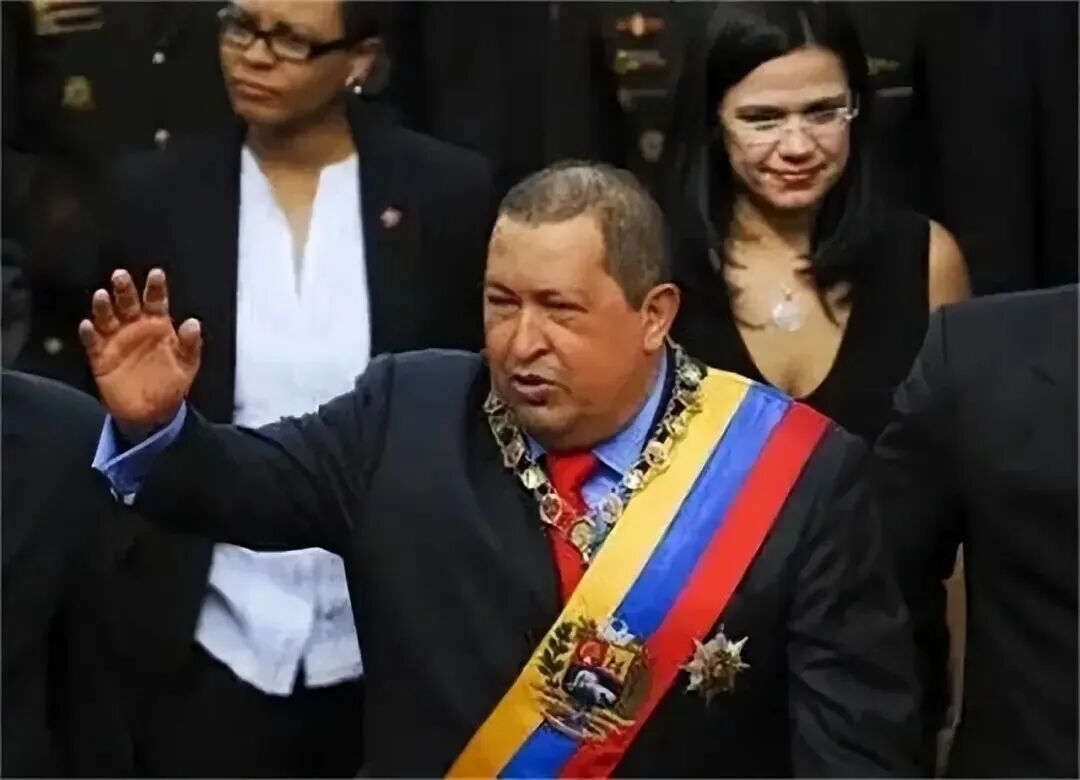
Image Captions: The Chávez revolution reversed the developmental direction of the Venezuelan state.
Between 1999, when he took office, and 2013, when he passed away at the age of only 58, international oil prices remained high, which greatly benefited Chávez and the Bolivarian Process. Upon gaining control of oil revenues, Chávez utilized them to create extraordinary social progress. First, he launched a series of large-scale social programs known as "misiones" (missions), redirecting oil revenue to satisfy basic human needs: such as grassroots healthcare (Misión Barrio Adentro), literacy and secondary education for the working class and peasants (Misión Robinson, Misión Ribas, Misión Sucre), food and food sovereignty (Misión Mercal, followed by PDVAL), and housing (Gran Misión Vivienda).
The state was reshaped into a vehicle for achieving social justice rather than a tool that excluded the working class and peasants from market gains. As these reforms progressed, the government began to build "people's power" through participatory tools such as communes (comunas). These communes originated from popular consultative assemblies known as community councils (consejos comunales) and subsequently developed into mass institutions that controlled public funds, planned local development, established communal banks, and formed local cooperative enterprises known as social production enterprises (empresas de producción social). The communes represent one of the most ambitious contributions of the Bolivarian Process. Although they could not make the income of the Venezuelan people perfectly equal, they remain a historic effort: through the communes, a system of people's power can be constructed to serve as a long-term alternative to the oligarchic model of governance.
Two events occurring between 2013 and 2014 posed a serious threat to the Bolivarian Process: the first was the untimely death of Mr. Hugo Chávez, the core driver of the revolution; the second was the decline and subsequent collapse of oil revenues. The president following Chávez was the former foreign minister and union activist Nicolás Maduro, who attempted to stabilize the situation but encountered severe challenges regarding oil prices: prices peaked in June 2014 at approximately $108 per barrel, fell sharply in 2015 to below $50, and dropped further to below $30 by January 2016. For a Venezuela dependent on the external sale of crude oil, this decline was catastrophic. The Bolivarian Process could not completely correct the redistribution model's reliance on oil revenue, both domestically and regionally through the "Petrocaribe" program; it remained dependent on oil exports and was thus subject to the inherent contradictions of being a "single-commodity exporter". Similarly, the Bolivarian Process did not strip the ruling class of its wealth, and these strata still exert a powerful influence on the economy and society, thereby hindering a comprehensive transition to the socialist cause.
By 2013, the United States, its European allies, and the oligarchic forces in Latin America had already forged the weapons for a hybrid war against Venezuela. When Chávez first won the election in December 1998 but had not yet taken office the following year, Venezuela saw an acceleration of capital flight as the oligarchic groups moved their wealth to Miami. During the coup and the oil industry shutdowns, signs of capital flight became even more apparent, destabilizing Venezuela's currency. The U.S. government began laying the diplomatic groundwork by labeling the Venezuelan government a "problem" and building an anti-Venezuela international coalition. By 2006, this led to Venezuela facing restrictions in accessing international credit markets. Rating agencies, investment banks, and multilateral institutions steadily raised borrowing costs, making refinancing difficult—all of which occurred before the United States imposed formal sanctions on Venezuela.
After the death of Chávez and the decline of oil prices, the United States began to launch a more focused hybrid war against Venezuela. Hybrid war refers to the coordinated application of economic coercion, financial strangulation, information warfare, legal manipulation, diplomatic isolation, and selective violence, aimed at destabilizing and reversing a sovereign political project without the need for a full-scale invasion. Its goal is not territorial conquest but political submission: to discipline countries that attempt redistribution, nationalization, or the pursuit of an independent foreign policy. Hybrid warfare operates by "weaponizing" daily life. Currency attacks, sanctions, manufactured shortages, media narratives, pressure from non-governmental organizations, and judicial harassment—often called lawfare—as well as artificially created crises of legitimacy, are designed to erode state capacity, exhaust popular support, and tear social cohesion apart. Subsequently, the resulting suffering is packaged as evidence of internal failure, thereby masking the institutionalized structure of external coercion.
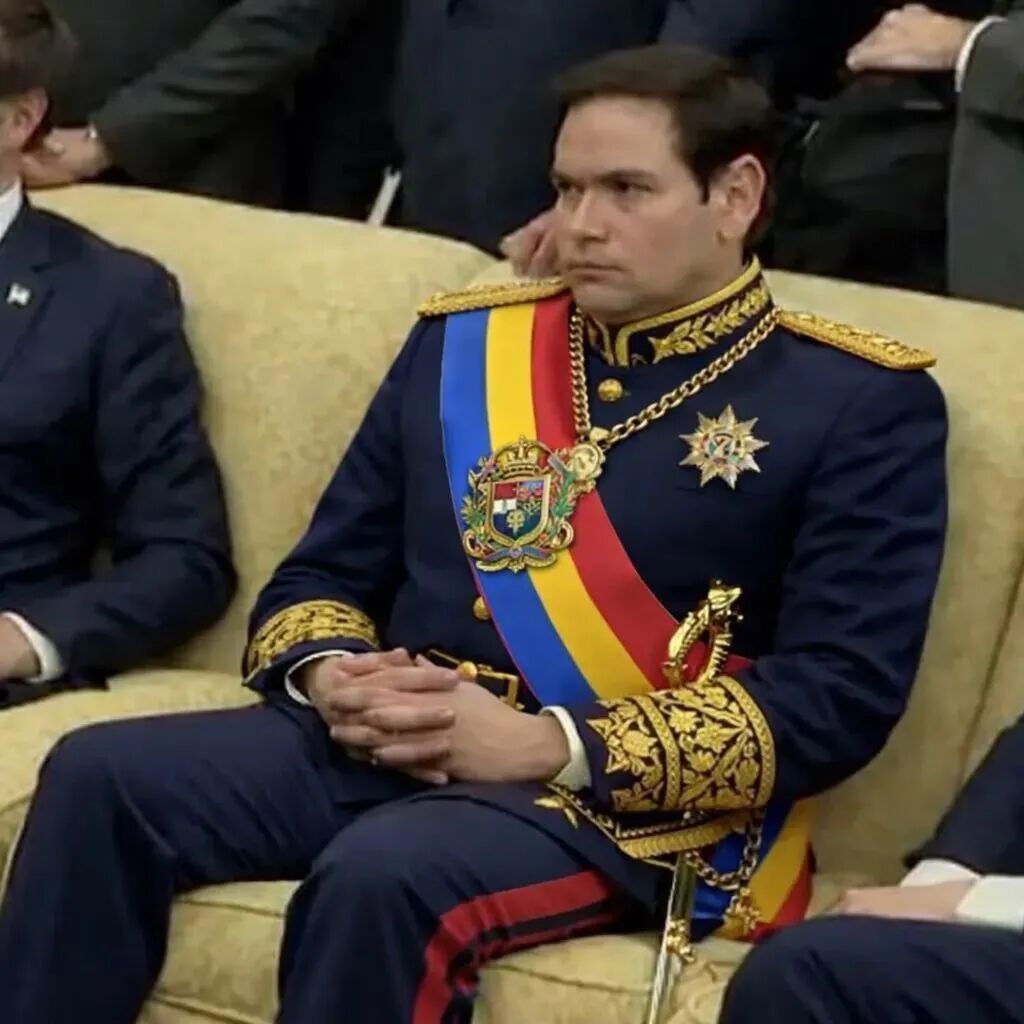
Image Captions: On January 4 local time, The Washington Post reported that U.S. Secretary of State Rubio will serve as the "Governor of Venezuela." Overseas netizens photoshopped a "Venezuelan Presidential Uniform" onto Rubio. X.
Since the United States illegally imposed financial sanctions on Venezuela in August 2017, this is precisely the situation the country has faced; secondary sanctions in 2018 further escalated the pressure, disrupting payment systems and trade channels and forcing "over-compliance" with U.S. sanction regulations. Simultaneously, Western media systematically downplay the role of sanctions in their narratives, instead magnifying inflation, shortages, and migration as purely internal phenomena to reinforce the discourse of "regime change". The collapse of living standards in Venezuela between 2014 and 2017 cannot be separated from this progressively advancing strategy of "economic suffocation".
The elements of this campaign are interlinked: mercenary attacks, sabotage of the power grid, the manufacture of conflict between Guyana and Venezuela to benefit ExxonMobil, the fabrication of a "substitute president" in Juan Guaidó, the awarding of the Nobel Peace Prize to someone who called for war against her own country (Machado), attempted assassinations of the president, the bombing of fishing boats off the Venezuelan coast, the seizure of oil tankers leaving the country, and the assembly of fleets in offshore waters. These actions aim to keep Venezuelan society in a state of constant nervous tension, thereby forcing the "Bolivarian Process" to surrender and return to the conditions of 1998, which would lead to the abolition of the Organic Hydrocarbons Law that grants the state its sovereignty. If the nation were to truly return to 1998 as María Corina Machado has promised, then all the democratic achievements of the "Misiones" programs, the communes (comunas), and the 1999 Constitution would be nullified. In fact, Machado once remarked that the United States bombing her fellow Venezuelans would be "an act of love." The slogan of those seeking to overthrow the government is "Ahead to the Past".
Meanwhile, in October 2025, Maduro addressed an audience in Caracas in English, saying: "listen to me, no war, yes peace, the people of the United States." That same evening, he warned in a radio broadcast: "oppose regime change, which reminds us of the endless and failed wars in Afghanistan, Iraq, Libya, and other places. Oppose the coup d'état orchestrated by the CIA (Central Intelligence Agency)." This phrase "no war, yes peace" was subsequently spread on social media and remixed into songs. Maduro frequently sang "no war, yes peace" to upbeat music at rallies and meetings, and on at least one occasion, he wore a hat printed with the slogan.
Shortly after 2:00 a.m. local time in Venezuela on January 3, 2026, the United States began launching attacks on multiple locations in the country, including the capital, Caracas, in violation of Article 2 of the United Nations Charter. Residents were awakened by loud noises and flashes as multiple large helicopters appeared in the sky, and videos of the scene began to appear on social media. Online public opinion was in chaos, and rumors were rampant. In less than an hour, the skies returned to calm. At 4:21 a.m., U.S. President Donald Trump stated that his forces had launched an attack on Venezuela and kidnapped President Nicolás Maduro Moros and his wife, Cilia Flores. Shortly thereafter, Venezuelan Vice President Delcy Rodríguez confirmed that Maduro and Flores were missing. U.S. Attorney General Pamela Bondi confirmed that Maduro and Flores were already in the United States and were charged with "narcoterrorism conspiracy".
The outcome of this attack against Venezuela remains unclear. Despite the kidnapping of the president, the government remains in control of the situation. Although the Venezuelan people are shocked, they are filled with the will to resist. It is currently uncertain whether the United States will launch further attacks or if the U.S. government has clear political arrangements for the post-strike situation. The attack on January 3 was not the first action taken against Venezuela; it was merely a periodic manifestation of the pressure war that began in 2001. Even after the engines of the Chinook helicopters have cooled, this war will continue.
The history of this twenty-five-year pressure campaign includes the U.S. funding anti-Bolivarian social and political groups through the NED (National Endowment for Democracy) and USAID (United States Agency for International Development) in 2001 , and its role in the failed 2002 coup. In 2002, the USAID Office of Transition Initiatives established a Venezuela program , and throughout 2003 and 2004, the U.S. provided funding and political guidance to the work of Súmate, led by María Corina Machado, in an attempt to recall Chávez through a referendum. In 2004, a "five-point strategy" was developed to "penetrate" Chávez's base, "divide" Chavismo, "isolate" Chávez, support groups like Súmate, and "protect vital U.S. business interests". In 2015, President Barack Obama signed an executive order declaring Venezuela an "extraordinary threat," providing the legal basis for subsequent sanctions. By 2017, Venezuela was banned from U.S. financial markets , and in 2018, international banks and shipping companies were forced into "over-compliance" with illegal U.S. sanctions, while the Bank of England seized the gold reserves of the Central Bank of Venezuela.
In 2019, a "provisional" government was established by "appointing" Juan Guaidó as the U.S.-authorized president and organizing a failed uprising, which also involved freezing Venezuela's ability to sell oil and seizing its overseas petroleum assets. In 2020, "Operation Gideon" attempted to kidnap Maduro—who had a bounty placed on him—while the U.S. conducted a "maximum pressure" campaign during the pandemic, including the IMF's refusal to allow Venezuela to access its own reserves. By 2025, the Nobel Peace Prize was awarded to María Corina Machado, with the Nobel Committee stating that Maduro should leave office. Between 2025 and 2026, attacks were carried out on small boats off the Venezuelan coast, a fleet was deployed to implement an embargo, and Venezuelan oil tankers were seized.
Unfortunately, whether in Iraq in 2003 or in Venezuela from 2001 to 2026, no power has been able to stop the United States once its government decides to take unilateral action. In 2003, even as millions of people, including American citizens, took to the streets to demand an end to the war and most governments worldwide issued warnings, the administrations of George W. Bush and Tony Blair persisted in launching an illegal war. This time, even after the leaders of Venezuela's neighbors, Brazil and Colombia, and major powers like China and Russia—with Chinese Special Envoy Qiu Xiaoqi having met with Maduro just hours before the U.S. attack—made it clear to the United States that launching a war in South America and the Caribbean would cause immense instability, the world still failed to stop the United States. The decision to launch the attack on January 3 was made so that Trump could claim a major victory during his State of the Union address to Congress on January 4.
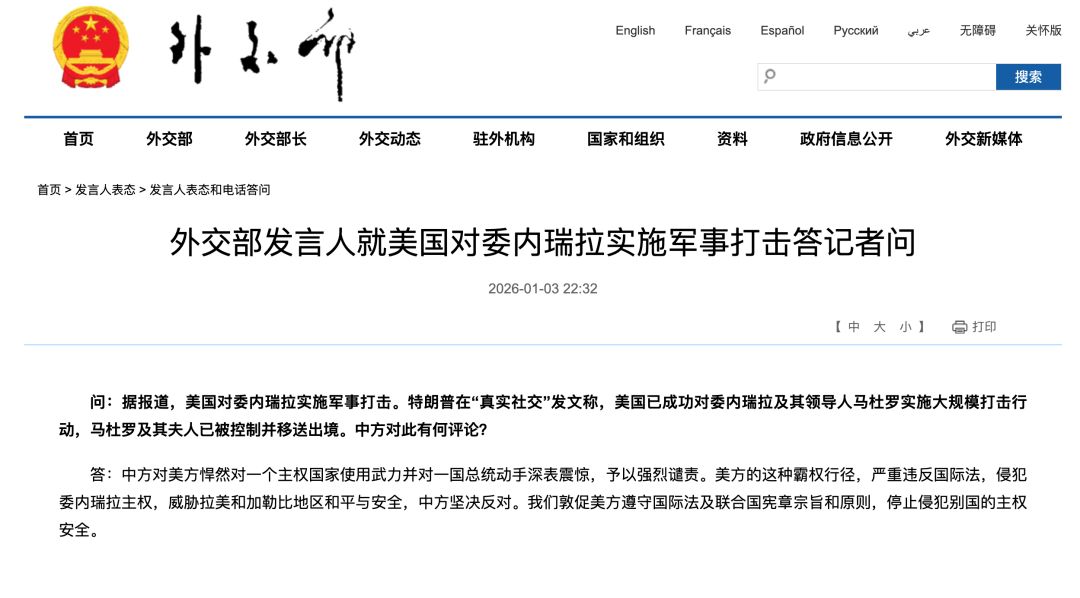
Image Captions: The spokesperson for the Chinese Ministry of Foreign Affairs expressed strong condemnation of the United States. Image source: Official website of the Ministry of Foreign Affairs.
However, this is not a victory for the United States but merely another illustration of its unilateralism. It will not improve the global situation. Looking back, the illegal U.S. war in Iraq only ended in a forced withdrawal after lasting more than a decade and resulting in the deaths of a million civilians; the same is true for Afghanistan and Libya, both of which were destroyed by the "American Hawks". If the United States continues to bomb and sends ground troops to the country, the future of Venezuela will be unthinkable. These "regime change wars" bring no benefits and have no exceptions. Brazil and Colombia are uneasy about this attack because they know the only consequence will be long-term turmoil throughout northern South America and potentially the entire Latin American region, mirroring what has already occurred in North Africa. Trump will receive a standing ovation in the U.S. Congress, and the price of that applause will be the lives of hundreds of Venezuelan civilians and the struggles of millions during twenty-five years of U.S. "hybrid warfare".
All images were obtained from publicly available sources.