How Is the "Great Communication" of the Village Super League Forged? — A Praxis Theory from the Perspective of "Party Organizational Communication"
Lu Xinyu
Abstract: Today, we must immerse ourselves in the practical sites of "Chinese Modernization" (the unique path of modernization under the leadership of the Communist Party of China) to resolve the theoretical dilemmas in journalism and communication studies. Western transmedia theories—concerning media materiality, embodiment, and mediatization—fail to explain the dynamics and subjects of innovative communication practices. Relying on the national strategy of Rural Revitalization, the Village Super League (VSL, known in Chinese as "Cun Chao") employs the Mass Line for digital economic development at the county level. It transforms grassroots residents into "New Quality Productive Forces" (forces of production driven by revolutionary technological breakthroughs and innovative allocation of factors), uses the cadre corps as the underlying architecture for billion-level traffic, and turns "fun" into "daily life." This "Great Communication" embodies the characteristics of "Party Organizational Communication"—revolving around the historical practical activities of the socialist party as a whole. It represents an innovative implementation of the "Great Publicity" (Da Xuanchuan) work philosophy. In this process, all people and objects can be transformed into media, manifesting historical subjectivity and initiative in practice. The "Great Publicity" perspective is the cornerstone of Marxist journalism and communication studies as a theory of praxis; the practical activities of the masses are the driving force of history and communication alike. This marks the watershed between Chinese and Western communication theories and is the essential path toward an autonomous knowledge system for journalism and communication with Chinese characteristics. From a communication perspective, "Party Organizational Communication" connects the great practice of the Party leading the people from revolution to construction. The "Rongjiang Story" is a "typical" (exemplary) case of Chinese modernization and a theoretical field for Socialist Development Communication.
Keywords: Party Organizational Communication, Village Super League (Cun Chao), Mass Line, "Great Publicity" Pattern
How Is the "Great Communication" of the Village Super League Forged?
— A Praxis Theory from the Perspective of "Party Organizational Communication"
This article was published in the first issue of Journalism & Communication in 2026.
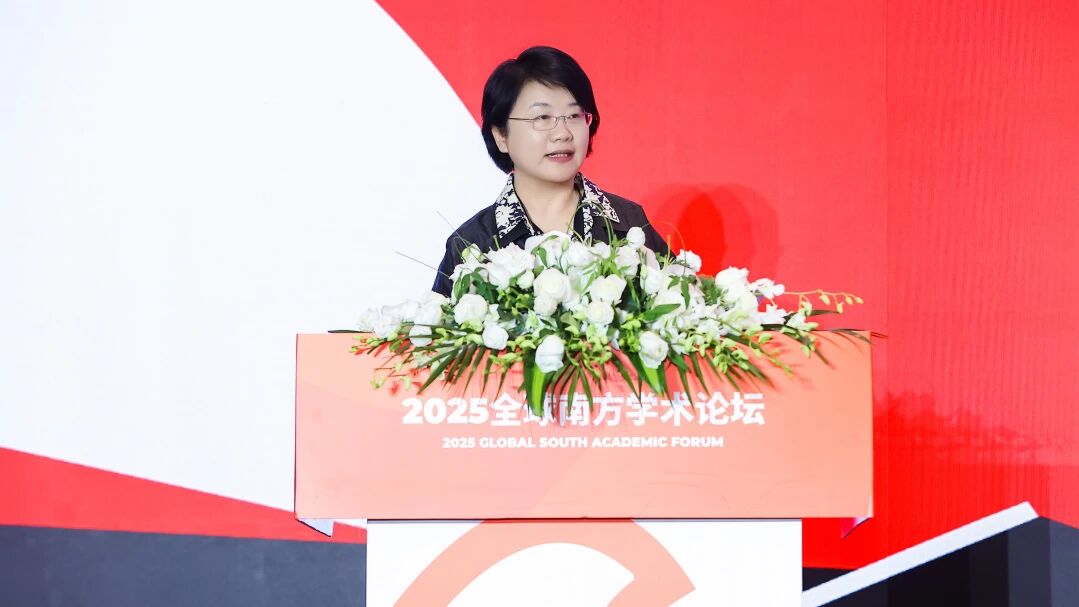
Lu Xinyu, Chair of the Global South Academic Forum
Rongjiang County, located in the Qiandongnan Miao and Dong Autonomous Prefecture of Guizhou Province, was once a revolutionary base area and a mountainous region with the widest extent and deepest degree of poverty. Among its 385,000 residents, 16 ethnic minorities account for 83.9% of the total population. It was among the last batch of counties to be removed from the poverty list in 2020. Even after escaping poverty, it remained destitute and virtually unknown. However, since the "Rongjiang (Sanbao Dong Village) Construction of Beautiful Countryside Football Super League"—abbreviated as "Cun Chao" (Village Super League)—exploded into the spotlight in May 2023, it rapidly became a magnificent phenomenon of internet-wide communication. In that year alone, it generated 70 billion views, attracted 7.6585 million tourists, and achieved a comprehensive tourism income of 8.398 billion yuan. It was praised by President Xi Jinping in his 2024 New Year Address. Today, Cun Chao has become an epic communication phenomenon with billion-level traffic.
In just three years, what exactly happened in Rongjiang? Is the Cun Chao phenomenon sustainable? Is it a new model for China's Rural Revitalization? What is its significance for changing the urban-rural and regional disparities in China? Is it a new path for the "Internal Circulation" (a strategy to rely primarily on domestic demand and supply)? What does it mean for China's journalism and communication studies? To address these questions, the author has conducted online and offline participant observations since 2024, organizing teacher-student summer practice teams, the "3rd Spring Cross-Strait Report Literature Camp," and Global South scholar research groups. We established the "Global South Society" and "Fieldwork China" workstations locally and visited Rongjiang for field investigations over ten times. This research is a process of continuous, grounded reflection.
I. Cadres Are the Decisive Factor: "Party Organizational Communication" in Poverty Alleviation and East-West Collaboration
In March 2024, Xu Bo, then magistrate of Rongjiang County, stated during a symposium: "Cun Chao is a 'Great Communication' event; communication is the engine of Cun Chao, and Cun Chao is the engine of Rural Revitalization." As my investigation deepened, I gradually recognized the profound meaning of this statement.
The "Symposium on Decisive Victory in Poverty Alleviation" held by the Central Committee in March 2020 was the largest-scale meeting on poverty alleviation since the 18th National Congress. In April 2021, a new round of the National East-West Collaboration strategic deployment was launched. The Rural Revitalization strategy moved from a blood-transfusion style "Targeted Poverty Alleviation" model toward a blood-generating Rural Revitalization mechanism. Except for Xinjiang and Tibet, the East-West collaboration method shifted from a scattered responsibility system for each province to a unified provincial assistance model to better coordinate layout and resources. During the "14th Five-Year Plan" (2021–2025) period, Guizhou continued to receive comprehensive assistance led by Guangdong Province. Under this policy, Xu Bo was dispatched from Shenzhen to Rongjiang as an exchange cadre in September 2021. After graduating with a Master's degree from the Tsinghua University School of Law in 2012, Xu Bo became a National Selection Student (Xuan-Diao-Sheng) and insisted on going to the grassroots, serving as a village Party secretary in the most basic levels of Jilin. From the rural areas of Jilin during the poverty alleviation era to the forefront of reform and opening up in Shenzhen, rich grassroots experience is the best school for a cadre. The Selection Student system, which recruits young intellectuals from universities to exercise at the grassroots frontline, as well as the paired assistance system of East-West Collaboration, should be the core concerns of Chinese political communication—I refer to these as important topics of "Party Organizational Communication" with Chinese characteristics.
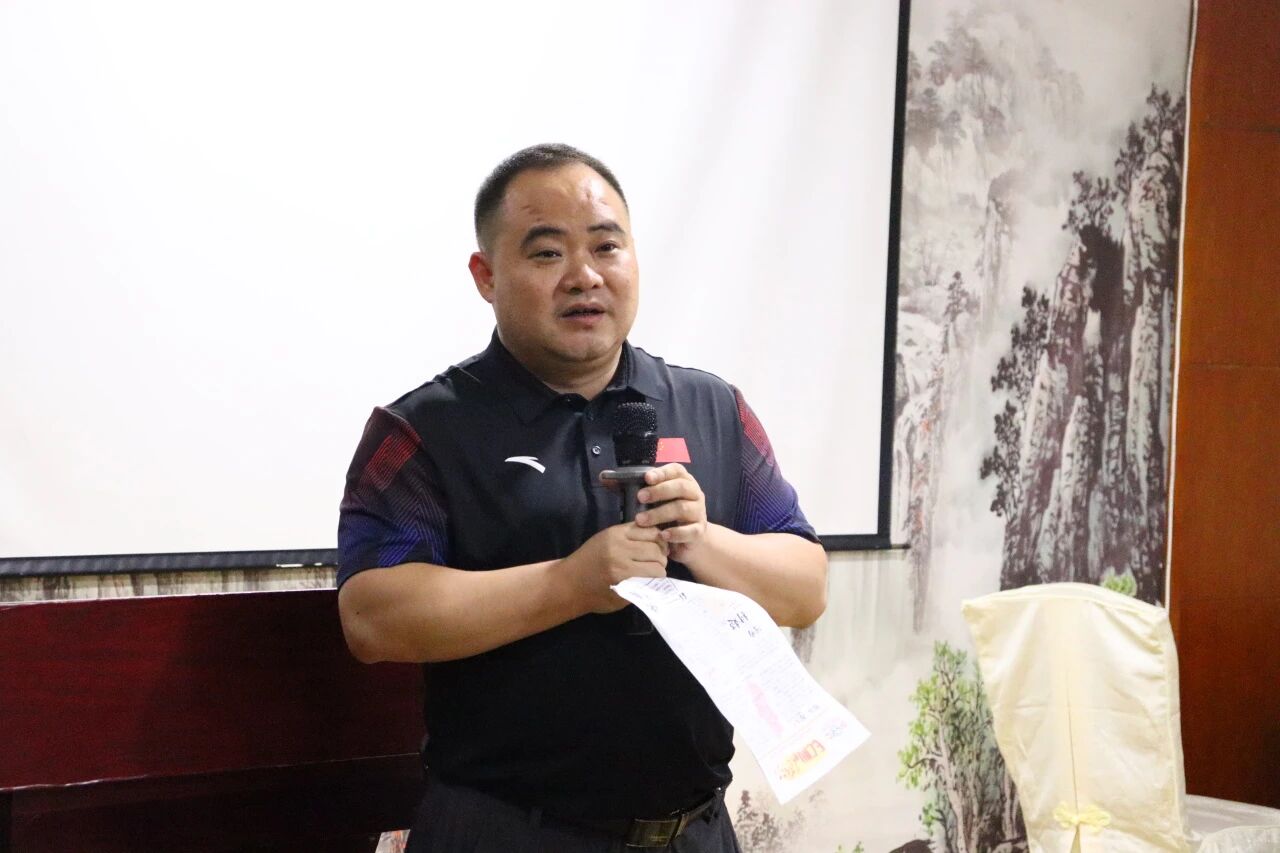
Image Captions: On June 26, 2024, Xu Bo, then magistrate of Rongjiang County, shared the story of "Cun Chao" with teachers and students from the School of Communication at East China Normal University.
Mao Zedong famously stated: "Once the political line is determined, cadres are the decisive factor." This has become the most important organizational line of the Communist Party of China. Among the county-level cadres in Rongjiang, there is a deputy magistrate on temporary assignment from the Foshan Social Security Bureau in Guangdong, responsible for assisting the implementation of Guangdong-Guizhou collaboration projects. There is also a deputy magistrate from the National Railway Administration, responsible for the specific targeted assistance of central government organs in Rongjiang. The National Railway Administration has provided targeted assistance to Rongjiang for ten years, helping complete Rongjiang's hardware infrastructure and high-speed rail construction; this is already the fifth cadre on temporary assignment.
This is not just the story of Rongjiang; the most essential feature of Socialism with Chinese Characteristics is the leadership of the Communist Party of China. From the Party's political line to its organizational line, the deployment of cadres serves as the bond and bridge between the Central Committee, developed coastal regions in the East, and paired assistance in the Central and Western regions. This is the institutional guarantee for the transition from Targeted Poverty Alleviation to Rural Revitalization and represents the cadre system of Chinese Modernization. It ensures that every county-level node can dynamically and synchronously link to the nation's overall strategic map. It illustrates the construction function of Party organizations in the new era: letting every cadre become a bond connecting the Central and local governments, the East and the West, and the city and the countryside, not only transmitting policies and resources but also planting seeds, blooming, and bearing fruit in various places. They constitute the lifeblood of Chinese politics that flows day and night—this is the key to "Party Organizational Communication" with Chinese characteristics and the key to the political system of Socialism with Chinese Characteristics. "Whether the task of poverty alleviation can be completed with high quality depends on people, specifically on the work style of the cadre corps".
East-West Collaboration means "achieving industrial complementarity, personnel interaction, technical mutual learning, conceptual communication, and mutual reference of work styles for common development". It has formed a dense and thick organizational architecture woven from documents (policies), cadres, projects, and funds, covering every corner of the Chinese land and connecting the East, West, South, and North into a network circulation system of people, materials, and information: the Internal Circulation. "Where there is a will, there is a way; even distant mountains and seas cannot limit it"—is this not the philosophy of Great Communication? In 2020, the proportion of poor villages with access to fiber optics and 4G in poverty-stricken areas exceeded 98%, and e-commerce covered all poor counties. Information construction in poor areas achieved leapfrog development, "smoothing the flow of people, logistics, knowledge, and information between poor areas and the outside world, providing strong hardware support for the development of poor areas". It is precisely these infrastructure constructions that have completely changed the communication pattern of deeply impoverished villages in Central and Western China, where "transportation relied on walking and communication relied on shouting."
Regarding Guizhou, when President Xi Jinping participated in the deliberation of the Guizhou delegation at the Second Session of the 12th National People's Congress in March 2014, he first proposed that cadres should "look at true poverty, help true poverty, and truly help poverty". On the eve of the Spring Festival in 2021, Xi Jinping visited Guizhou for inspection and research, proposing to "blaze a new path in Western development in the new era, open a new chapter in Rural Revitalization, seize new opportunities in the strategy of digital economy, and achieve new accomplishments in ecological civilization construction, striving to create a colorful future for Guizhou where the people are rich and the ecology is beautiful". In January 2022, the document "Opinions of the State Council on Supporting Guizhou to Blaze a New Path in the Great Development of the West in the New Era" was released, providing specific implementation requirements and policy guarantees. In April 2022, the People's Government of Guizhou Province issued the "Implementation Opinions of the Provincial People's Government on Supporting the 'Li-Cong-Rong' Area of Qiandongnan Prefecture to Build a 'Bridgehead' for Integration into the Guangdong-Hong Kong-Macao Greater Bay Area," positioning the three counties of Rongjiang, Congjiang, and Liping as industrial transfer demonstration zones, ecological tourism and health care zones, two-way opening pioneering zones, and common prosperity experimental zones.
As early as October 2021, Rongjiang began laying the groundwork for new media construction, forming a Leading Group for New Media E-commerce Assisting Rural Revitalization with the main leaders of the County Party Committee and County Government as co-chairs. They established a new media work task force, set up new media service centers in all towns (streets), and established new media service stations in all villages (communities), building a three-level organizational system of county, town, and village. Simultaneously, they formed the Rongjiang New Media Company, a joint-stock venture between state-owned and private enterprises, and established the Rongjiang New Media Work Command Center. This is an effective mobilization and training mechanism coordinated by the County Party Committee leadership, grassroots cadres, and social forces. On November 25, 2021, the "Rongjiang New Media Assisting Rural Revitalization Cultural and Creative Industry Park" was completed, becoming the base and headquarters for new media training. These organizational and institutional innovations were the first steps in launching Cun Chao. In June 2022, the Fourth Plenary Session of the 13th Rongjiang County Party Committee implemented the plan to "integrate into the Guangdong-Hong Kong-Macao Greater Bay Area," elevating mobile phones, data, and live streaming to the level of "New Three Rurals" (agriculture, rural areas, and farmers) and making a comprehensive deployment: "Vigorously develop the new media industry, stimulate the mindset of the whole people to participate in new media, turn mobile phones into new farming tools, data into new agricultural materials, and live streaming into new farm work, realizing that everyone is an anchor and everyone can sell goods."
Thus, the timely rise of Cun Chao was no accident but the inevitable result of actively seizing national policy dividends and opportunities. This logic of establishing and promoting the operation of governments at all levels through top-down instructions and documents requires deep understanding and interpretation. It embodies the political communication system with Chinese characteristics and serves as the basic architecture for "Party Organizational Communication."
On this basis, relying on the overall national development strategy and within the scope of the county economy, the systematic mobilization and integration of resources across the region to transform grassroots masses into "New Quality Productive Forces" to the maximum extent is an important experience of Cun Chao—it created the Mass Line for digital economic development at the county level in the new era. This first tests the wisdom, responsibility, and initiative of the cadre corps. The development of county economies in Central and Western China determines the pattern of China's Rural Revitalization and Internal Circulation. Every living story of a grassroots cadre is an indispensable key to the China Story; the question is only how to tell such a story. The cadre corps in Rongjiang is the underlying architecture for its billion-level traffic communication, a new era solution to "Party Organizational Communication," and the institutional support for the "People's Subjectivity"—where Cun Chao is created by the people, participated in by the people, and cared for by the people. These two elements together constitute the connotation and extension of the Rongjiang "Great Communication" phenomenon.
The Rongjiang "Great Communication" pattern comes from the "Four Haves": the government's proactivity, the market's effectiveness, the masses' love, and technology's capability. Among these, the government's proactivity is the first and is the condition that determines the others, or rather, the basic architecture. At the Global South Academic Forum held in Shanghai in 2024 with the theme "The Global South and World Modernization," we brought the story of Cun Chao to our friends from the Global South. The forum invited Chen Xuemin, member of the Standing Committee of the Rongjiang County Party Committee and Deputy Magistrate, to give a keynote speech titled "Football + Eyeballs + Globe—Finding the 'Guizhou Cun Chao' Brand Path for Rural Revitalization from the Fun of Rural Sports." Chen Xuemin is a cadre on temporary assignment from the National Railway Administration. He said Cun Chao involves mobilizing the whole people to blaze a new path and promote high-quality development in Rongjiang, and the first step in mobilizing the masses is to make them trust the government. The problem of the masses being "mobilized" but not moving, and the lack of endogenous power for development, is common in Rural Revitalization and is the first issue to be solved. How did Rongjiang do it?
For a poor county deep in the mountains to develop "New Quality Productive Forces" and achieve "overtaking on a curve" (surpassing competitors by taking advantage of a turning point), it is impossible to use money to buy traffic or create hot spots. But what is behind traffic? It is people; it is created by people. If each of the 385,000 Rongjiang people gives one "like," that is 385,000 likes. This is the simplest traffic logic of "Cun Chao"—it is the Mass Line.
Cun Chao has a "Four-Reliances" methodology for the "Online and Offline Mass Line": development relies on the masses, the masses rely on mobilization, mobilization relies on activities, and activities rely on driving force—the core is to drive the participation and benefit of the whole people. Ultimately, there must first be the drive of an engine to create practical activities that conform to the interests of the people so that the masses can act according to the situation. The kinetic and potential energy of the engine determines the breadth and depth of the Mass Line. it echoes the classic quote on historical materialism by Marx and Engels in The Holy Family (1844): "Historical activity is the activity of the masses; with the deepening of historical activity, the mass of the people whose activity it is will surely increase." "Ideas cannot carry out anything at all. In order to carry out ideas men are needed who can exert practical force". History is driven by the practical activities of the masses and determined by the correct political and organizational lines.
The Mass Line includes three levels: everything for the masses, everything relying on the masses, and from the masses, to the masses. It embodies the thoughts and methods of organizing the masses; without the process of organization, the masses are but a mob. Western news theories are based on this—that mass communication is communication directed at an atomized "mob," with the market as its survival model. In contrast, "Party Organizational Communication" is a practical activity of organizing the masses to achieve self-liberation; it is about boldly mobilizing the masses, strengthening the people's power, and continuously solving problems in the process of discovering them. It is a dynamic process of reform and development conducted by a socialist party oriented toward goals, problems, and results. Therefore, it necessarily manifests as communication as action-movement, organized and promoted by a Marxist-Leninist party, and is a political institutional mechanism completely different from those under capitalist conditions. This is the essence of the Marxist View of Journalism (Ma-Xin-Guan) and the fundamental difference from Western news views.
Any organization needs to be driven by a perspective of righteousness and benefit. "For the masses" embodies the political principles of socialist party organizations and the value of "People First." "Relying on the masses" is the organizational principle and the lifeblood of the Party. "From the masses, to the masses" is the methodology. Cun Chao is the most vivid and lively great practice of the Mass Line in the new era. This is also why, after we invited grassroots cadres and residents of Cun Chao to share their struggle stories, a guest from Okinawa, Japan, expressed deep feelings about the "Guizhou Cun Chao" story, sensing the difference between socialist and capitalist systems, especially since Ryukyu and Miyako Island have always been the poorest areas in Japan but have failed to receive care.
"Turning mobile phones into new farming tools, live streaming into new farm work, and data into new agricultural materials" reflects precisely the transformation of New Quality Productive Forces and relations of production. New Quality Productive Forces are essentially characterized by the leap-forward improvement of laborers, labor materials, labor objects, and their optimal combinations. "Turning" means first creating the conditions for change, or creating conditions where none exist, empowering productive forces with new technology through the transformation of relations of production. "Changing" is not magic; it is something done realistically by cadres and masses together. It is through the transformation of the relations of production between laborers and tools that "New Quality Productive Forces" are created, determining the heat and height of the Cun Chao "Great Communication."
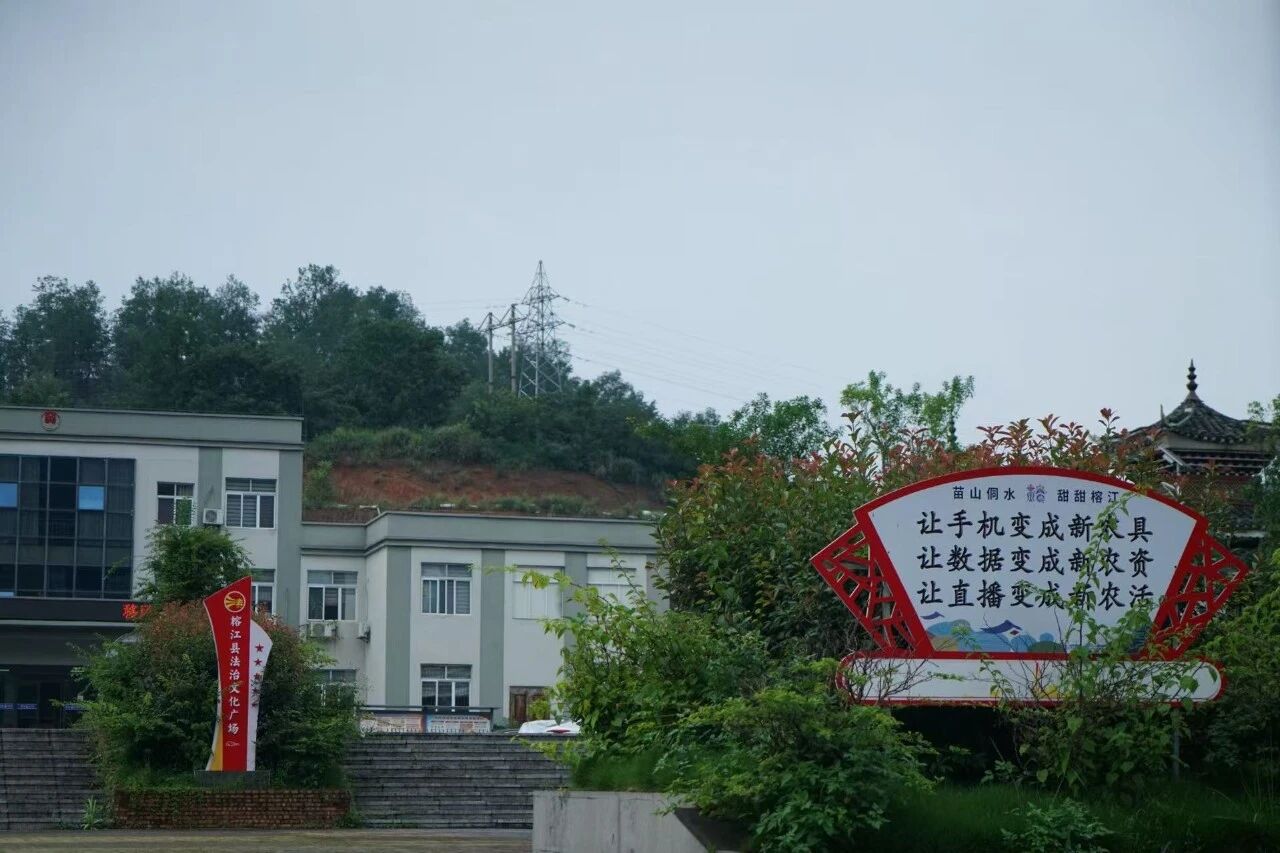
Image Captions: Slogans in the Rongjiang New Media Industry Park.
Online popularity is determined by the intensity of human labor in reality; online and offline are different facets of the same labor process. Cun Chao flips the critical perspective of "alienation" of digital labor in Western political economy of communication. It eloquently demonstrates how, in the era of the digital economy, socialism creates the broadest New Quality Productive Forces with significance for liberation and construction through the transformation of relations of production. This should also be the new cornerstone of the political economy of communication in China today: centered on Socialist Development Communication. In the journey of Chinese Modernization, how to let the transformation of relations of production become the driving force for the development of Socialism with Chinese Characteristics is the first theoretical and practical problem to be solved. The Mass Line is precisely the methodology for promoting the development of New Quality Productive Forces in the digital economy era through the transformation of relations of production. The "New Three Rurals" brings the relations of production of the digital economy era to the forefront of the times; this is also the essential path for the system of Socialism with Chinese Characteristics.
The Communist Party of China leads social revolution through self-revolution, and continuously reforming and improving the political guarantee and institutional support that oversees the whole situation and coordinates all parties is the cornerstone of "Party Organizational Communication." And how to let the research of such institutional mechanisms of "Party Organizational Communication" become the cornerstone of Chinese Socialist Development Communication (China's political economy of communication)? This is a major subject that must be faced today. In this sense, "Party Organizational Communication" is an organic part of the Chinese political system—it connects the great practice of the Party leading the people from revolution to construction from a communication perspective, linking the state and society. The "Rongjiang Story" is a "typical" case of "Party Organizational Communication" in the process of Chinese Modernization.
II. Communication Is Productive Force: When New Technology Empowers the Mass Line
On June 24 and 28, 2025, Rongjiang encountered successive catastrophic floods that swept through two-thirds of the main urban area, including the Cun Chao football field. This was the first severe life-and-death test for Cun Chao in three years. Scenes of cadres and masses fighting hard day and night were captured by Rongjiang people and posted on social media. Because it is the birthplace of billion-level communication traffic, flood fighting, post-disaster silt removal, and reconstruction were also major events for whole-people live streaming. Everyone was live-streaming the stories happening in Rongjiang, and the relationship between cadres and the masses was naturally focused upon—a positive, all-around social supervision. As a result, many self-media and mainstream media at all levels live-streamed a new Rongjiang reborn in the flood in a multi-vocal way, creating new and massive traffic.
I tracked every step of the situation in a Cun Chao WeChat work group of about two hundred people. Cadres, masses, and volunteers at all levels in the group coordinated efficiently to handle various emergencies, connecting with the tidal wave of aid resources and rescuers from all over the country, and continuously and timely adjusting to and absorbing enthusiastic opinions and suggestions. Such WeChat work groups, where county-level cadres go directly to the grassroots, have become a vital force of the Mass Line.
Precisely because of the deep social cultivation of Cun Chao, a fully mobilized social mechanism became the most powerful weapon for overcoming disaster. The Disaster Relief Canteen in Chengzhong Town "emerged from the circle" in this flood report. The scene of a village cadre shouting through a loudspeaker in the village: "Bring your kitchen knives and come to the village committee to work!" became a trending topic and was spread across the internet. Every day, hundreds of people helped in the Chengzhong Disaster Relief Canteen, building a strong "life supply line." Netizens from all over the country who were watching sent various cooking materials here through various means; drones airdropped box lunches to villages surrounded by water. From 2,800 meals a day to over 5,000, then to over 10,000, and reaching a staggering 22,000 meals a day at its peak, the total reached approximately 470,000 box lunches. On June 29, the short video "24 Hours in Chengzhong Town" on the Douyin platform recorded the entire process of the canteen preparing meals from the early morning until 11 p.m., preparing ingredients for the next day and delivering supplies to personnel who were clearing silt and obstacles through the night. It gained 660,000 likes on Douyin, 100,000+ views on WeChat, and 869,000 views on Bilibili.
Alimujiang, a Uyghur disaster relief volunteer from Xinjiang, bought more than ten cattle, slaughtered them, and sent them here. He was invited by the Cun Chao organizing committee to be the football envoy for the Xinjiang region in the national tournament. When Cun Chao "restarted with gratitude" on July 26, he brought 56 pomegranates back to Rongjiang—this was a suggestion gathered from the internet. As a gathering place for ethnic minorities, the striking banner on the Cun Chao football field "All ethnic groups cling together like pomegranate seeds" is a vivid social practice in reality; Cun Chao has become a grand stage for ethnic integration. In 2024, Rongjiang was awarded the title of "National Model Collective for Ethnic Unity and Progress" by the CPC Central Committee and the State Council, commending the Cun Chao tournament for actively and effectively promoting the path of inter-embedded development of all ethnic groups in space, culture, economy, society, and psychology—this is also a paradigm of Party Organizational Communication. The System of Regional Ethnic Autonomy is one of the foundations of Chinese political communication, and the operation of commendation systems at all levels is also a subject for Party Organizational Communication.
Rongjiang is the birthplace of the Dong and Miao people. The Rongjiang Miao have 15 branches, and the Dong have 7 branches. The Grand Song of the Dong People is a world intangible cultural heritage, and the area is known as a cultural thousand-islands and the "Home of a Hundred Festivals." Rongjiang's new media training is about turning various festival events into new media competitions, training troops through competition, which has been highly effective—thus completing the grand spectacle of whole-people communication where everyone is a communicator, everyone is a publicist, and every village has a spokesperson. Ethnic development in the process of modernization is a worldwide problem—in the process of Chinese Modernization, how ethnic integration can achieve "harmony in diversity and shared beauty" is demonstrated by Cun Chao as a microcosm with international communication value.
At the restart ceremony of Cun Chao on July 26, 2025, all disaster relief contributors were invited to attend. All donation accounts, large and small, were made public after the disaster—this was precisely the plan heatedly discussed in the Cun Chao WeChat work group during the most intense period of disaster relief. It innovated the model of Chinese public welfare, won social trust, and created and harvested new traffic hotspots. Doing the right thing to create positive traffic and form positive energy—this is the traffic code of Cun Chao and also the "communication mindset" of Cun Chao—it has become the cultural gene of Rongjiang today.
When seeing off rescue teams from all over the country, the ethnic minority masses stayed up all night to boil red eggs, make silk threads, and embroider insoles according to the highest ethnic customs, hanging colorful insoles and pendants with red eggs on the chests of the rescuers. At the farewell scene, national flags fluttered, laughter and tears flew, singing and gratitude intertwined, and watermelons and various delicacies were stuffed into the departing vehicles amidst refusals and acceptances. The scene of members of the County Party Committee standing with the people, shedding tears in the long street, was live-streamed and enthusiastically forwarded on social media. These scenes hit the trending lists of short video platforms, forming a continuously fissioning communication effect. Interestingly, in the crowds on both sides of the farewell, the common point was the forest of raised mobile phones; recording and communication have become the way of life in Rongjiang.
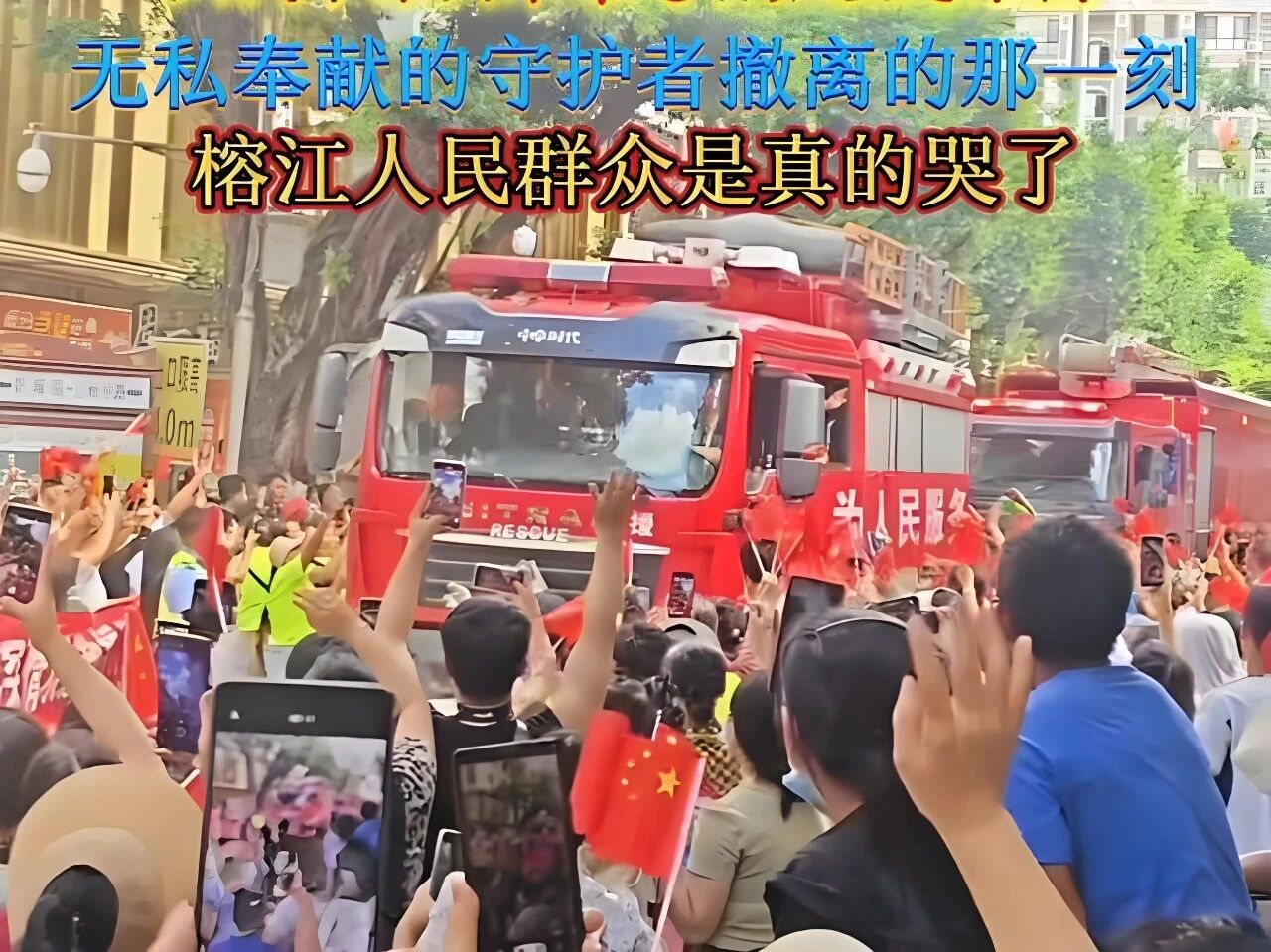
Image Captions: Rongjiang people seeing off the People's Liberation Army.
Such a scene, if placed in a global context, could only happen in China; if viewed from the history of the birth of New China, this "fish-and-water" relationship between the military and the people is precisely the political gene of Socialism with Chinese Characteristics in the 21st century.
Since May 2023, Cun Chao has created 20 billion yuan in comprehensive tourism income for Rongjiang County. This small city of less than 400,000 people has received more than 17 million tourists in total, which is epic in any sense. The tens of millions of tourist visits are the result of the continuous fission and radiation of communication as a productive force. Cun Chao thus continuously absorbs new heat and transforms it into even greater energy to be released—this sea-like process of inhalation and exhalation is the life code of Cun Chao. And the Cun Chao football site, covering about 8,000 square meters between the old and new urban areas of Rongjiang, has created a communication world where mountains and rivers connect, and the virtual and real merge.
The key to the success of the Village Super League (Cun Chao) lies in whether it can consistently remain an attractive field of "positive energy." Rongjiang’s summary is: "Turn positive energy into massive traffic, transform the small and beautiful into the true, the good, and the beautiful, turn old pastimes into new paths, and convert data traffic into the power of civilization". It is precisely in this sense that it must first be "positive energy". What is positive energy? It is an action-practice process driven by values that embody the interests of the people; its values must be powerful enough to move China and the world. The philosophy of the Village Super League is that if you do the right thing, the right people will come. The story of the Village Super League is a "growth record" of positive energy. "Being moved" is the psychological journey of almost everyone who comes to Rongjiang, and it is also the process of emotional identification with the Village Super League. Like a melting furnace, it continuously produces "New Rongjiang People" who throw themselves into this passionate energy field.
"Mount Tai does not reject soil, rivers do not reject fine streams, and the flames rise high when everyone adds firewood"—this is the secret to the Village Super League's "Big Communication" and the source of Rongjiang's confidence in restarting the national tournament just one month after being hit by two major floods. The "Chinese-style unity" and struggle of "one city, one group of people, one heart" is the greatest effect of the mass mobilization mechanism in the new era. Such a Big Communication "energy field" is inevitably a strong magnetic field of value and emotion. During the post-disaster reconstruction process, hundreds of people spontaneously went to the Village Super League site every day to clear silt by hand. On July 1, when the lights of the Village Super League stadium were turned on again, everyone present shed tears. The Village Super League is "everyone's child". This emotional connection and convergence determine that its nature is diametrically opposed to the market traffic economy that harvests social pain points and "reaps leeks". As a billion-level mass movement of recording and communication, it has changed the network dynamic structure where data flows from economically developed cities to peripheral rural areas, and it should become the "living water" for the independent knowledge production of Chinese journalism and communication studies.
At the Global South Academic Forum (2024), Ning Qingchen, president of the Rongjiang County Internet Professionals Federation, gave a vivid explanation, stating that "communication is productivity". This is both his personal experience and the consensus of everyone in Rongjiang. As New Rongjiang People rooted in the county and former members of the county’s new media task force, they built a three-level new media training system covering the county, townships, and villages within a year. At the beginning of the training, grassroots cadres did not understand, asking if making short videos was "neglecting their proper duties". The elderly in the villages also did not understand; their children had repeatedly warned them that scammers target the elderly on mobile phones, and the WeChat group for the training class was even renamed the "Scammer Group".
To overcome these difficulties, the county and township cadres in the task force worked alongside social training forces, each performing their own duties. The county and township cadres established trust and institutional support, while social forces ensured training effectiveness—breaking through the limitations of grassroots personnel quotas. They innovated the "Rong-Easy Six Steps" (Rong-Easy shooting, Rong-Easy clipping, Rong-Easy editing, Rong-Easy broadcasting, Rong-Easy selling, and Rong-Easy creating) as a concise "literacy" tutorial for new media. They fought battle by battle, going from village to village and into the fields to complete training tasks such as the "Village Spokesperson," "Thousand-People Action," "Ten-Thousand-People Plan," and "Wealth-Leading Pioneers". They achieved new media literacy training for tens of thousands of farmers and grassroots cadres, most of whom were left-behind elderly, relocated residents, and women, incubating more than 23,000 rural anchor accounts. Unlike the market logic of urban mega-influencers, these small and medium-sized rural self-media accounts are rooted in the local soil of Rongjiang and are organically integrated with local economic development. Rongjiang’s mixed-ownership professional new media company established a "middle platform" to recruit ten thousand anchors, helping farmers solve problems such as commodity certification, listing, and subsequent delivery and after-sales service, providing talent output and industrial support. The development of new media in Rongjiang is a combination of short-term and long-term goals and a process of new media empowerment—not just technical empowerment, but also political empowerment. From the perspective of Big Communication, it is the construction of a wave-like dynamic communication network that continuously diffuses from the inside out.
This is the second meaning of "Party organizational communication": the mass line. Only in this way can the tentacles of the Party organization be extended to every corner of society, forging a new type of people’s subjectivity, allowing villagers in remote western mountainous areas to transform into new quality productive forces and release powerful communication power, and creating the county-level public brand of the Village Super League. The Village Super League brand has already obtained 133 trademark registrations from the Trademark Office of the China National Intellectual Property Administration (CNIPA). Fifty-one percent of these brand earnings will be returned to and strengthen the collective economy of the 250 villages in the county, which is also an innovative path for the development of the rural collective economy; forty-nine percent will be used to support the development of the Village Super League’s rural sports public welfare undertakings, which is a concrete and vivid embodiment of the "all-people shareholding" of the Village Super League.
The focus of Rongjiang’s work in 2025 is to direct traffic back to the villages, turning traffic into tangible benefits for rural revitalization and making the Village Super League a powerful engine for rural revitalization; this is known as "Village Super League, Village Cadres". For a county economy that has just escaped poverty, the village collective economy is bound to be generally weak. Therefore, first creating effective county-level public resources, then feeding back and forcing the village collective economy to develop sustainably through culture and tourism, as well as the improvement of grassroots governance—whether this path can be successful is the key to the lasting development of the Village Super League. It transcends the specific resources and particularity relied upon by single-village experiments and blazes a new trail for the development of village collective economies across the entire county, serving as an important experience for the development of China’s rural collective economy.
This is why the Village Super League must be surnamed "Village". The goal is to activate the enthusiasm of every village. Since the inception of the Village Super League, the income of village collective economies in Rongjiang County has increased 1.5 times. By organizing women's cheerleading squads and various types of cooperatives and other industrial mutual aid groups that the masses love, the fragmented "sand-like" model of atomic small-scale farming has been changed. It has also changed the narrow concept of the village collective economy; the village collective economy now presents an open and diverse flourishing ecosystem, activating idle village collective assets. Whether for business or agriculture, it is not limited to the interior of the village collective economy but bridges the relationship between the village collective economy and market entities—a new form of "combining unified and separate operations". It gives full play to the organizational and cohesive power of village cadres and women's cheerleading squads, innovates the rural grassroots social organization model under the guidance of Party building, and radiates strong endogenous power. Under this model, more than 8,600 new market entities have been added in the county during the three years of the Village Super League's popularity, and more than 130 of the 250 villages have actively taken action, establishing football teams and cheerleading squads named after their villages. These market entities then give back to the village collective economy in different ways—a development model where "the river is full when the small streams rise". In 2024, the growth rate of resident savings and market entity loans in Rongjiang County ranked first in the entire prefecture, reflecting social vitality and confidence.
The 158,000 rural women in Rongjiang achieved grassroots social change and role reinvention by organizing themselves. In the Village Super League stadium, they are enthusiastic cheerleaders and volunteers; back in their own villages, they transform into self-media e-commerce anchors and mutual aid organizations for the development of the cultural tourism industry. The cheerleading squads are both the medium for grafting Village Super League traffic into the villages and service-oriented mutual aid organizations. At the same time, they are "dual-purpose" teams: in normal times, everyone works together to plan, rehearse, and promote programs, develop industries, and receive traffic; when floods come, they can immediately transform into various logistics teams, lunch box teams, desilting teams, volunteer teams, and donation teams. There are already more than a thousand such cheerleading squads. This is the most vivid experience of "Big Communication" as a "people's war" in the new era. The endogenous power of the village collective economy and villager self-organization is the potential for the future development of the Village Super League; it answers the question of whether the Village Super League is sustainable and is the most core part of the "Rongjiang experience".
Whether the "village" can be reactivated as the basic social form of rural China is the key to whether young people can return to and build their hometowns, the key to the village regaining endogenous motivation, and the foundation of the new collective economy. Only when the villages are "alive" can the various football teams of the Village Super League truly take root in the villages, obtaining lasting nourishment from the village collective economy while also importing external resources into the village—allowing the teams to truly become a medium connecting the village to the outside world, linking the minority villages hidden deep in the mountains with the rest of the world. Villages are the foundation of all ethnic groups in traditional China; preserving villages is not just about preserving nostalgia but is also a new civilizational form explored by "Chinese-style modernization" for urban-rural integration—the reproduction of a new social structure. In this regard, Rongjiang's experience in developing the county-level collective economy is particularly worthy of continuous tracking and attention.
Today, Rongjiang is actively planning and cultivating AI (Artificial Intelligence) to empower the Village Super League and rural revitalization, aiming to become a national benchmark county for AI application. This is the lifeline that will determine the next stage of the Village Super League’s development. The revolution of tools as a change in production relations is the key to Rongjiang’s creation of miracles. People are the decisive factor of productive forces, and they determine the communicative meaning of socialist democratic practice on this "hot land" of Rongjiang. A new round of practice to popularize AI education and application has begun in the countryside, using competitions to promote application, evaluations to promote innovation, and bridging grassroots governance and development—the logic remains consistent. It is in this sense that it represents an opportunity to break through the predicament of the journalism and communication discipline.
III. Everyday Life and the "New Person": Turning "Fun" into "Life"
At 7:00 PM on December 31, 2023, President Xi Jinping delivered his 2024 New Year Message. When he said: "The 'Village Super League' and 'Village Gala' are full of vitality; the warm breath of life and the busy pace of recovery illustrate people's pursuit of a better and happy life, and also show a vibrant and steaming China"—at that moment, the crowd watching the live broadcast on the big screen at the Village Super League site erupted in cheers, and some shed tears. Luo Yu, a reporter from the Guizhou Branch of Xinhua News Agency who had been writing reports on the Village Super League for a long time, compiled his reports into a book titled Village Super League's Fun, Path, and Life, describing this scene at the beginning. The title comes from Rongjiang's summary of experience: exploring paths through fun and enriching life. What do such "fun economies" and "warm development" mean?
The people's longing for a better life is the goal of the Communist Party of China (CPC), and it needs to be reflected in a good life: "Our goal is very grand and very simple; in the final analysis, it is to let the common people live a better life". Socialism must be implemented in everyday life. The mass line guided by "fun" is precisely the engine that reshapes the everyday life of the common people. Xu Bo said that the Village Super League embodies a people-centered methodology: "the people as the subject, the people as the creators, the people as the promoters, and the people as the receivers". It first carries out a "Trilogy of Thought" discussion on ideological liberation among the masses: What can I do for the Village Super League? How can I protect the Village Super League? What can I do to create the atmosphere of the Village Super League? Dozens of brainstorming sessions unified thoughts and activated grassroots democratic practices, mobilizing and connecting people from all walks of life—villagers, small vendors, cleaners, taxi drivers—with the Village Super League. It allowed them to become participants, creators, proud owners, and honored members of the Village Super League brand, making the Village Super League their daily life.
The people as political subjects must be forged through grassroots democracy. The methodology of "from the masses, to the masses" must be specifically embodied in the institutional arrangement of grassroots democracy to truly let go and mobilize the masses. Rongjiang has a whole set of institutional innovations in grassroots democracy, with tens of thousands of local "Village Super League Recommendation Officers" and various vivid methods such as "brainstorming sessions," "Rong-Easy Talks," "bench meetings," and "gong-beating and shouting in the villages". These methods have effectively mobilized the enthusiasm and initiative of the masses at all levels; they eagerly raise questions, ideas, opinions, and suggestions, which receive the most timely responses. When their suggestions are quickly adopted, they happily say, "Are we participating in the deliberation and administration of state affairs?"
The "Trilogy" of the Village Super League is to mobilize the people of Rongjiang to play by themselves, then attract people from all over the country to play together, and finally lead people from all over the world to play together. The first wave of national Village Super League invitationals was a gourmet-themed gourmet football friendly match, turning food into a new engine for local development. As the saying goes, "hunger breeds discontent; food is the first necessity of the people," and food is precisely the "flavor" of life. Turning matches into festivals and happiness into life makes every day flavorful, meaningful, and valuable. In this sense, the Village Super League hopes to become an innovative and open communication platform—a platform that can continuously iterate and innovate the "lifestyle" and "everyday life" ecosystem.
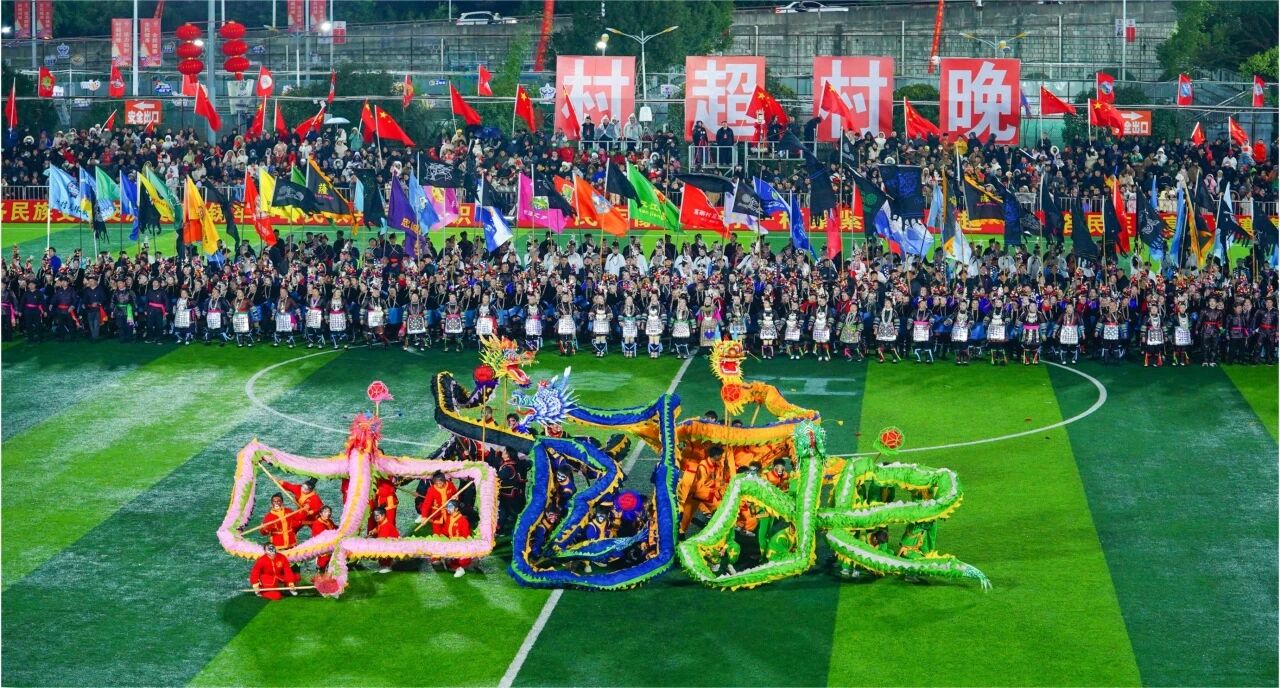
Image Captions: Scene of the Village Super League and Village Gala.
The contest for and transformation of everyday life is the foundation of the rise of social media. What mainstream media has lost is precisely this battlefield, and it is also a "major lesson" that needs to be made up for in today's "systemic change". In this sense, the communication strategy of the Village Super League can serve as a reference. It is a "happy economy" that enriches both the mind and the pocket, rather than the capitalist logic of "amusing ourselves to death". It is a mass culture and popular literature and art of the new era where the masses are the real protagonists, rather than a popular culture where traffic and algorithms are supreme—the political economy and cultural logic behind the Village Super League is none other than "whole-process democracy," which is the most noteworthy innovation logic of new media.
The first step is to use the mass line to create a "traffic pool," turning the masses into communicators through "professional guidance and universal participation," a matrix of ten thousand people where everyone is a walking media outlet. As one of the operators of the Village Super League's communication planning, Wang Yongjie, starting from his experience in the county-level integrated media center, believes that viewing communication as appearing on People's Daily or CCTV news a few times a year is far from enough. Instead, it is necessary to establish one's own communication matrix and build one's own "traffic pool" to have a source of living water. Planning is the way to drive the development of events; it is a communication tactic that takes shape according to the circumstances, and strategy needs to be realized through tactics. Therefore, the initial breakthrough of the Village Super League was: "establishing self-media accounts in a self-media way, building our own traffic pool, which brought us great convenience in terms of creative space, public opinion space, and trial-and-error space".
In this sense, the reason why the positioning of grassroots local integrated media as "government media" is an unavoidable pain point is precisely because it hinders the functions of mobilizing and organizing the masses. Therefore, it is necessary to switch roles and put oneself in the position of the masses—the blockage of this "last mile" remains a pain point in the systemic change of mainstream media. Relying solely on the "mass line" online—joining various social media platforms—cannot replace the mass line as a real-life action-practice behavior.
It is only after the Village Super League formed an "event" through its own "traffic pool" that mainstream media could add their support, creating a continuous "breaking out of the circle" effect. The prerequisite for connecting the self-built traffic pool with the official mainstream media channels is to have "real stuff," and content must be greater than the platform—the Village Super League itself, as a movement-practice, is the foundation of communication and is primary. Such planning will not blow away with the wind and can take root among the masses. The experience of the Village Super League lies in: self-media first, building one's own traffic pool; multi-media integration, broadening the traffic pool; and mainstream media joining in, raising the height of the traffic pool. Thus, the success of the Village Super League's communication is the result of the efforts of many media outlets.
On October 1, 2025, the 76th National Day of the People's Republic of China, the Ministry of Foreign Affairs released a special short video titled The Right Path ("He who follows the right path can reach anywhere"). In the video, images comparing the disaster-stricken areas of Rongjiang seven hours after the major flood were included in the national narrative—this is the position Rongjiang has won for itself in the People's Republic.
During the severe period of the mid-1950s when the Cold War had just descended, the French Marxist scholar Henri Lefebvre published his important long-term study Critique of Everyday Life, warning against the "alienation" of everyday life under capitalist development and raising the issue of Marxism and everyday life to a historical height. His question was: how can socialism intervene in everyday life? "We can only define socialism (this new society, this new life) concretely at the level of everyday life as a system that makes various changes in so-called lived experience". Therefore, capitalism and socialism inevitably manifest as a struggle for everyday life. What should everyday life be like under socialist conditions? What is the relationship between the socialist "new person" and everyday life?
As a Marxist, Lefebvre saw "action" as the essence of everyday life. Large scenes on the historical stage are more like theatrical "performances," and there are profound connections between theater, action, and life. Historical scenes are actions, and actions must be understood according to their purposes and results; everyday life should be understood with a moving, active, and goal-oriented consciousness. Therefore, "performance" continues reality, equals reality, and explores new possibilities. Performance is not dishonest; on the contrary, performance adds to reality: the understanding of the situation, the action, and the goal result. Therefore, everyday life is similar to drama: "replaying, concentrating, and 'representing' the life of the real audience". Profound historical research must consider history as a whole: "the audience, the situation, the setting of the giant impromptu comedy," and "consciously link history and human knowledge with the life of the past and present—everyday life".
It is astonishing that these arguments from nearly a century ago perfectly explain the significance of the Village Super League as a never-ending expo, a grand show, and a football field. It is not a cultural carnival of codes, nor a political economy of codes, but everyday life built on the "economic foundation" of changes in production relations, and the "people-ness" that carries and "performs" national culture every day, which gives the "everyday life" of the Village Super League true, material, and historical meaning.
In this sense, everyday life and the ordinary world are the end of history:
It is in everyday life, and through everyday life, that humanization is realized. Every inspiration, genius, or heroic act must serve—even if not subjectively, then objectively—the ordinary person. If there are other claims for these moments, then those claims must fall into the realm of "alienation," where humans are separated from the world they created. Great things have always been done in the name of "alienation," but they have never succeeded or have been abandoned; however, unexpectedly, ordinary people and the ordinary world benefit from them. Idealism uses this fact to prove the inevitable failure of all "greatness"; on the contrary, because of this fact, we must see true greatness, the formation of the greatness of human life.
The author is willing to see Lefebvre's critique of everyday life as a historical call for the socialist mass line, and a cross-century Marxist dialogue with Rongjiang’s social practice of turning "fun" into "life"—cracking and looking forward to the puzzles of socialism and everyday life in different historical contexts. Doesn't the communist vision of "hunting in the morning, fishing in the afternoon, rearing cattle in the evening, and engaging in criticism after dinner" describe labor and everyday life?
In this sense, the birth of the socialist "new person" envisioned by Lefebvre is a "real" process of transformation:
Where only "positive models" are shown, there is a need for the images of real people—diverse, individual, containing conflicts and contradictions, and models of different types of real people. The influence of such images of real people has even had a formal statement; certain negative types of images of real people are not without meaning. New and old conflicts, positive and negative conflicts, are occurring in the inner worlds of many men and women. Men and women are in transition.
The new person is similar to who he once was, and it is in this similarity that the new person is humanized. We find that when the distance between socialists or communists and "us" narrows, socialists or communists become much more interesting.
This is why the reports on the Village Super League are all ordinary but real and touching stories of the masses: a "gallery of heroes" from all walks of life. In the words of Xu Bo: the masses of the people are the true heroes of the Village Super League. For this reason, in his view, the endogenous power of today's Rongjiang is already in place, the cycle has been opened, and the path from "fun" to "path" to "brand" and finally to "life" has been cleared.
Visiting the former site of the Red Seventh Army Headquarters in Guzhou Town, Rongjiang County, the guide recited a ballad by a Red Army propagandist, which says: "Propagandist, propagandist, every day walking ahead of difficulties, speaking, shouting, blowing, plucking, and singing, never resting the legs or the pen". If you replace "pen" with "mobile phone," it describes the daily life of today's tens of thousands of "Village Super League Recommendation Officers" in Rongjiang, and the daily life of the 385,000 people of Rongjiang. They are the propagandists and correspondents of the Village Super League, wading through mountains and rivers every day, walking ahead of difficulties, and using their own "every day" to support the "life" of the Village Super League and its "tomorrow".
IV. Taking the Village Super League as a Method: Being the International Communication Vanguard of the New Era
Today's Village Super League, as a vivid case of "Chinese-style modernization," is an important case in the development process of contemporary socialism and should be a theoretical field for the sociology of socialist development communication. A story in progress is also a burgeoning process; the perspective of participant observation can provide more testimonies of the times and is a way to enter the scene—an empathetic internal perspective, the perspective of the actor, is a profile of the Village Super League phenomenon and a side view of its "Big Communication". The convergence of different side views can achieve a "thick description" of a grand era and become the era itself.
In fact, Rongjiang's mass line is not only within the scope of the county but also covers all people who care about the development of Rongjiang, which is also its "Big Communication" strategy. Honorary village heads and various consultants, alumni associations, student associations, and various external social groups and individuals, who are jokingly referred to as the "two-yuan project" (referring to the cost of the certificate), are all guided into the energy field of the Village Super League in various ways. The author was appointed by the People's Government of Rongjiang County as an "International Communication Consultant for the Guizhou Village Super League." The moment of receiving the certificate from Secretary Xu Bo was also the moment of intersecting with the spirit of Rongjiang. On June 26, 2024, teachers and students from the School of Communication at East China Normal University, along with international partners, rushed to the Village Super League to carry out a summer multi-media reporting practice. At the request of the students, the author wrote a message on the plane titled "Learn from the People of Rongjiang, Be the International Communication Vanguard of the New Era":
Diligent in learning, sharp in thinking, and earnest in practice—today's international communication especially needs to break through at these three levels. We should not only talk about the path while sitting but also walk the path by rising. We advocate journalism and communication studies as "action," thereby promoting the integration of Marxist views on journalism, thematic reporting, and international communication teaching and research. Therefore, how can we bridge the relationship between internal and external publicity, break down the barriers between teaching and practice, innovate the ways of thematic and typical reporting, place character reports within typical events, drive typical characters with typical events, and innovate the "typical case" reporting method to face the "Village Super League phenomenon" and "Rongjiang experience"? We are also facing a major lesson, and Rongjiang is our big classroom. We should learn from the people of Rongjiang how to make mobile phones new farm tools, traffic new farm resources, and live streaming new farm work in the pioneering spirit of "people's football." We should learn how to master the eighteen kinds of martial arts of the new media era, let new media transform into new quality productive forces, and go to the world together with the "Village Super League" to be the international communication vanguard of the new era.
This is an attempt at teaching the Marxist View of Journalism course as practice. "People's football, international communication" was the eye-catching slogan held up by our teacher-student reporting team when we participated in the cheerleading squad.
[Image showing a crowd of people in a stadium holding up large white signs with red Chinese characters]
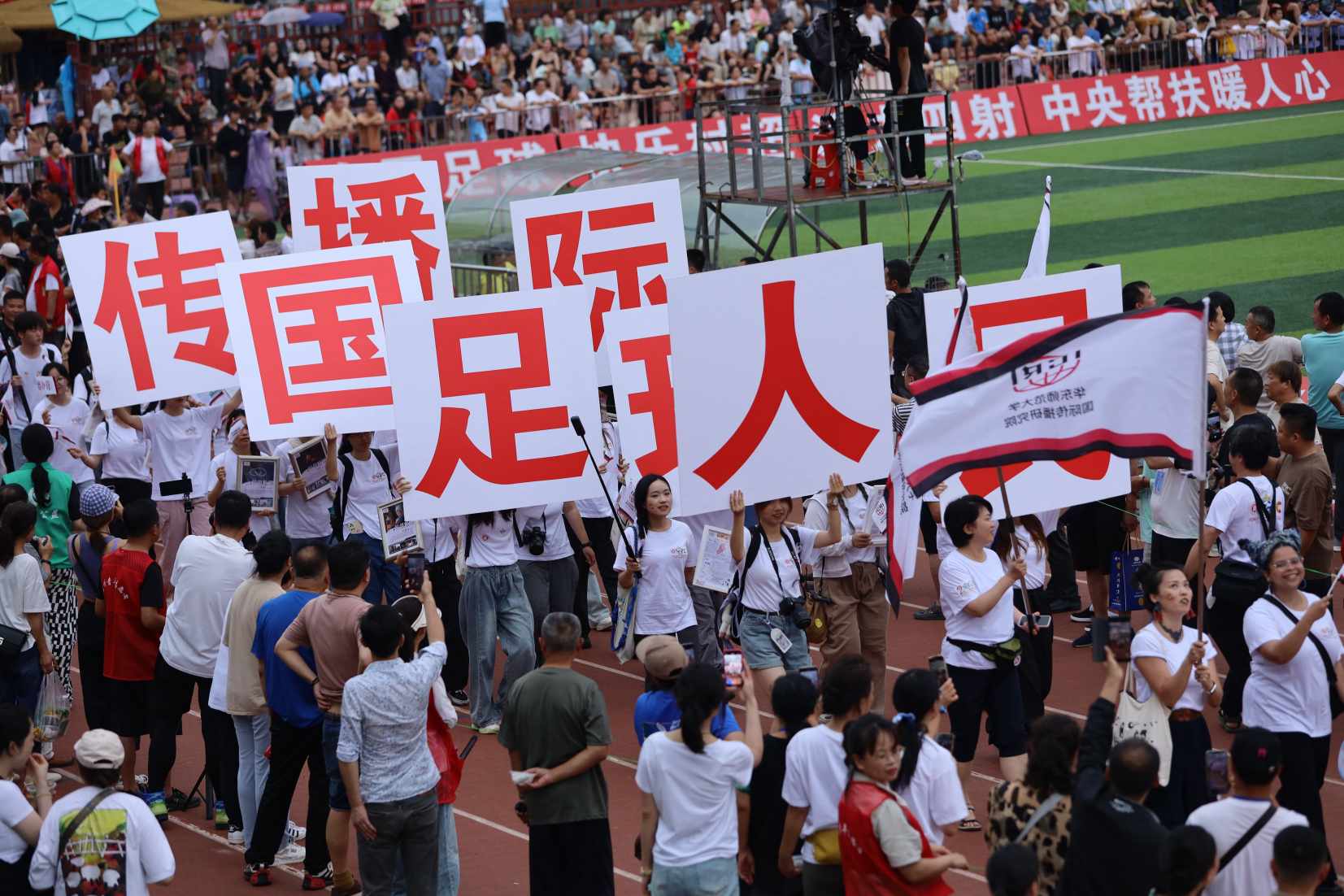
Image Captions: In July 2024, teachers and students from the School of Communication at East China Normal University participated in the Village Super League cheerleading squad.
In March 2025, we invited a parliamentary delegation from the Landless Workers' Movement (MST) of Brazil to visit Rongjiang. MST is one of the largest and most influential social movement organizations in Latin America. Since its establishment in 1984, it has become a model for global South peasant movements through land occupation, ecological agriculture practices, and grassroots education. Over the past 40 years, MST has helped 450,000 families obtain 8 million hectares of land, accounting for 2.3% of Brazil's arable land. These lands have established more than 500 cooperatives through a collective management model. By combining land reform, ecological agriculture, grassroots education, and international solidarity, it has provided "another possibility" for solving the global agricultural crisis. Today's MST is a testing ground for social justice in Latin America, a creative force for reshaping the global South's social structure, and has been listed by UNESCO as a "grassroots education innovation case".
During the visit, they learned about the practice of grassroots democracy in Rongjiang, participated in singing and dancing at the Village Super League site, and deeply felt the love of the Rongjiang people for Brazilian football and the Brazilian people. When visiting the field-side live stream room of the "Yuezai Niangniang Squad," they couldn't help but jump down to the field to hoe the ground with the "Niangniangs" (a local term for women). At the symposium, they choked back tears while reviewing and comparing MST's struggle. They said, "Football is our life; we also have festivals, food, and wonderful national culture, but we don't have a 'Village Super League.' We need to learn from the 'Village Super League'". The scene of the Brazilian MST friends dancing passionately at the Village Super League site was also captured by various self-media and went to the top of the Douyin headlines.
In April 2025, the author flew to Sao Paulo, Brazil, to attend an academic conference and specially visited the headquarters and farms of MST. In the live broadcast room of the MST farm radio station, while telling the "Village Super League" story, the author said that MST has already cooperated with China Agricultural University in organic fertilizers and agricultural machinery, and what I most want to promote is the "Mountain and Sea Love" across the globe between MST and the Village Super League with football as the medium. The MST woman cadre who received me said proudly, "We are certainly better at football; we can teach our friends from the Village Super League football skills, and our friends from the Village Super League can teach us how to make short videos".
V. Conclusion: Village Super League and "Typical Reporting"—Marxist Journalism and Communication Studies as a Theory of Practice
Starting in 2025, following the explosion of the Village Super League, non-professional football "supers" combined with urban culture and tourism have been flourishing across China. This is largely due to learning from the experience of the Village Super League, which also proves that the mass line of the Village Super League is reproducible and promotable—this is the meaning of "typical". It is not about shaping an unapproachable "advanced model" but about identifying and summarizing the path forged through practice: a reproducible methodology for more people to learn from and benchmark against, becoming a "typical" of "everyday life". This is precisely a point often neglected in today's "typical reporting".
"Grasping typical cases" is the CPC's way of working in practice: "Being good at grasping typical cases and letting them lead the way and play a demonstrative role has always been an important working method of our Party. Practice has proved that what kind of typical cases we grasp reflects what kind of orientation we have and what kind of results we will receive". Good typical cases "come from the masses and are recognized by the masses; they are approachable, respectable, and learnable". This also reflects that typical reporting can be about people or events; events are made by people.
The reason why typical reporting is the essence of the Marxist View of Journalism is that it benchmarks against the central work of the Party and is an embodiment of the "Party organizational communication" nature of Marxism-Leninism. The reason for forging this new academic concept is to hope to resolve the theoretical dilemma of whether and how the journalism and communication discipline can enter the practice site of "Chinese-style modernization," and it is also the deep background to answering the so-called "Zhang Xuefeng's question". The experience of the Village Super League is an opportunity to rethink typical reporting and the Marxist View of Journalism.
Unlike Western political communication centered on election politics, the "trinity" of the CPC's political line, organizational line, and mass line constitutes the cornerstone of Chinese political communication. The author names it "Party organizational communication" because its mission is to be the mouthpiece of the Party organization and the people, and "typical reporting" is the methodology. The Village Super League as a "typical" is not a universal reality, but in the most general sense, it represents the direction and practice path of rural revitalization and is a reality containing the future. It tells us what is meant by being the mouthpiece of the Party and the people. Isn't the "Big Communication" of the Village Super League the mouthpiece of the Party and the people? It embodies Mao Zedong's thought on Party newspapers, that is, newspapers must be run by everyone—by the whole Party and by the masses as a whole. On January 4, 2025, the new season of the Village Super League started, and 108 football teams signed up. When the author witnessed players, volunteers, police, cleaners, self-media operators, and representatives of various industries jointly announcing the start of the tournament at the scene, it was this concept of Party newspapers that entered my thoughts. Its inheritance today is the "Big Publicity concept," which means the whole Party takes action and fully mobilizes the forces of all fronts to achieve a "two-way journey" between the Party and the masses.
The "Big Communication" of the Village Super League is an innovative practice process of the "Big Publicity" work concept. It melts the Party's most important economic work and extremely important ideological work into one furnace, innovates a new mechanism for the coordinated development of economy and culture in rural revitalization, and creates a methodology of socialist "humanistic economics" from the bottom up based on grassroots organizations in the new era: systemically promoting the integrated development of agriculture, culture, sports, tourism, and commerce at the county level. This is a model of rural revitalization based on a new form of village collective economy. In this sense, "Big Communication" is not just about the field of circulation, but also bridges the boundaries between production and circulation, and between the real economy and the digital economy. This is a major issue that needs to be addressed theoretically when discussing "new quality productive forces" today. It includes the redefinition of labor, new quality productive forces, and production relations in the digital age, as well as the re-inquiry into the relationship between values and new quality productive forces, and the re-exploration of the relationship between mass culture, popular art, and the economic base in the new era. Mass literature and art themselves are the propaganda tradition created by the Chinese revolution, the wings and feet of Party theory, and the "incarnation" of theory.
It is not the government doing everything, but rather changing the style of cadres, improving government efficiency, creating a business-friendly environment, and transforming the government into a platform and soil for rural revitalization, allowing society to grow on its own. When the three lines—political, organizational, and mass—are truly connected, a "Big Publicity" pattern will be formed, which can create a social atmosphere of unity between the higher and lower levels, stimulate social positive energy, and condense more consensus and strength to complete the social transformation of rural revitalization. The result is that under a major flood, the whole society actively helps and saves itself, and its spirit does not collapse. The masses spontaneously shouted the slogan "one city, one heart," while sincerely feeling grateful for the social system of "when one side is in trouble, eight sides come to support". Dong Songs Sung to the Party became the most widely sung song after the disaster. The song praises the life of striving for moderate prosperity after high-speed rails and planes were connected to the Dong villages in the new era, and expresses the hope that the thousand-year-old Dong songs will be sung to the motherland and the Party, so that a better and happy life will last for ten thousand years. What kind of political communication theory should be used to explain such a "Party" and "motherland"? What force can make "happy" everyday life sustainable?
In this sense, "communication" is the engine of the Village Super League, a pioneering undertaking where all the people run the media, and a way to make "communication" the steering wheel for the people to master historical initiative. The mass line of the Village Super League is the greatest success of Party organizational communication, a visible, learnable, and borrowable experience, a real and perceptible Village Super League with both Party-ness and people-ness, and a positioning that mainstream media currently undergoing systemic change needs to find again. In the process of promoting a new order of information and communication in the 21st century, how should socialists around the world reconstruct Marxist journalism and communication as a historical theory of practice? China should make more contributions to this.
Mao Zedong said: "The Long March is a manifesto, a propaganda team, a seeding machine... It has scattered many seeds in eleven provinces, which will sprout, grow leaves, flower, and bear fruit, and there will be a harvest in the future. It will be recorded in history". Being a manifesto, propaganda team, and seeding machine of action is the essence of the Marxist View of Journalism and the essence of the Marxist view of communication, that is, practice as action is the source of communication. Communication has always been a verb; communication is done through work and is an embodiment of historical agency. Marxist journalism and communication is communication as practice, which is precisely the propaganda view of the CPC, the political system and political communication with Chinese characteristics, and the starting point that needs to be re-established today by breaking the formalism, dogmatism, and media-centrism in academia: the important thing is to lead the masses to transform the world.
In this sense, the Marxist View of Journalism and the View of Communication are an inseparable organic whole, and Marxist journalism and communication studies is an urgent theoretical construction needed today. Therefore, the author tries to use "Party organizational communication" as a core concept to run through the historical process of the CPC's journalism and communication practice from Party newspaper theory to the "Big Publicity" concept. In this sense, we must liberate "propaganda" from the stigma of the Cold War victors. What is propaganda? In 1927, American political scientist and communication scholar Harold Lasswell said when summarizing World War I: "What is called propaganda is actually a war of ideas against ideas". The so-called "new Cold War" pushed by the United States today is still essentially a war of ideas against ideas, and behind the war of ideas is the dispute over the path of "modernization" as the economic base: is it modernization for the majority or modernization for the oligarchy? This is the cornerstone of Chinese communication political economy and the fierce battlefield of international communication today.
Today, the academic community is keen to discuss theories of cross-media, media materiality, embodiment, mediatization, and various theories of mediatization from the West. However, looking back at history, the journalism and communication practice of the CPC has always been cross-media, material, embodied, and organized mediatization. It can be news or art; it can be slogans, posters, wall newspapers, and flags on the wall, or interpersonal communication in literacy classes, anti-illiteracy classes, and "Lenin rooms"; it can be Party newspapers, correspondent networks, radio stations, and broadcasts, or opera, music, dance, and painting, that is, all the material and spiritual ways of mobilizing and organizing the masses: a communication energy field with agency.
An important thought in Mao Zedong's On Protracted War is the war of resistance by the whole nation, which requires deep and universal political mobilization, mobilizing all the common people and letting every soldier and every person know why they are fighting, so as to create a wave of enthusiasm for the war of resistance; otherwise, the war of resistance can never be won. After the specific political program is clear, how to mobilize? "Rely on words, rely on leaflets and posters, rely on newspapers and books, rely on drama and movies, rely on schools, rely on mass organizations, and rely on cadres". "It is not about reciting the political program to the common people, for no one will listen to such recitation; it is necessary to link it with the development of the war and the life of the soldiers and the common people, and turn the political mobilization for the war into a regular movement. This is a great matter, and the victory of the war must first rely on it". The war of resistance was a great cross-media movement; its victory was not the victory of media, but the victory of the people. The Village Super League is also a well-deserved cross-media communication, a "people's war" to escape poverty in the new era and a "people's war" toward common prosperity. It is not media as an ontological entity, but when media movements as a process to change the world become the daily life of the people, that history can be pushed to change. Only in such movements can media be discovered, created, and transformed.
The reason why the aforementioned Western theories are insufficient to explain the characteristics of the CPC's "Party organizational communication" is that it has never been carried out around a specific media, but around the mission of the Party and its overall historical practice activities; communication is this practice process itself. In this process, all people and things can be transformed into media and manifest as historical subjectivity and initiative in the process of practice. This is why identifying communication as material, embodied, and mediatized is not enough; such materiality is only passive physicality. Without the "trinity" of the political line, organizational line, and mass line of "Party organizational communication," the power and subject of historical development cannot be explained. This is the inspiration brought by the Village Super League as a Chinese story, and typical reporting is to name the mass movements as practice, letting them appear in history and become the vanguard. "Vanguard" is the direction that determines the progress of history.
It is not the media nature of newspapers, radio, drama, music, etc., that determines communication, but the practice of historical movements that determines communication. It is not metaphysical materiality, but material production activities under the perspective of dialectical materialism and historical materialism that are the material basis of communication; it is with the development of productive forces and the change of production relations that the masses increasingly consciously participate in the historical process and finally become the decisive force of social change. The practice activities of the masses are the driving force of history and the driving force of communication. This is the foundation of Marxist journalism and communication studies and the watershed that distinguishes it from the journalism and communication theories built on the basis of the Western press. It is the starting point for building the communication political economy of scientific socialism. Scientific socialism means institutional innovation pushed by the practice of the people under the objective constraints of existing productive forces and production relations. It is hoped that the practice of "Chinese-style modernization" such as the Village Super League will push journalism and communication theory back to this Marxist theoretical starting point; otherwise, it will be impossible for an independent knowledge system of journalism and communication with Chinese characteristics to emerge.
Today, China has entered a "New Long March," facing new encirclements and blockades under the changes unseen in a century. China needs to unite with the people of the global South, walk the mass line in the global South, and build a united front to break through various difficulties and obstacles and jointly complete the great task of world peace and development—an unprecedentedly great historical task. "The Red Army fears not the trials of the Long March, holding light ten thousand crags and torrents".
In this sense, the greatness of the Village Super League as a "Big Communication" event lies in the fact that it does not only belong to Rongjiang or China, but will also belong to the world—the community with a shared future for mankind is, in the final analysis, a grand communication practice that crosses mountains and rivers and is interconnected.