teleSUR Reports on Global South Academic Forum: Voices From the South in Solidarity With Venezuela
Bruno Falci
The Global South Academic Forum (GSAF) defends Venezuelan sovereignty: “They want Maduro out because they cannot control him.” Reported by Bruno Falci on December 22, 2025.
The Global South Academic Forum (2025), held in Shanghai, established a tone of solidarity with Venezuela and the strengthening of scientific and cultural cooperation among Global South nations. More than 250 experts from 21 countries participated in the forum.
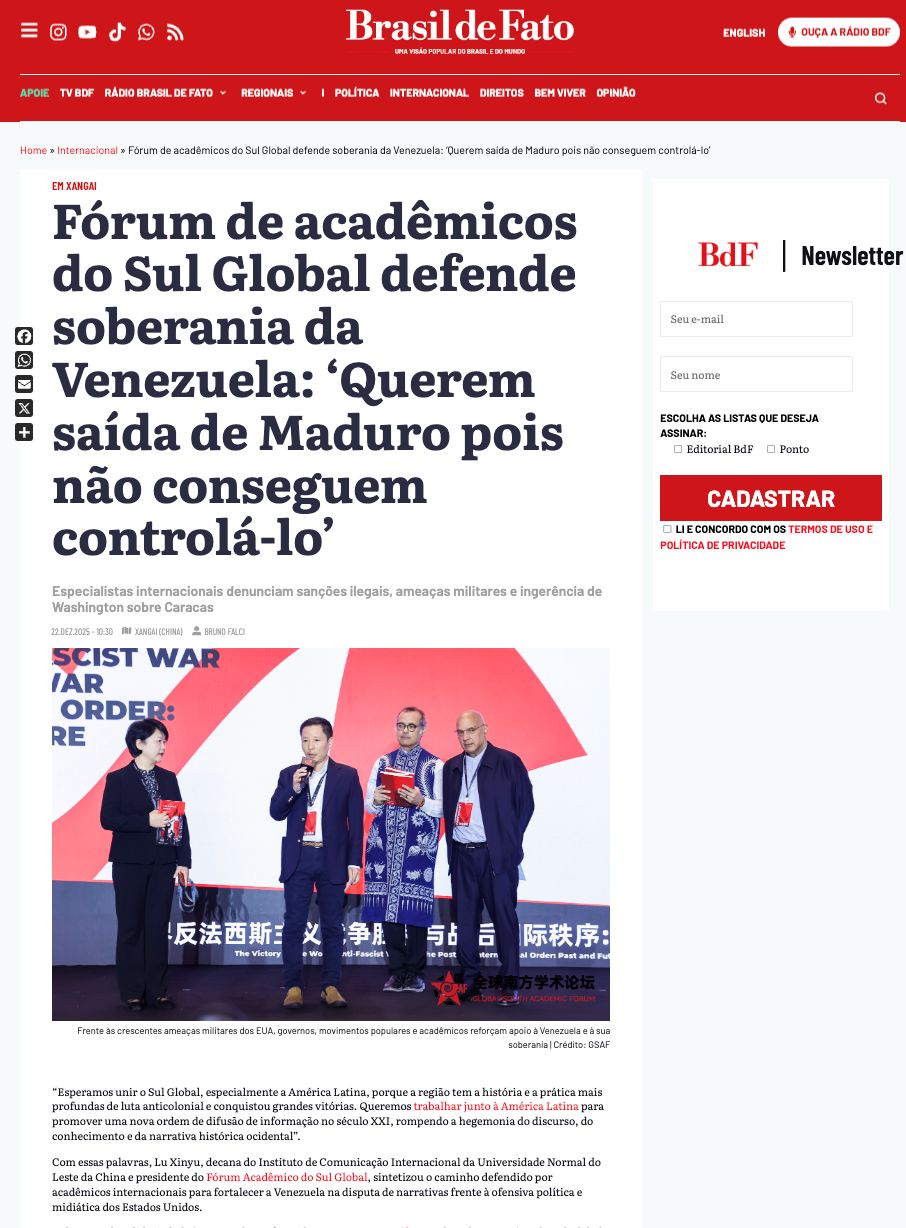
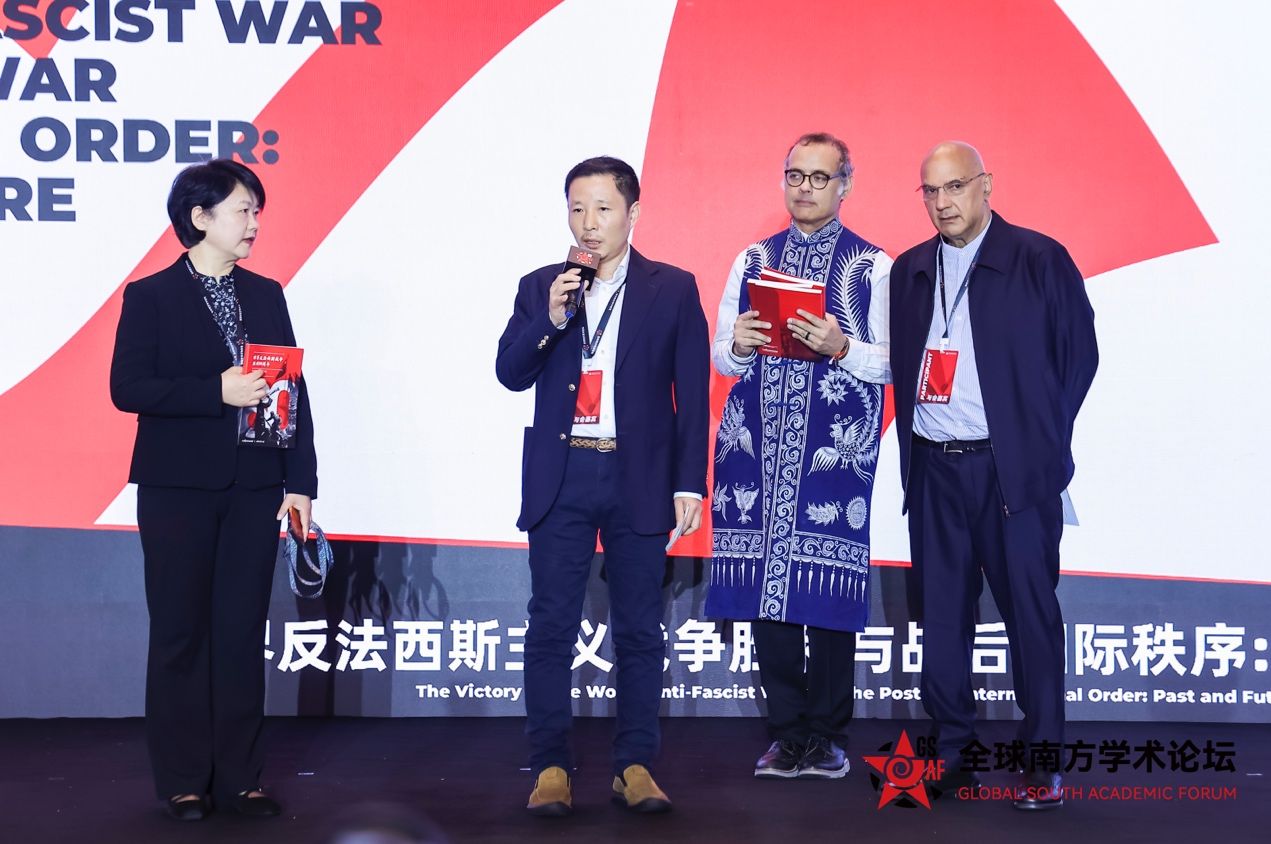
Image Captions: In the face of increasing military threats from the United States, governments, people, and academia reinforce their support for Venezuela and its sovereignty | Source: GSAF
"We hope to unite the Global South, especially Latin America, because the region has the deepest history and practice of anti-colonial struggle and has achieved great victories. We want to work together with Latin America to promote a new order of information dissemination in the 21st century, breaking the hegemony of Western discourse, knowledge, and historical narratives." With these words, Lu Xinyu, Dean of the International Communication Research Institute at East China Normal University and President of the Global South Academic Forum (GSAF), synthesized the path advocated by international academics to strengthen Venezuela in the dispute of narratives against the political and media offensive of the United States.
Venezuela is facing increasing military and economic pressure, with threats from the United States being particularly severe, including the deployment of warships in the Caribbean, the implementation of sea and air blockades, attacks on Venezuelan fishing boats, and the imposition of nearly a thousand sanctions recognized as illegal by international law. Meanwhile, Venezuelan opposition leaders, led by Maria Corina Machado, have publicly called for the introduction of external military forces to intervene in the country's affairs.
In an interview with Brasil de Fato, the forum president highlighted the experiences of social resistance in Latin America, such as the MST (Movimento dos Trabalhadores Rurais Sem Terra — Landless Workers' Movement) in Brazil: "I visited Brazil this year and visited the MST and the Florestan Fernandes National School. The courage, spirit of resistance, and political strength of the MST members deeply moved me." Lu Xinyu stated that these initiatives show that, in the face of disinformation and international pressure exerted on countries like Venezuela, Global South nations can still develop their own resistance solutions.
Indian historian and Director of the Tricontinental: Institute for Social Research, Vijay Prashad, also severely criticized the false allegations made by the United States against Venezuela, stating that the "narco-state" narrative is actually an excuse for U.S. military intervention.
"To say that Venezuela is a narco-state is complete nonsense because the U.S. Drug Enforcement Administration (DEA) reports clearly state that 80% of drugs in the United States come from the Pacific coast and have nothing to do with Venezuela. But the deeper lie is about democracy and freedom. This lie suggests that the United States is a beacon of democracy, while all other countries, such as Cuba and Venezuela, cannot compare to the United States."
Prashad believes this war is built on fabricated narratives that ultimately lead to military interventions, which are actually intended to seize oil, such as the Iraq War. The historian also criticized opposition figures who advocate for foreign intervention, comparing them to governments that violate international norms. "Maria Corina Machado won the Nobel Peace Prize, which puts her in the same category as Barack Obama, who also won the Nobel Prize but later used drones for illegal attacks in other countries. We simply cannot take them seriously," Prashad noted.
Anna Rosario Malindog-Uy, Vice President and Director of the Asian Century Philippines Strategic Studies Institute (ACPSSI), shared the same view, pointing out that U.S. actions toward Venezuela are a regime change plan aimed at controlling the country's natural resources. "They want Maduro out because they cannot control him. Venezuela is one of the major oil suppliers and possesses many natural resources that interest the United States; the United States wants to control these resources. But Maduro is not a puppet of the United States."
"Trump argued that this move was to solve the problem of drug trafficking, but no one in the Global South believes this claim. We all know that when the United States is interested in a country's natural resources, they find ways to intervene, including plotting regime change. This situation has happened many times around the world, such as in the Philippines and the Middle East," the researcher emphasized. She called on the Venezuelan people to defend national sovereignty. "I call on my Venezuelan compatriots and comrades to unite and not let your country fall under the control of imperialist powers like the United States. You must fight for your country," she concluded.
All images were provided by the original author(s).