From January 12 to 15, a delegation from the Global South Academic Forum visited the Ryukyu Islands for investigation and research. They held the "China-Okinawa Exchange and Opinion Exchange Meeting—Building a Cross-Border Peace Community" symposium in collaboration with the "No More Battle of Okinawa: Life is Treasure Society" and the Asia-Wide Campaign (AWC) against U.S.-Japanese Domination and Aggression to promote a shared vision of peace and development. Participating Ryukyuan guests included Kunio Arakawa, Hidenori Sakoda, and Takamatu Gushiken, who were respectively invited to participate in the Global South Academic Forum (2024) and the Global South Academic Forum (2025).
As a member of the "Nanjing-Okinawa Connection Association," Masami Gushiken shared the experiences of 61 residents from Okinawa who traveled to China over the past three years. They visited Nanjing, Shanghai, Wuxi, and other locations to learn about the atrocities committed by the Japanese army during its invasion of China. He expressed a profound understanding of the semantic differences between Chinese and Japanese terms such as "massacre" and "survivor," noting that confronting history directly leaves one with a heavy heart. The following is the content of his speech.
The Global South Academic Forum, in cooperation with Guancha.cn, presents the "Voice of the Global South" column. The authors are all guest collaborators of the Global South Academic Forum.
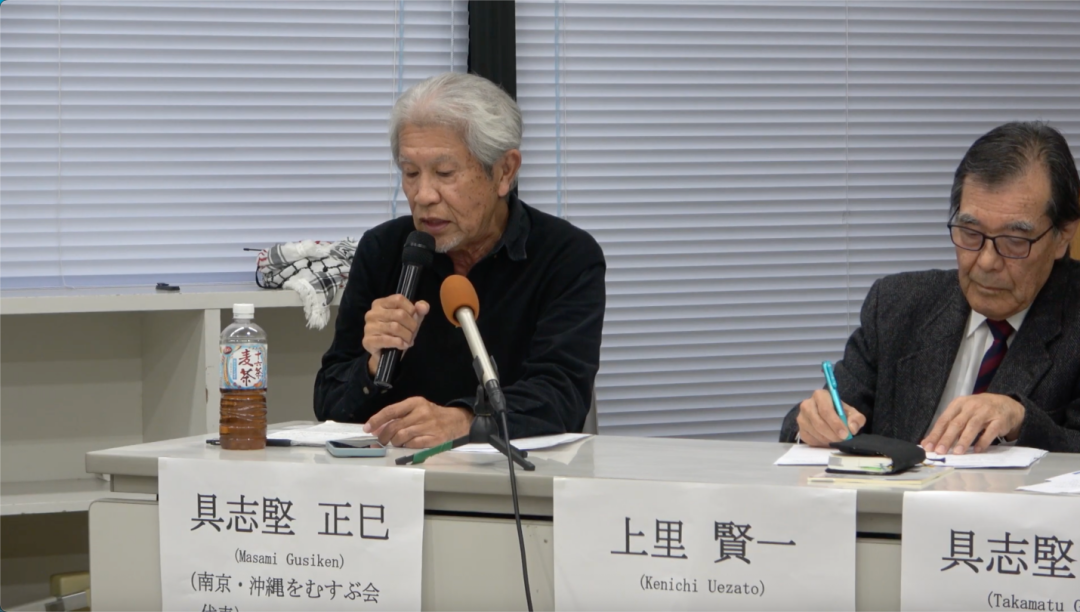
Image Captions: Masami Gushiken, member of the "Nanjing-Okinawa Connection Association."
I am Masami Gushiken from the "Nanjing-Okinawa Connection Association." Our association has so far conducted three exchanges with China focusing on Nanjing. In 2023, 14 people participated, primarily engaging in exchanges in Nanjing, with Shanghai serving only as a transit point. In 2024, 28 people participated; in addition to Nanjing, we visited the Jinshan Anti-Japanese War Memorial Park and the Sihang Warehouse Battle Memorial Hall in Shanghai. I personally visited Shanghai Jiao Tong University, which is the former site of the Toa Dobun Shoin University (East Asia Common Culture Academy). Overall, during these three years, a total of 61 people from Okinawa have traveled to China for exchanges.
Through what I saw and heard during these exchanges, and by learning deeply from Chinese friends, I have come to understand the extremely cruel atrocities and acts of aggression committed by the Japanese military in China, which are among the most brutal in human history. Every time I visit Nanjing, I tour the Memorial Hall of the Victims in Nanjing Massacre by Japanese Invaders (often referred to in Japan as the "Nanjing Incident Memorial Museum"). In Japanese, the word gyakusatsu (slaughter/massacre) is frequently used, while in Chinese, the term tushua (massacre/butchery) is employed.
I was deeply shocked when I first heard the word tushua. In Japanese, tushua mostly refers to the slaughtering of livestock; however, in the Chinese context, it explicitly refers to the killing of innocent people. I believe that using tushua to describe the actions of the Japanese military at that time is appropriate.
The memorial hall is built upon the very site where the Japanese army massacred Chinese civilians. Inside the hall, I confronted the cruel acts implemented by the Japanese military through various materials, including images and videos. Every time I leave, my heart is exceptionally heavy. At the exit, the words of the "Nanjing Incident" survivors are displayed—they are not referred to simply as "those who lived" (seikan-sha), but as "lucky survivors" (xingcun-zhe).
Okinawa was once called the "place where human hell poured down" during the Battle of Okinawa, where approximately one-fourth of the population perished. However, many Okinawans were also sent to the Chinese battlefield. According to records, an estimated 10,000 to 20,000 Okinawans went to China. My father and two of my mother's brothers all participated in that war. My father narrowly survived; during the Battle of Okinawa, he served as a naval civilian employee on a suicide mission in the south, was captured by the U.S. military, and was sent to a prisoner-of-war camp in Hawaii.
One of my maternal uncles achieved "merit" in China and was honored for it. At that time in Japan, the war was referred to as the "China Incident" (Shina Jihen). However, I must say that the actions of the Japanese military in China were nothing short of a crime. This uncle later returned to Japan on a Chinese ship, was forced to participate in the Battle of Yaetake during the Battle of Okinawa, and eventually died in combat. Another uncle studied at Toa Dobun Shoin University in Shanghai; he was forced to go to war in his third year under the name of "student mobilization" (gakuto shutsujin) and ultimately died in action near the Yangtze River. War can turn an individual into both a perpetrator and a victim; the same applies to a nation.
The "Nanjing-Okinawa Connection Association" has visited Nanjing and Shanghai, and last year we went to Wuxi. Wuxi is located between Shanghai and Nanjing, adjacent to Taihu Lake, and is a very peaceful city. Yet, even in such a place, the Japanese military once rounded up residents and massacred them. In metropolises like Nanjing and Shanghai, the flames of the massacre and oral memories are systematically preserved and passed down. However, at the massacre sites in Wuxi, there are no monuments; we could only listen to the historical facts through witnesses and preservationists. Traveling through these places, I realized more clearly that the Japanese army repeatedly implemented the so-called "Three Alls Policy" (Sanko Sakusen: kill all, loot all, burn all) along the route as they advanced toward Nanjing.
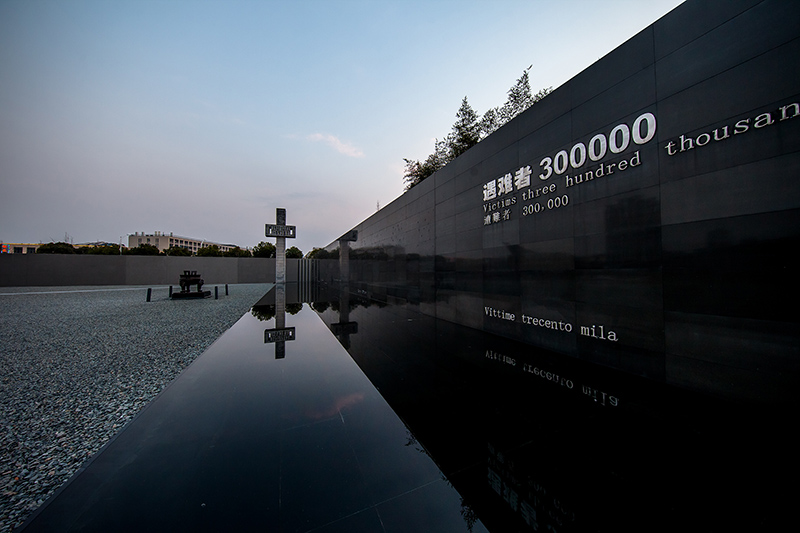
Image Captions: The Memorial Hall of the Victims in Nanjing Massacre by Japanese Invaders.
While learning about the history of Japanese aggression in Nanjing, we are also committed to promoting exchanges with the Chinese people. Last April, a group of 20 people—including the "Chongqing Bombing Victims Group" from Chongqing and the neighboring city of Chengdu, as well as witnesses and history preservationists of the biological warfare injuries caused by Unit 731 in the Changde area of Hunan—came to Okinawa. We held an exchange gathering at the Naha City Collaborative Plaza together with the "Nanjing-Okinawa Connection Association" and the "Association to Make the 'Image of the Battle of Okinawa' a Treasure for All Citizens." Due to high social interest in Chinese issues, approximately 300 people attended that day. On November 4 last year, the victims of the Chongqing Bombing visited again, and we held the "Chongqing Bombing Victims' Testimony and Photo Exhibition," which also featured images related to biological warfare; about 100 Okinawan residents participated.
Friends from Chongqing plan to come this April to participate in the memorial service at the Chiyodori bunker. During their visit last year, they collaborated with Ms. Minori Kondo at the studio of Mr. Minoru Kinjo in Tamagusuku Village to create a relief sculpture themed on the Chongqing Bombing and the Battle of Okinawa; Mr. Minoru Kinjo is also working on a simultaneous creation. It is expected that the work will be unveiled this October, at which time the Chongqing delegation will visit again, hoping to maintain continuous exchanges with the people of Okinawa.
The reason friends from Chongqing and Changde chose to come to Okinawa is that, although the natures of the Second Sino-Japanese War and the Battle of Okinawa were different, we, as victims of the same war, share a common will: to not let war repeat itself, and to not let China and Okinawa become battlefields again. Although places like Hiroshima, Nagasaki, and Tokyo also suffered deeply from the war, they chose Okinawa. I also hope to continuously accumulate such exchanges.
It is worth mentioning that when our friends from Chongqing visited last year, we went to the Self-Defense Forces sub-base in Katsuren, Uruma City. Under the initiative of Mr. Kunio Arakawa, we held a protest rally with local residents. An appeal was read at the meeting, which included: the Japanese government should apologize and provide compensation to the Chinese war victims; the Japanese government and the Self-Defense Forces should not point missiles at China; and the Japanese government should swear that Japan and China will not go to war.
We advocate that the citizens of both China and Japan should neither become perpetrators of war nor victims again. This appeal was read in front of the local Self-Defense Forces commander. A 91-year-old Mr. Song, a member of the visiting delegation, read aloud, raised his fist in appeal, and sent a clear message to the Self-Defense Forces personnel and everyone present. I deeply feel that such exchanges are of vital importance. This year, I still plan to go to Nanjing and Shanghai and look forward to the other party continuing to visit.
However, affected by the "Takaichi remarks," the aforementioned exchanges are currently facing uncertainty. In order to ensure that our mutual visits can continue, I will demand the withdrawal of the relevant remarks and a public apology, as well as the assumption of corresponding political responsibility and resignation.
As I have expressed here: China and Japan should jointly build a "Community of Non-War." I will continue to work toward this and I sincerely ask for your support.
All images were provided by the original author(s).