This article originates from the "Bottom Line Thinking" public account; the author is Takamatsu Gushiken.
Since November 2025, Japanese Prime Minister Sanae Takaichi has repeatedly made erroneous remarks regarding the Taiwan issue, publicly discussing the possibility of Japanese intervention in a Taiwan Strait conflict under the framework of a "Situation of Existence Crisis" , leading to continued tension in China-Japan relations. On February 9, 2026, the results of the Japanese House of Representatives election were announced. The Liberal Democratic Party (LDP) and its allies secured 42 more seats than the number required for constitutional amendment, once again sparking persistent concerns both within Japan and abroad regarding a resurgence of right-wing militarism and the rise of armament expansion.
From January 12 to 15, a delegation from the Global South Academic Forum (GSAF) traveled to Ryukyu (Okinawa) to conduct field research and held a symposium entitled "China-Okinawa Exchange of Opinions: Building a Peace Community Across National Borders" with Okinawan peace groups. The Japanese groups participating in this exchange included "No More Okinawa Battle: Life is a Treasure" (ノーモア沖縄戦 命どぅ宝の会), which has long opposed the "re-battlefieldization of Okinawa," and the "All-Asia Campaign against U.S.-Japanese Domination and Aggression" (AWC), a transnational civic group opposing the U.S.-Japan led military order. Ryukyu guests in the discussion included Kunio Arakaki, Hidetomo Sakoda, and Takamatsu Gushiken, who were previously invited to participate in the Global South Academic Forum in 2024 and 2025, respectively.
At the meeting, Takamatsu Gushiken, a special researcher at the Regional Research Institute of Okinawa University and representative of the Okinawan War Remains Collection Volunteers, and Seikiyo Matayoshi, a guest professor at Okinawa University, delivered speeches focused on topics such as "opposing the re-militarization of Okinawa and Japan, guarding against the spillover risks of the 'Taiwan Contingency' narrative, and promoting transnational civilian peace collaboration." They called for the use of dialogue and grassroots exchange to curb the risk of war, oppose the restoration of warmongers, and safeguard regional peace and development.
The Global South Academic Forum, in collaboration with Guancha.cn, features a column titled "Voice of the Global South," with articles authored by guest speakers associated with the Global South Academic Forum.
The following are the transcripts of the speeches delivered by the two scholars.
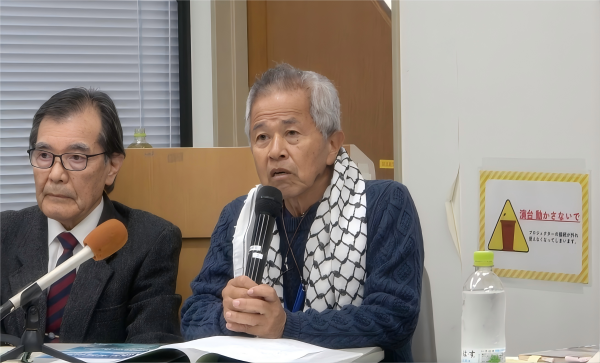
Image Captions: Researcher Takamatsu Gushiken delivering his speech.
Takamatsu Gushiken:
My name is Takamatsu Gushiken. When introducing myself, I need to present three titles: first, I am the representative of the Okinawan War Remains Collection Volunteers; second, I serve as the co-representative of "No More Okinawa Battle: Life is a Treasure"; and third, I am the co-representative of the "Stop the War! Okinawa-Western Japan Network."
The work of collecting remains is, in essence, an unfinished post-war processing of the Battle of Okinawa that occurred during the previous war. Our goal is clear and simple: to return the remains to the bereaved families. While continuously carrying out this work, the risk of a so-called "Taiwan Contingency" has gradually emerged. If this situation becomes a reality, Okinawa may once again be embroiled in the flames of war; we must resist the movement to make Okinawa a battlefield again. Based on this position, we have voiced our concerns in Okinawa and received widespread support from the people on the Japanese mainland.
In the process of interacting with partners across various regions, I gradually realized that this is not an issue confined to Okinawa alone. This is because the Japanese government is advancing the construction of missile ammunition depots: from Hokkaido to Kyushu, there are plans to build 130 new ammunition depots nationwide. It is reported that approximately 300 Self-Defense Forces (SDF) bases across the country are being reinforced and moved deep underground. This implies that the SDF has already recognized itself as an entity likely to come under attack. However, information regarding these risks has not been fully shared with local residents. Nevertheless, residents in various places have begun to worry: once new ammunition depots for long-range missiles are built locally and used to launch attacks on the Chinese mainland, will it invite retaliation?
Consequently, people are raising demands such as "do not build here." Such actions have taken the lead in areas like Kyushu, Shikoku, and Kansai. Because we are not the only ones calling for this, we decided to unite with these regions to jointly voice our opposition, which led to the creation of the "Stop the War! Okinawa-Western Japan Network." At this point, the question is no longer "will Okinawa become a battlefield," but "Japan may become a battlefield."
To prevent Okinawa from becoming a battlefield and to ensure Japan does not become one, I have considered and clearly expressed the following position: in front of the gates of the Self-Defense Forces bases, I demand—SDF, please leave Okinawa along with your missiles. This is not because I loathe the Self-Defense Forces. Once war breaks out, the first to be sacrificed will be the members of the SDF; the sacrifice of SDF members means that Japan has already been drawn into the war. Protecting the lives of SDF members is, conversely, protecting Japan from heading toward war; this is absolutely necessary.
The greatest problem with the SDF being involved in a "Taiwan Contingency" lies in the fact that Japan itself would not have been attacked, yet the SDF would depart from Japan to conduct attacks against China in the direction of Taiwan. Sanae Takaichi stated that as long as it involves the deployment of warships accompanied by the exercise of force, it constitutes a "Situation of Existence Crisis." In other words, even if Japan is not attacked, Japan will proactively launch strikes against China. Such an action must never be allowed.
The ignition point of the war will be in Okinawa, and the detonator will be the SDF firing missiles at the Chinese military—we must avoid this situation at all costs. Therefore, I reiterate: SDF, please leave Okinawa along with your missiles. This is the true way to protect Japan from war.
I want to solemnly state our position on the matter of the Battle of Okinawa: we respect China, Taiwan (China), Japan, and South Korea; we do not harbor hatred toward any party. Regarding the United States, I respect the American people, but I cannot respect the U.S. military. The reason is that over the 78 years since the war, the many crimes committed by the U.S. military in Okinawa have constituted humanitarian issues that must be faced. Regardless of whether a war occurs, the U.S. military should withdraw from Okinawa. As for the Self-Defense Forces, the reason I advocate for their departure from Okinawa is to prevent Japan from moving toward war. This is a point I must state clearly and explicitly.
Seikiyo Matayoshi:
I am 84 years old this year, and in the blink of an eye, I have reached this age—an age that has opened up an indescribable world to me. I have always hoped to live a few more years, but this is not something I can decide alone; the prerequisite is that human dignity is clearly established and protected. It seems as if humans are endowed with such a mission from birth. Therefore, I still hope to live for about twenty more years.
Today, I was invited to speak with almost no preparation, but having traveled extensively and met many people over the years, I am not worried. What I first want to convey are some facts that are often little-known but must be faced and reflected upon together, and I have brought relevant materials with me.
Among them, the most important is a map. By looking closely at a map, one realizes how rich life can be. For human survival, we cannot move forward without such a "map in the heart." It is for this reason that I have always cherished this map. As a teacher at Okinawa University, I have visited China, South Korea, Russia, and other places. I must first firmly grasp where Ryukyu and Okinawa are located, mark where the Yamato (the ancient Japanese people) are, and also understand the vast region of China. We must depend on and assist one another within this broad region to survive.
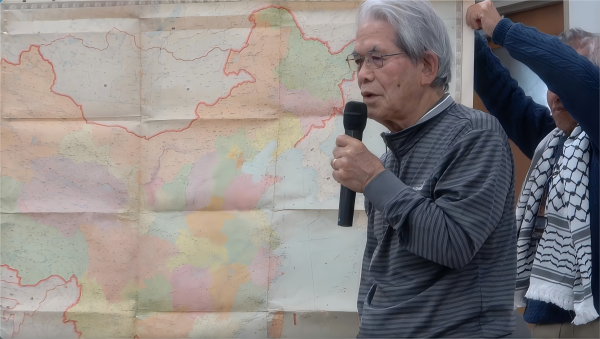
Image Captions: Professor Seikiyo Matayoshi displaying a map of the People's Republic of China.
To this end, I have traveled to various places. People often say, "Matayoshi is here, doing these things again." They believe I understand the possibility of moving forward together and forgiving one another across eras, and they encourage me: "Matayoshi, don't just live to a hundred, but live to two hundred, three hundred, or five hundred years." While these words are exaggerated, they carry expectations for me.
In any case, the key is to live well and to live correctly, rather than simply extending one's lifespan to two hundred years. I have repeatedly traveled through the aforementioned regions and persisted until today. Next, I hope to work with all of you to clarify and disseminate the question of "living" in an appropriate form in various places.
Some ask if presenting this map will invite war. I say clearly that no one can easily go to war with a country like China; if things truly reach that point, it will only exhaust the last remaining hope. This further shows how important our relationship with China is. I look forward to China demonstrating its unique path and cultivating talents capable of shouldering responsibility, which is something neither the United States nor Taiwan can replace. In a sense, China provides the whole world with a model of prosperity and survival. I hope everyone can be inspired by this.
Therefore, I am more willing to engage in dialogue and mutual forgiveness with everyone, building an era of abundance where everyone can say from the bottom of their heart: "It's good to be alive."
I have also brought two articles from the Okinawa Times and the Ryukyu Shimpo; please spread them out and read them carefully. These are reports from 2016. At that time, we had to engage in a significant struggle and confrontation, and everyone supported each other within their respective cultural contexts. However, it is regrettable that some members from those years now seem to have lost interest, which worries me. For this reason, I hope to return to these benchmarks time and again and send out messages based on the sanctity of life from here. I ask everyone to confirm this once more. The subsequent details are also in the materials, which I will continue to circulate.
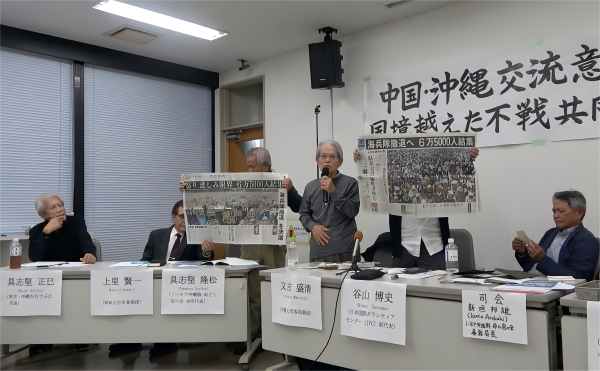
Image Captions: Professor Seikiyo Matayoshi displaying front-page reports from two 2016 newspapers: "Anger and Sorrow Reach a Breaking Point, 65,000 Gather in Protest" and "Mourning the Victim and Demanding the Withdrawal of the Marine Corps, 65,000 Participate in Okinawa Prefectural Assembly." At that time, a heinous crime occurred in Okinawa: a former U.S. Marine, then a civilian employee of the U.S. military in Japan, murdered and disposed of the body of a young female local resident. The incident sparked intense anger across the prefecture, and residents held a large-scale rally at Onoyama Park in Naha, demanding that the U.S. military in Japan leave Okinawa.
All images were provided by the original author(s).