As artificial intelligence (AI) reshapes the global development landscape, Xiong Jie, Secretary-General of the Global South Academic Forum, was invited to share his insights on AI with the National Numsa Workers' Union (NUMSA) of South Africa. He pointed out that while Marxism requires a totality of knowledge, various realistic factors currently restrict people's ability to utilize the "entire wealth of knowledge created by mankind." AI presents an opportunity to subvert this status quo by breaking down knowledge barriers across four dimensions: data, analysis, methodology, and output. Xiong Jie simultaneously emphasized that while AI aims to liberate labor and promote the democratization of knowledge, human thought and insight remain the core of this process.
The National Union of Metalworkers of South Africa (NUMSA), established in 1987 through the merger of six unions, broke down the union barriers of the apartheid era. As a major industrial union in South Africa, it unites workers in related fields under the concept of "industrial unionism" and serves as a key force in maintaining workers' rights and promoting social equity. Today, it is exploring paths for workers in the Global South to respond to technological change.
Marxists in the 21st Century and Artificial Intelligence
I would like to thank General Secretary Comrade Irvin Jim for the invitation, which has given me the opportunity to exchange some of my thoughts regarding artificial intelligence with the comrades of NUMSA. Over the past two years, we have been asking ourselves a question: exactly how important is AI in human history? Some believe AI is like the steam engine, representing a new productive force that will trigger a new industrial revolution. Others believe AI is like humanity learning to use fire, bringing enlightenment to the entirety of human civilization. Personally, I am very fond of an expression used by a Brazilian mayor, who said that AI is like writing. After humanity learned to write, the entire mode of thinking and processing information underwent a revolutionary change. The length of memory that could not be preserved in the past, the breadth of information that could not be obtained, and the depth of thinking that could not be processed all became possible with the advent of text and writing.
Lenin once said that Marxists should "enrich their minds with all the wealth of knowledge created by mankind." The holistic methodology of Marxism requires the observer to have some exposure to the fields of economy, politics, culture, and ideology. The unity of theory and practice requires revolutionaries to understand both abstract theory and concrete reality—how factories operate, how finance is manipulated, how the state apparatus functions, and so on.
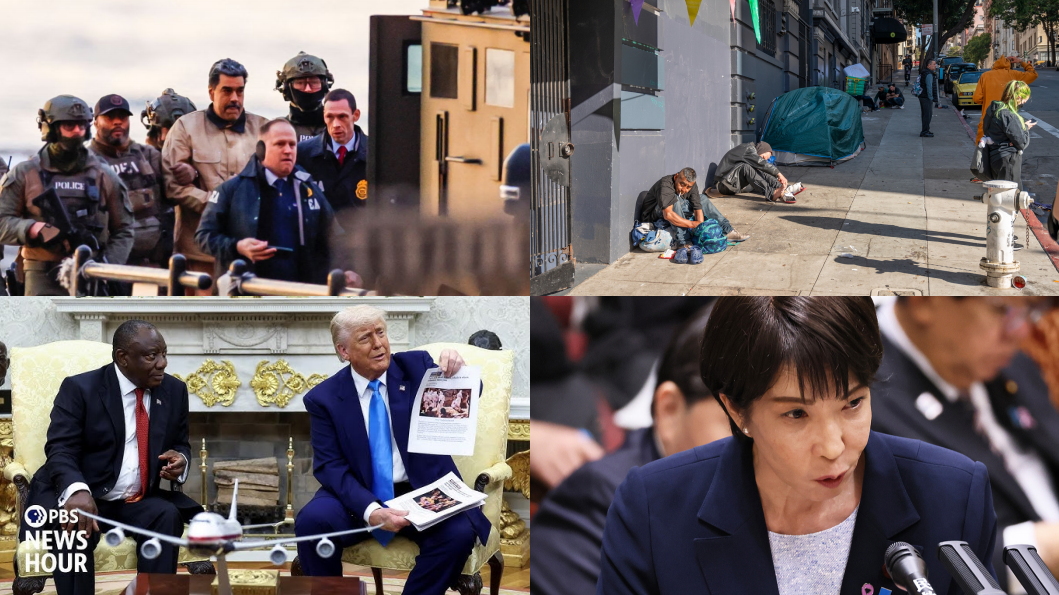
Taking our world today as an example, it is only by using this holistic methodology that we can recognize the underlying connections between various events: the illegal kidnapping of President Maduro by the U.S. military; Trump claiming that South Africa is implementing "genocide" against white people while imposing high tariffs on South Africa; internet celebrities exposing that the American lower-class proletariat is struggling on a "kill line" where they might lose their lives at any time; and Sanae Takaichi continuously provoking China on the Taiwan issue. All of these reflect the outbreak of the systemic crisis of capitalism and the entry of polarized imperialism into a dangerous new historical stage.
On the other hand, the volume of the "entire wealth of knowledge created by mankind" is too vast, its changes too rapid, and its subdivisions too specialized, such that applying the holistic methodology of Marxism has become almost impossible. This is especially true for cadres like yourselves who must fight on the front lines.
Our energy and attention also restrict the depth and complexity of our thinking. We are all ordinary people; we need to drink water and use the restroom every hour, eat every half day, and sleep every day. These are all interruptions to concentrated thinking. When the volume of information and complexity exceeds the load of the brain, we can only compress the scope of our thinking: either through sampling—keeping only part of the information and losing precision—or through abstraction—replacing details with concepts and losing depth. This means we can only analyze problems based on a small amount of filtered information and methods.
There are, of course, other factors restricting our ability to utilize the "entire wealth of knowledge created by mankind." For instance, the largest carriers of knowledge are English and Chinese, and much knowledge has no translated versions in other languages. Many academic resources and professional databases charge high fees. Furthermore, cadres of people's movements do not have vast amounts of time to engage in reading, research, and writing. Ironically, scholars serving capital interests have more abundant resources, time, and energy to produce knowledge that does not serve the people but rather exploits and oppresses them.
The situation does not look optimistic. However, what I want to tell you, comrades, is that AI has the opportunity to completely change this status quo, thoroughly overturn the elite class's monopoly on knowledge, and fully realize the democratization of knowledge. In this process of democratization, the greatest beneficiaries will be us Marxists, because the holistic methodology we believe in will become a reality, providing a massive boost to our ideological and practical struggles. This revolutionary change will occur across the following levels.
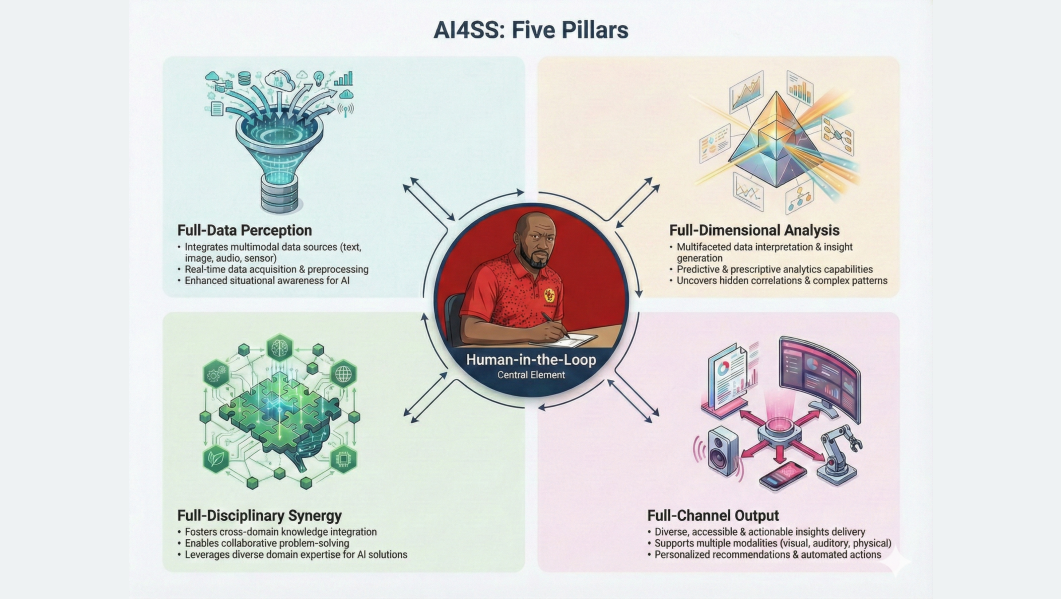
First, at the data level, we will break down the barriers to information acquisition and achieve full-data perception. Large language models (LLMs) can process massive amounts of information in various languages and formats. We can achieve the ability to take all the data and materials of a field into our hands and conduct research based on all that data, rather than being limited to small, finite datasets as in the past.
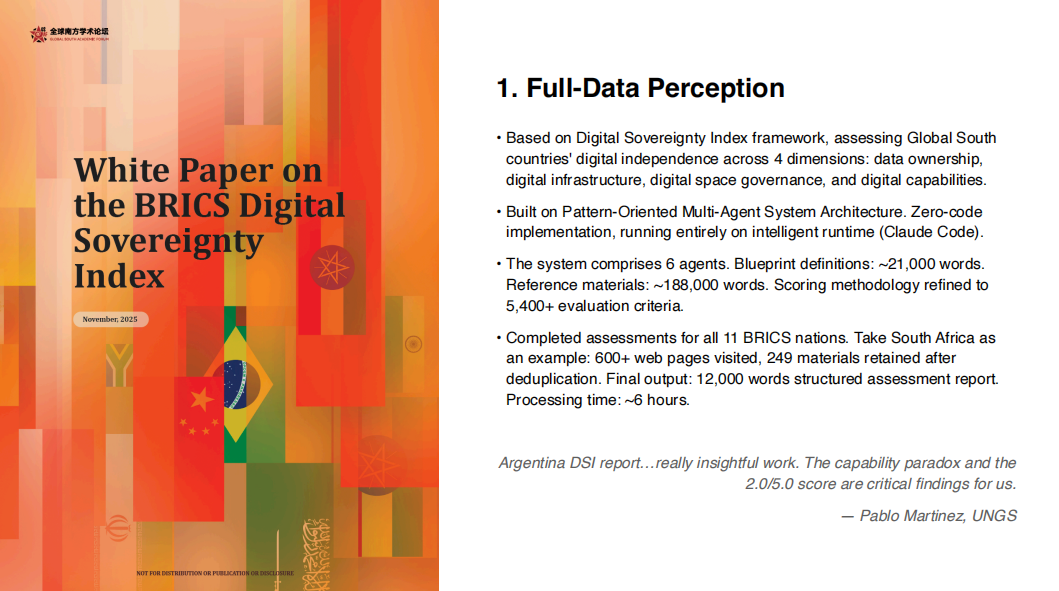
Last year, using the Digital Sovereignty Index (DSI) framework we developed, I conducted an assessment of the BRICS-11 countries and discovered structural challenges regarding digital sovereignty shared by Global South nations: digital infrastructure is heavily dependent on the United States; digital space governance ideas are out of touch with reality; and there is a serious drain of digital talent. Taking South Africa as an example, we reviewed approximately 600 webpages and downloaded 249 documents, from which we analyzed and summarized 91 pieces of strong evidence to form the South Africa assessment report. I can say with great confidence that this research process covered all available materials in the world related to this issue. With AI assistance, conducting such an assessment takes only 6 hours. This is the capability AI grants us to "conduct research based on all data."
Second, at the analysis level, we will be able to maintain tracking of complexity and achieve full-dimensional analysis. Even for complex analysis of large amounts of data, we no longer need to sample or abstract and thus lose information.
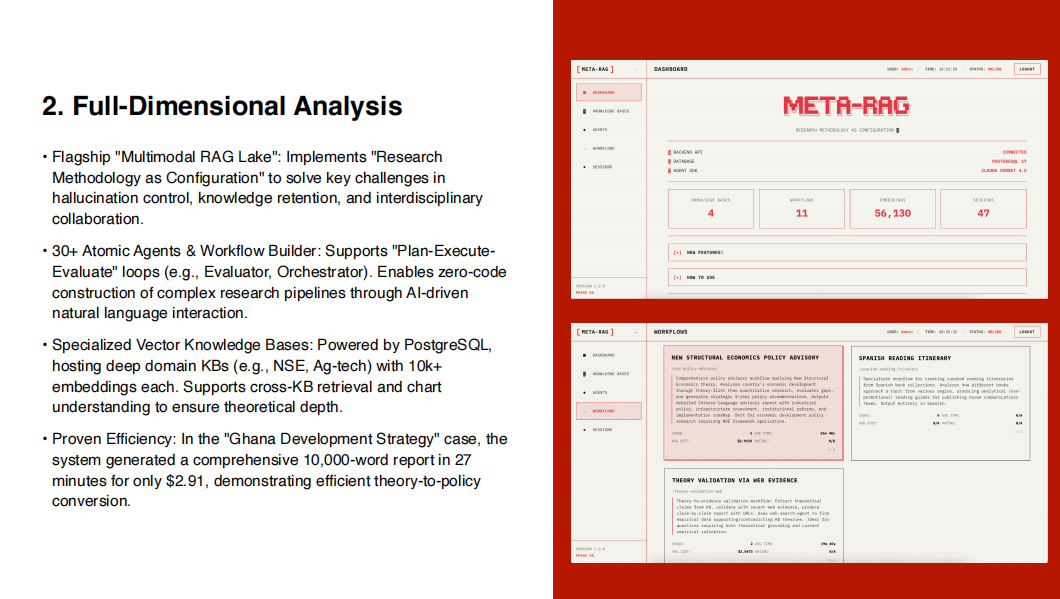
I will give a very common example: fieldwork. In the past, when we went to the countryside for fieldwork, we could only record key points or make quick summaries of recordings; the subsequent analysis process was based on this abstracted information. Now, I can perform basic text transcription for hundreds of hours of recordings and then put these interview records into a database dedicated to that specific research project along with related books and documents. I can then ask the AI questions to find any existing information within that database. I have a doctoral student who used this method to discover information from interview records that even he himself had not heard clearly or noticed at the time of the interview.
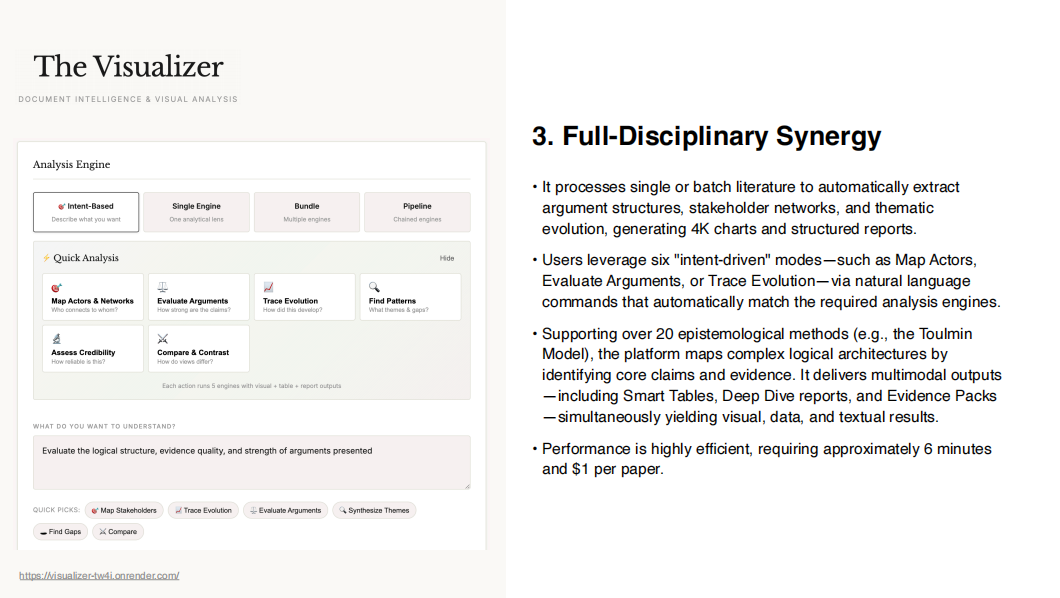
Third, at the methodological level, we will be able to apply the knowledge, techniques, and methods of various disciplines to achieve full-disciplinary synergy. Analysis methods from different disciplines can be encapsulated as callable tool modules; you only need to say one sentence to the AI to use the experience accumulated by a discipline over many years. The latest progress in this direction is skills.sh, a website that aggregates a large number of reusable skills and knowledge. Personally, I believe this website represents the next stage of AI development, and comrades should pay attention to it.
For example, we created a tool called "Visualizer," which can transform any complex academic concept into a visual chart. Each use takes only a few minutes and costs about $1. I gave one of my articles to this tool and asked it to help me sort out the argumentative structure within. It used a method called the Toulmin Argument Structure to identify the core claims, grounds, warrants, backing, and qualifiers in the literature, presenting them in the form of a visual map. Before this, I had never heard of the Toulmin model, but that did not hinder my use of the method at all.
Fourth, at the output level, we will be able to produce content products in any form at extremely high speeds, achieving full-channel output. Whether it is academic papers, policy documents, PPTs, podcasts, images, or videos, the difficulty and cost of production will be greatly reduced. Based on our experience, when ideas and content are present, it is entirely expected for a researcher's content output speed to increase by dozens or even hundreds of times.
Last year, we made an attempt to use the image of Comrade Mika to create a digital human to lecture on Marxist courses. We first used AI to generate an easy-to-understand broadcast script of about 40 minutes based on Marxist classics. Then we fed the script to the digital human and used AI to generate background images matching the content, easily producing such a course video.
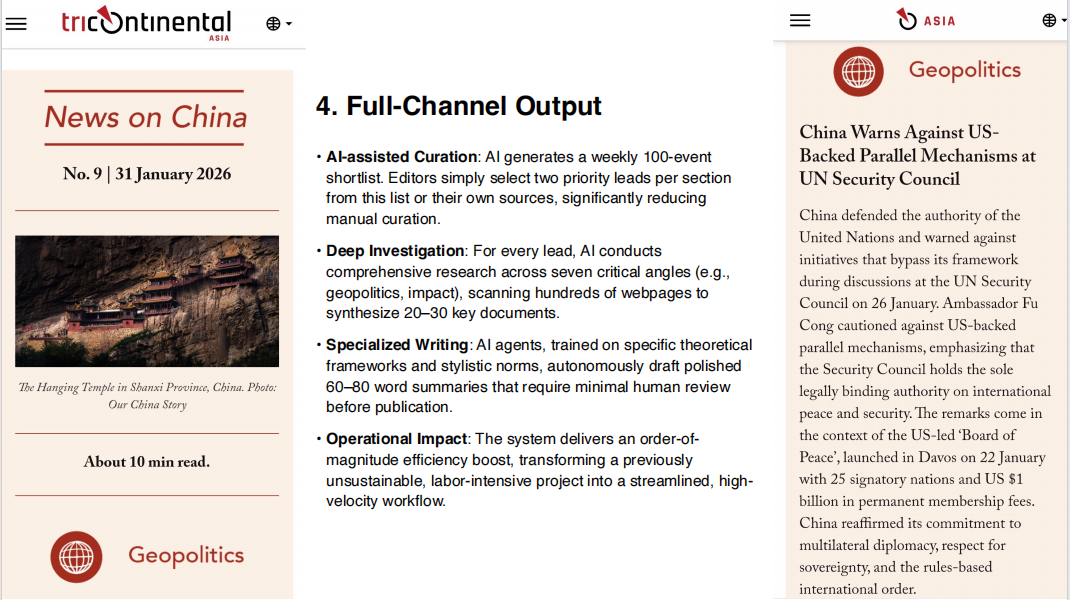
Another of our attempts, which is now in production and operation, is the weekly News on China email newsletter. This newsletter sets up six sections: Geopolitics, Domestic Politics, Economy, Agriculture and Environment, Technology, and People's Livelihood and Culture. Every week, it selects 10 to 12 of the most important news items from China over the past week, allowing readers to understand what happened in China in just 5 minutes. Many comrades may know that we stopped this newsletter two years ago because it required a tremendous amount of energy to produce at that time. Why have we restarted News on China now? Naturally, it is because we know comrades in the Global South have this demand, but more importantly, the development of AI—especially development since October last year—enables us to produce such a content product with very low costs and a light workload.
(a) Every Wednesday, AI automatically generates a shortlist of about 100 news items for us, containing events the AI considers important from the past week. Editors responsible for each section select two news leads they deem most worthy of recommendation from this shortlist or from news they have followed themselves. The editors' work basically ends there.
(b) Then, for each news lead, the AI conducts comprehensive research from seven angles: the full picture of the event, media reports, expert commentary, historical background, professional knowledge, geopolitics, and impact analysis. For each news lead, the AI browses hundreds of webpages and scrapes 20 to 30 relevant documents.
(c) Subsequently, based on all these materials, the AI writes a 60 to 80-word summary for each news lead. The AI agent writing the summaries has already mastered Marxist thought, the theory of polarized imperialism, the style specifications of the Tricontinental: Institute for Social Research, and the writing techniques of the previous editors. The news summaries it produces require very little final review and processing by the responsible editor before publication.
It is no exaggeration to say that in the editing and production of News on China, AI has given us an order-of-magnitude increase in efficiency, making a project that we once felt could not be sustained viable once again.
From the experience of News on China, we can expand our imagination: does this workflow—"AI collects news leads -> Editor selects -> AI conducts research -> AI creates content -> Editor finalizes"—apply to many media outlets and self-media? Is it particularly meaningful for progressive media in the Global South, which lack resources and manpower? I truly believe that, based on the technology available today, we are fully capable of developing AI-assisted production lines for text, image, audio, and video products, allowing numerous progressive media in the Global South to increase their content capacity several times over while significantly reducing the human labor invested in content production.
Every time I say "AI can reduce the human labor invested in something," a comrade will surely ask me: does that mean AI is going to replace people? Will people be useless in the future? What will people who are replaced by AI do?
I will still use News on China as an example: we once tried to let AI automatically select 12 news leads, but we found the results were poor and unattainable. Why? Because saying "I recommend my comrades watch this news" is a very personal and emotional thing. Because I know the comrades of NUMSA and have feelings for them, I know which news should be recommended and which should not. Once you use AI for the core task of "recommendation," you will find that the product immediately becomes mediocre.
The more we use AI tools, the more clearly we realize: human thought, human experience, and human insight are the most core and brilliant parts of the entire process of knowledge and content production. From our practice, AI assistance can reduce a large amount of simple, repetitive work, thereby further highlighting the core position of human thinking. Using AI-assisted tools is to allow the human brain to focus as much as possible on those core tasks that AI cannot replace: providing insight, pointing the way, and making final decisions.
Of course, and even more fundamentally and importantly: AI liberates us from heavy, mechanical, and repetitive desk operations, allowing us more time to go to the grassroots, into the villages, and into the factories to be with the masses, to do actual research, publicity, and mobilization work, and to practice the mass line. AI tools can quickly turn our thoughts into content products; our task is to let more of the masses come into contact with these content products and obtain feedback from them to improve our thoughts. With the assistance of AI, knowledge consumption and production that were once monopolized should be democratized and returned to the proletariat. With the assistance of AI, the "unity of theory and practice" (praxis) that Marx spoke of should complete its loop within the same Marxist.
Comrades can believe all that I have shared today: it is not an unattainable holy object in an ivory tower, nor does it require a lot of money. All the AI applications I introduced today have been implemented by the "Global South Insights" (GSI) project, jointly promoted by the Tricontinental: Institute for Social Research and the Global South Academic Forum. You can obtain them almost for free—except for a small token fee. I call upon you, comrades, to act immediately, to learn from us, to take our knowledge and achievements, and to apply them to your daily work. Our team in China welcomes your learning wholeheartedly.
(All images were provided by the original author(s).)