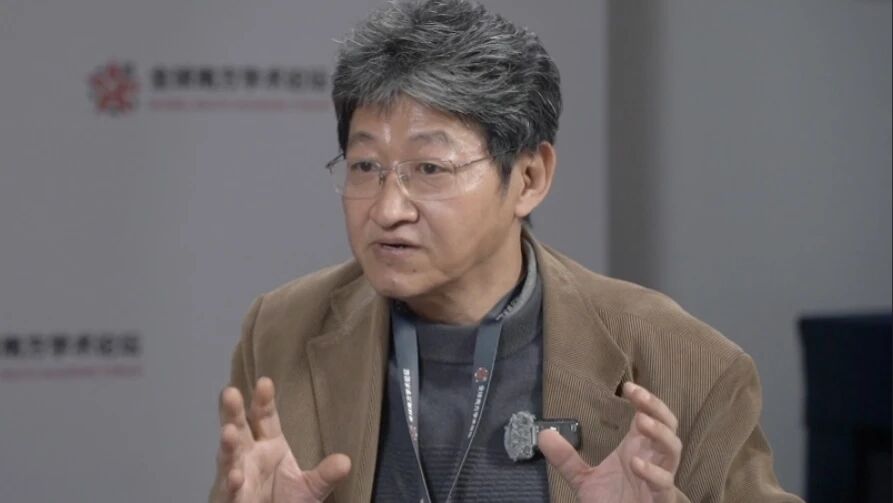

Image Captions: This article is written by Liu Shiyang in dialogue with guests Suh Sung, Zang Ruxing, and Lan Bozhou at the Global Southern Forum
On February 8, the Liberal Democratic Party (LDP), to which Japanese Prime Minister Sanae Takaichi belongs, won the House of Representatives election, achieving the best result in the history of the LDP. Takaichi expressed her gratitude to US President Trump for his support and said that she would further consolidate the US-Japan alliance "to ensure peace in a wider region" and reiterated her political stance of "visiting the Yasukuni Shrine". Previously, she had also claimed that "the US and Japan may take joint action" on the grounds of the "Taiwan Strait crisis". These are not isolated events, but rather the result of a nested combination of mobilization of threats, alliance structure, and historical revisionism.
When the East Asian specter of "militarism" "revisions" on historical issues while "resurrecting" itself through means such as breaking the "Peace Constitution," weakening the "three non-nuclear principles," and provoking regional incidents, it is "resurrected." It is not difficult to find that, compared with Japanese militarism before and after World War II, the characteristics of "new militarism" are: starting with a distorted historical narrative and aiming at promoting military expansion. More specifically, under the guise of "the pacifist constitution still exists," it promotes "remilitarization" through historical rewriting, normalization of military policies, and intervention by allies, challenging the international order, which must arouse the high vigilance of international forces of justice. Therefore, we must ask: who is reviving it? And what kind of conspiracy and structure has created a legitimate space and fertile ground for its growth? Previously, during the "Global South Academic Forum," I had a dialogue with Professor Suh Sung, Chair Professor of Woosuk University in South Korea, and Zang Ruxing, Deputy Secretary-General of the Labor Party of Taiwan, which outlined a clear logical chain: "new militarism" is born from the unresolved colonial history; the "China threat theory" provides a legitimate cloak and mobilization tool; the "US-Japan alliance" and regional security structure create strategic opportunities and institutional stage. In summary, the three are nested together, and a "conspiracy" composed of historical narrative, threat narrative, and regional alliance is taking shape.
I. The Japanese Right Wing and the Unresolved Specter of Colonialism
The first layer of this "summoning" occurs in historical narratives. Japan's "new militarism" is rooted in its never-fully-reflected colonial history. Suh Sung further points out that "Japan embarked on the path of imperialism and colonial rule, and has never truly reflected on this since World War II, especially regarding Taiwan and Korea." The "Taiwan crisis" rhetoric precisely proves that the Japanese right wing still views Taiwan as a "base of interests." This not only reveals "Japan's militaristic action logic and hegemonic thinking in still regarding Taiwan as a colony," but also structurally exposes Japan's post-war suspension of historical responsibility. When colonial responsibility is not settled, history enters a state of negotiation and rewriting, thus becoming a "usable resource" for its contemporary political narrative.
This "unresolved" history does not merely remain at the level of memory, but is continuously reproduced through the convergence of institutionalized historical engineering and popular culture: downplaying aggression, rewriting the war, packaging war criminals as "heroic spirits," and translating the history of aggression into a "narrative of sacrifice" in public ceremonies. When history is weakened into "multiple interpretations," the specter of colonialism transforms into a resource for legitimacy in contemporary politics. Militarism, disguised and repackaged under new guises like "restoring national dignity" and "restoring normal national rights," has re-embedded itself in reality.
The Japanese right wing and the unresolved specter of colonialism constitute the first layer of collusion: the former is the actor, and the latter is the available narrative resource, allowing militarism to resurface in reality in a more covert and "legitimate" form.
II. "Taiwan Independence" Forces and the "China Threat Theory"
The second layer of this "resurrection" occurs within the threat narrative. Zang Ruxing bluntly states that "the Japanese government, under the pretext of the China threat theory, is currently focused on confronting and refuting Japan's China threat theory." When historical responsibility cannot be directly addressed, the "threat narrative" replaces history, transforming the issue of responsibility for aggression into a real security issue.
The Japanese right wing, through the "threat theory," packages military expansion, constitutional revision, and increased armaments as "necessary self-defense" for "national normalization." Zang Ruxing further points out that not only the Japanese right wing, but also Taiwan's Democratic Progressive Party and pro-Japanese factions in South Korea, use this rhetoric to strengthen their legitimacy with the US-Japan alliance. Using external threats, Japan simultaneously whitewashes its historical responsibility and maintains its international standing. More importantly, the "China threat theory" has become a banner for its social mobilization—Japan uses this to reduce the social costs of military expansion, making "remilitarization" a consensus of "rational choice" among its citizens. Meanwhile, under this banner, the "Taiwan independence faction" packages its international image as "progressive and democratic." The DPP, "through false propaganda, presents itself internationally as a progressive party," leading to frequent misjudgments by foreign left-wing forces. "The extreme right wing and extreme pro-Japanese and pro-American stance of the Taiwan DPP are undeniable facts," but this misalignment of its international image reflects how the threat narrative is translating historical issues into value issues, and substituting the responsibility for aggression into the legitimacy of self-defense.
The Taiwan independence and pro-Japanese factions, together with Japan's "China threat theory," constitute a second layer of collusion, allowing "militarism" to re-enter social consensus under the rhetoric of "national normalization" and "East Asian regional security."
III. The US-Japan Alliance and the "One Chessboard in East Asia"
The third layer of this "resurrection" occurs within the framework of the US-Japan alliance and regional order. The resurgence of militarism is not merely a domestic issue; it has a clear regional spillover effect. This is particularly evident in the Taiwan Strait issue and East Asian security. Zang Ruxing points out that "the most important issue in cross-strait relations is the intervention of external forces, and the main source of these external forces is the US-Japan alliance." This judgment reveals the core contradiction of the East Asian security structure: the relationship between external forces and regional order.
Therefore, this "resurrection" is not only at the level of Japanese ideology, such as historical narratives and threat narratives, but also a result of the reconstruction of the regional order. Regarding the reconstructed regional security landscape, Zang Ruxing further points out that "East Asia is on a chessboard laid out by the United States; we all prosper together, and we all suffer together." Under this structure, the Taiwan Strait issue, the Korean Peninsula issue, and the East Asian security landscape can all become scenarios for the legitimization of "new militarism."
Meanwhile, the other side of the "One Chessboard in East Asia" also points to the direction of countermeasures. As Zang Ruxing stated, "On the standpoint of opposing militarism, East Asia and even the international community should naturally stand with us. However, the narratives under the current collusion of several major powers often leave the international community unclear about its direction. Therefore, the people of East Asia must unite."
"Why is East Asian unity so urgent, and what is the significance of this unity?"
Zang Ruxing and Suh Sung jointly provided an answer: on the one hand, this is a countermeasure to break the monopoly of the discourse of "new militarism"; more importantly, it is to re-establish a clear ethical judgment on war, aggression, and colonization at the East Asian and international levels. Suh Sung further pointed out, "In fact, to correctly view history, it's not enough for just the victims to speak out; it's also necessary to awaken the perpetrators to historical reflection with the people as the main body. We cannot remain stuck in the brief 'post-World War II silence.' We must correctly uncover and inform people what our history of oppression by militarism and our history of persecution truly are!"
In summary, Japanese new militarism is not an isolated concept, but rather a progressive result of a three-pronged conspiracy: the unresolved colonial historical perspective provides a gap in historical legitimacy, turning old narratives into new mobilization; the "China threat theory" substitutes historical responsibility for current security issues, continuously providing impetus for mobilization; and the US-Japan alliance embeds discourse mobilization into regional security structures, creating the practical conditions for "remilitarization." Thus, these three elements together constitute a complete chain from "narrative" to "mobilization" to "implementation."
IV. From the New "Japanophile" Debate to the "Pokémon" Yasukuni Shrine Visit
When history is erased, threats are amplified, and order is reshaped, the specter of militarism finds its way back to life. Recently, through Mr. Lan Bozhou's powerful article, I discovered that the critique of "new-type militarism" and its three major conspiracies merely reiterates Mr. Chen Yingzhen's judgment in 1988. Below, through Mr. Lan's original text, we revisit this historical scene, using a "returning spirit" perspective to help us re-understand the present:
In 1988, Wu Micha's article, "The Conservatism of Japan in the 1980s—Is the Ghost of Japanese Militarism Still Visible?", emphasized that "Japanese militarism has no soil for revival."
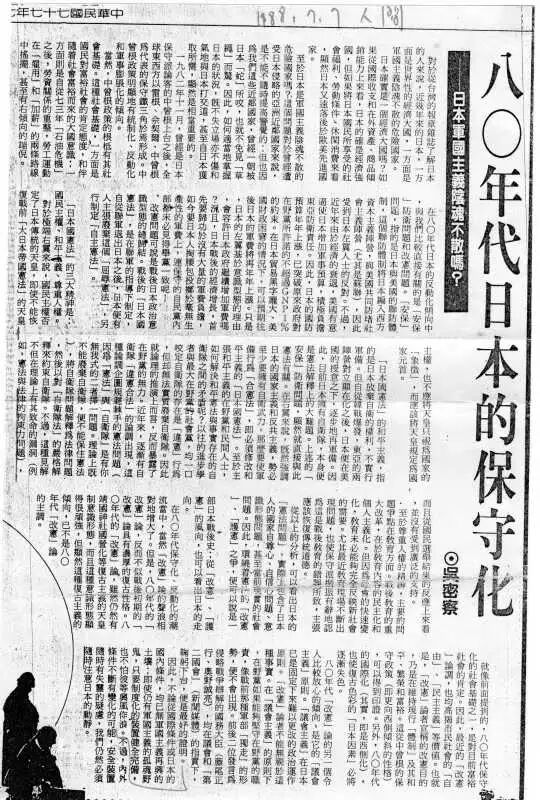
(Image source: Lan Bozhou, Taiwanese unification left-wing writer and scholar)
Chen Yingzhen subsequently wrote, "Strange indeed, the words of the new 'Japanophile'!" The article warned that “once the Cold War structure loses its balance and the development of the world capitalist system stagnates, Japan will inevitably rely on military and political expansion to maintain the uninterrupted operation of the Japanese capitalist machine. The Japanese war bureaucrats and military factions headed by the Emperor were not thoroughly purged after the war, but instead joined forces with the old Kuomintang ‘Japan experts’ who retreated to Taiwan, resulting in Taiwan’s lack of criticism of Japan’s history of aggression against China for forty years after the war.”
Although the old “Japan experts” have gradually withered away under the cruel laws of nature, “a new generation of ‘Japan experts’ has quietly emerged” and “speaks with the same voice as Japanese right-wing commentators.”
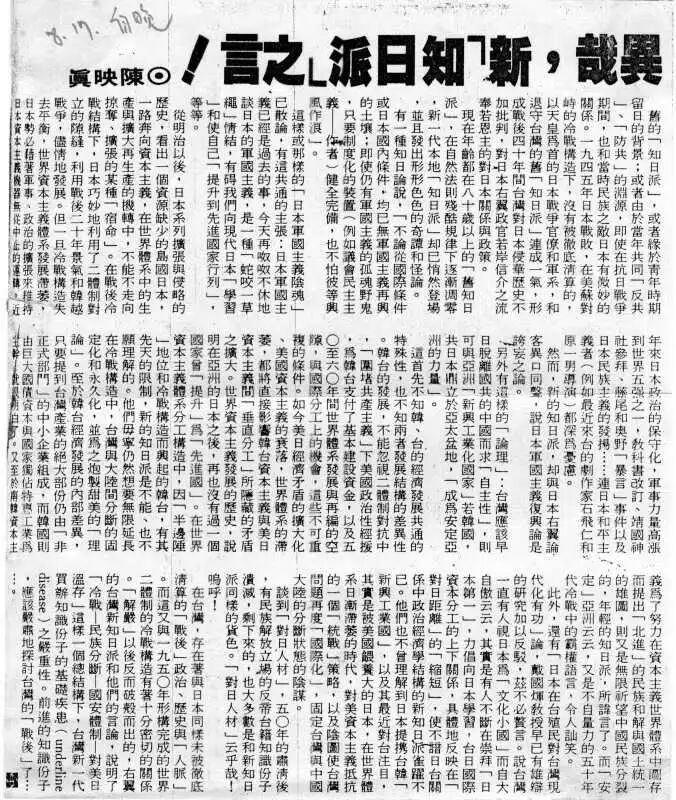
(Image source: Lan Bozhou, a Taiwanese unification leftist writer and scholar)
Professor Suh Sung was a close friend of Mr. Chen Yingzhen and also his comrade-in-arms in the anti-war movement in East Asia. At the end of the interview, he asked me indignantly why today’s young people uncritically embrace cultural products that are imbued with Japanese militarism and colonial ideology? At the time, I considered it a digression, but when the childhood anime "Pokémon" and "Detective Conan" openly worshipped ghosts, sparking heated debate, we must ask—is militarism, in a new and imperceptible form, quietly making its debut?
Returning to the question at the beginning—who is reviving Japan's "new type of militarism"?
The answer is not limited to any one country or faction, but is a conspiracy built by the unresolved historical narrative, the continuous mobilization of the threat narrative, and the structural impetus of regional alliances. Revisiting Mr. Chen Yingzhen's arguments today reveals the penetrating power of his viewpoint—the lack of institutional conditions does not mean the absence of gradual institutional evolution, and the constraints of the pacifist constitution are being gradually rewritten into an operational exception space.
Therefore, the starting point for countermeasures is not just exposure, but more importantly—can judgment be rebuilt? Rebuilding ethical understanding of aggression and colonization, rebuilding public memory of historical responsibility, and rebuilding connections and mutual trust among the people of East Asia. Only in this way can East Asia regain the initiative for peace and justice amidst the ever-evolving narratives.
Special thanks to Seo Sheng, Director and Chair Professor of the East Asian Peace Institute at Woosuk University in South Korea, Tsang Ju-hsing, Deputy Secretary-General of the Taiwan Labor Party, and Taiwanese writer Lan Bo-chou for their support of this article. This article was also published on Guancha.cn; see the original article link for details.