Editorial Note:
On February 28, as the U.S.-Israeli military operation against Iran broke out, U.S. President Donald Trump stated on social media that the bombing of Iran would "continue until we achieve 'peace' throughout the Middle East and the entire world!" As the war, waged under the banner of "peace," entered its eighth day, it had already caused the deaths of at least 1,332 Iranian civilians, including over 180 children.
In December 2024, at the Global South Academic Forum (2024) themed "Global South Cooperation and Unity: Moving Toward a Shared Path to Modernization," two scholars from Iran—Zenab Ghasemi Tari, Associate Professor in the Department of North American Studies at the Faculty of World Studies, University of Tehran, and Elham Kadkhodaee, Assistant Professor of Zionist Studies at the Institute of World Studies, University of Tehran—analyzed the substantive harms of the Western liberal peace model in the context of the West Asian situation, elaborated on Iran's vision for a new world order, and pointed out that Iran needs to reduce its dependence on Western countries in multiple areas, including the economy and politics.
It is worth noting that when the Iranian scholars took the stage at the forum, only one year had passed since the outbreak of the latest round of the Israeli-Palestinian conflict in 2023. Both scholars repeatedly expressed their concern over the situation in Gaza during their speeches. Yet today, this conflict remains unresolved and has resulted in the deaths of over 70,000 civilians in the Gaza Strip. As international uncertainties intensify, we hope to revisit these discussions to re-examine and reflect on the direction of the world order and human civilization.
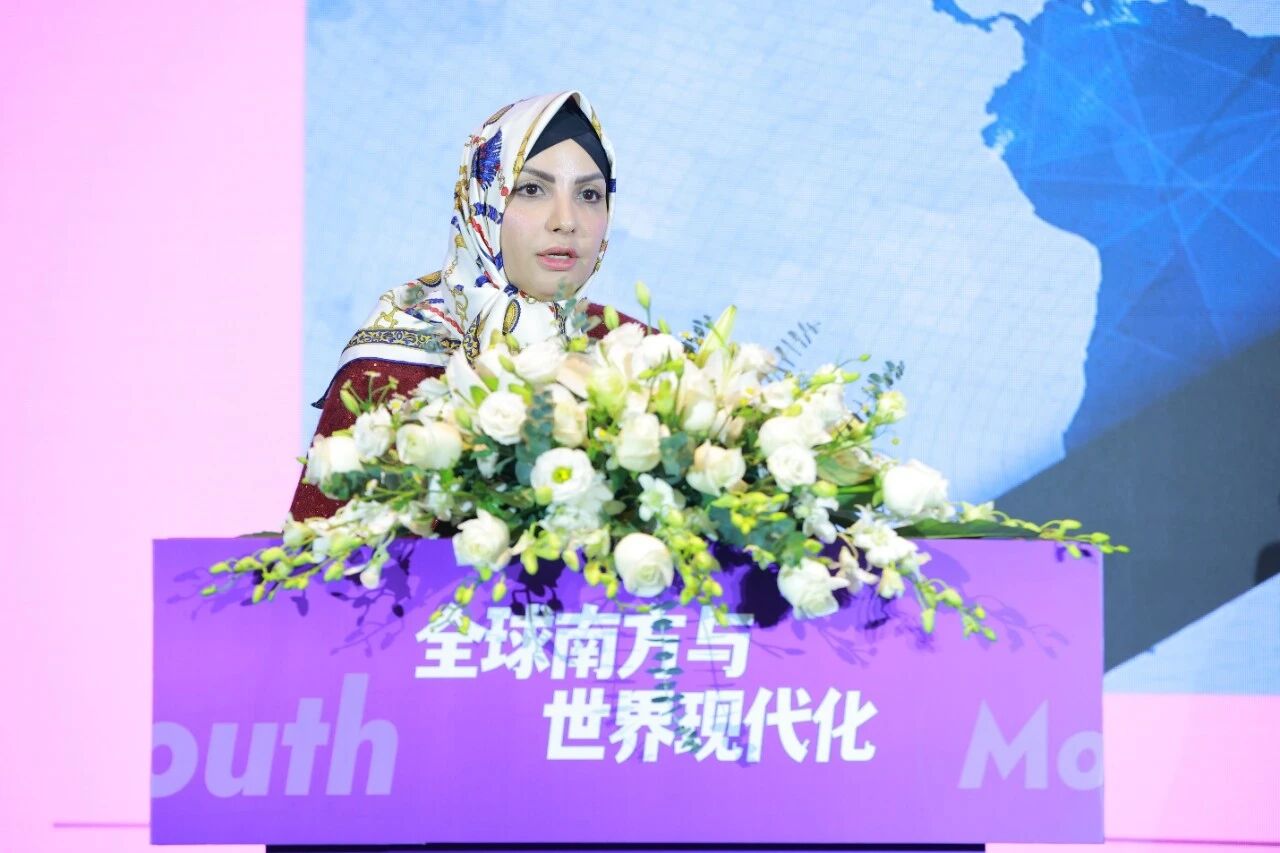
Image Captions: Zenab Ghasemi Tari speaking at the Global South Academic Forum (2024).
As you can see, the title of our speech is "Addressing Regional Hotspots: Iran's Vision for a New World Order and Sustainable Peace in West Asia," and we will deliver it jointly.
The speech is divided into two parts. I will make an introduction, roughly outlining Iran's vision and discussing what shapes Iran's vision for a new world order. Then my colleague will elaborate on Iran's vision for a new world order. Therefore, the first point to emphasize is that the impact of regional conflicts on the globe should not be underestimated.
The effects of war extend far beyond the immediate battlefield. Consider the three conflicts we are currently facing. The first is the war between Russia and Ukraine, which has had a tremendous impact on the global economy, affecting not only Russia and Ukraine but the entire world. The Gaza war began in Gaza, then Lebanon became involved. Syria and other countries in the region were also drawn into this war, and Iran was likewise implicated. Iraq and Yemen did not escape either. The third conflict is the recent developments in Syria, where mercenaries have come not only from the Middle East or Muslim countries but also from Europe and Asia. These individuals will eventually return to their respective countries, potentially bringing extremist ideologies back to their homelands.
Here is a chart showing European public opinion on the arrival of Middle Eastern refugees in Europe. It shows that public attitudes toward refugees are extremely negative. This is the perception of Middle Eastern refugees among the European public in 2016. Regrettably, refugees are seen as an economic burden, a political burden, and even a threat to Europe.
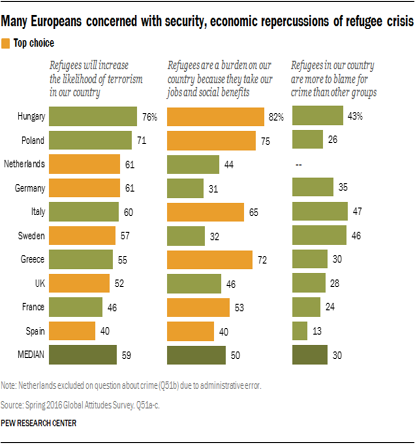
Image Captions: European public opinion on Middle Eastern refugees in 2016.
These perceptions are filled with prejudice against the Middle East, and this cyclical pattern actually reveals how the West provokes incidents in the region and then blames the victims.
Against this backdrop, a discourse of a "New Middle East" has emerged. This is a phrase praised by Israeli Prime Minister Benjamin Netanyahu in his speeches, calling for the establishment of a new Middle East. This evokes the term used by Condoleezza Rice in 2006 when she spoke of the killing of Lebanese civilians. She called these pains the birth pangs of a new Middle East. Today, Israel, acting as the West's long arm or extension in the region, is reenacting this scenario. The framework of this debate is set as a war between civilization and barbarism, between the West and non-Westerners. In this sense, racist terms are used to describe the people of Gaza, calling them beasts and barbarians. With such rhetoric, the massacres and genocide in Gaza and Lebanon can be justified.
Iran's new president has also written a letter regarding his vision for a new Middle East, which my colleague will elaborate on. However, as scholars, we need to examine and revise some concepts and assumptions that are taken for granted regarding the new world order. Among these assumptions is, for example, that democratic states are inherently more peaceful, as mentioned in one of our two speeches.
Yet, all the wars provoked in the Middle East, or the conflicts led by certain countries, do not actually reflect this. Furthermore, another assumption is that economic interdependence fosters peace. However, facts have shown that such interdependence does not always bring peace.
As people living in this region, Iran is one of the most sanctioned countries in the world. Sanctions are used as a tool for collective punishment of ordinary civilians, whereas international organizations and companies could bring stability, as has happened in Gaza. These assumptions, along with some shared values and norms, have been called into question. Among these fundamental values and norms are human rights and women's rights. But rights are easily violated, and these people are not even regarded as human beings, not as part of shared values and norms, nor as part of democratic states that seek consensus and public support in decision-making. Although, during the Gaza war, widespread protests against the war on Gaza or the war on Iraq could be observed.
However, public opinion or the public's opposition to such violence or humanitarian crises has been completely ignored. Therefore, these concepts or issues are worth considering: who defines what? What is democracy, and what constitutes democracy? This is one of the questions that needs to be considered. What needs to be considered is how the idea of selective alliances arises, because the concept of democracy is highly politicized, and how Western states use this definition to form selective alliances when it serves their interests. When their interests are met, they establish selective alliances. Furthermore, it is good to introduce some non-Western scholars whose reading materials are not Eurocentric and who challenge the universal and taken-for-granted definitions of liberalism or liberal peace. My colleague will continue to introduce the part about Iran.
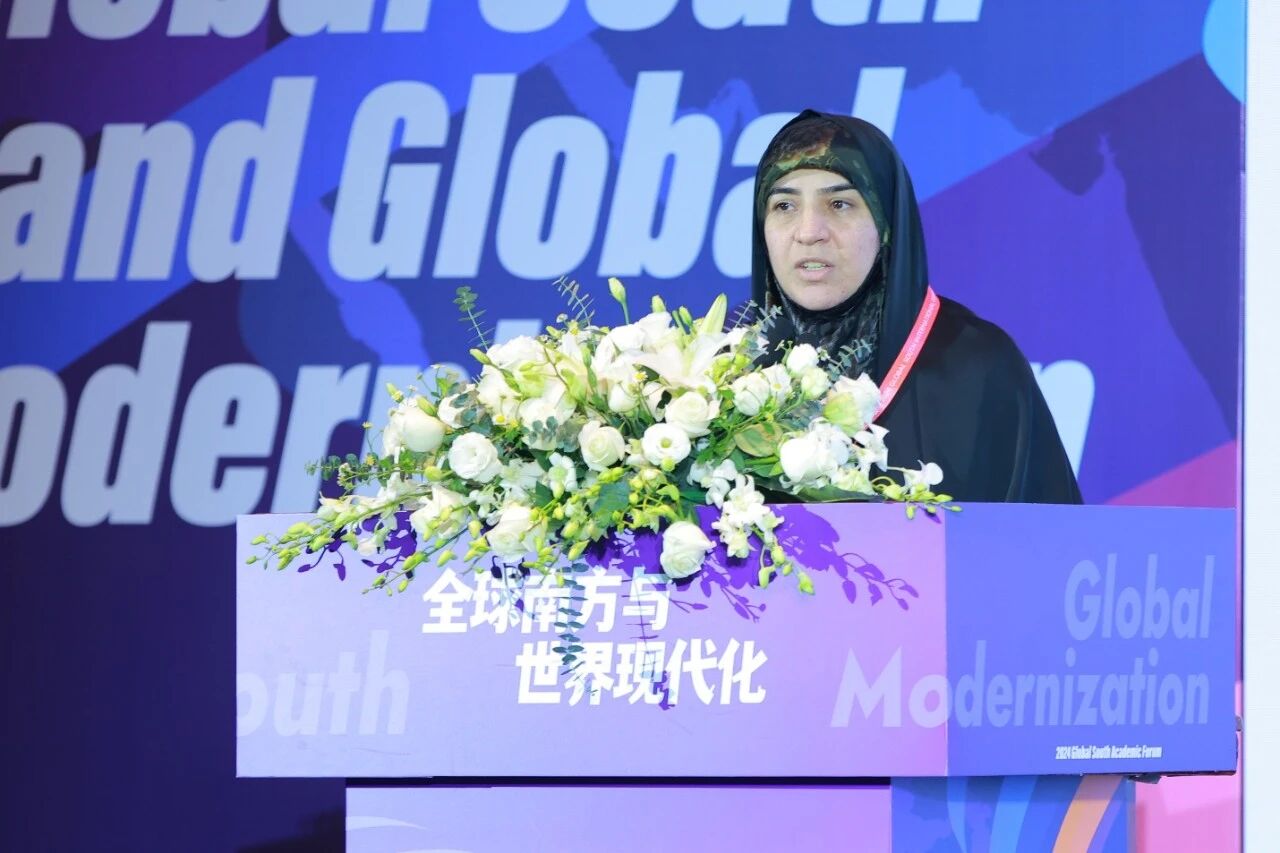
Image Captions: Elham Kadkhodaee speaking at the Global South Academic Forum (2024).
I am very pleased to be here. Thank you to my colleague for the opening remarks. Next, I will continue with what she mentioned and what we witness every day in the Middle East.
Every morning when we wake up, we expect something new to happen, and usually, it is something negative. We rarely hear good news. For a year, we have witnessed the ongoing genocide in Gaza, which has reached its extreme, and we truly do not know when or where this massacre will end. Therefore, I will introduce Iran's foreign policy vision.
After the 1979 Islamic Revolution in Iran, Iran adopted a new approach to its foreign policy based on the principles of dignity, wisdom, and prudence. From this perspective, Iran places great emphasis on the concept of justice, both domestically and internationally. On the other hand, Iran attaches great importance to the concept of "Mustadha'fīn" (the oppressed), meaning the oppressed communities worldwide. This is an issue that requires broad attention. This point is enshrined in the Iranian Constitution. As just mentioned, there is an opposition between the two concepts of "Mustadha'fīn" and "Mustakbirīn" (the arrogant oppressors). "Mustakbirīn" refers to the imperialist oppressors of the world. Therefore, according to the Constitution, Iran should expand its relations with other Islamic and popular movements across the world.
Moreover, it should oppose, to some extent, all forms of intellectual and social tyranny, as well as economic monopolies. This is actually the text of the Iranian Constitution, with an emphasis on entrusting the people of the world with their own destiny. Based on these principles, immediately after the Iranian Revolution, Iran terminated its relations with two apartheid regimes.
At the time, they were apartheid South Africa and Israel. Fortunately, we no longer have apartheid South Africa. But we still face an apartheid Israeli regime, and Iran has an obligation to oppose this regime at any possible level. Therefore, in the current context, Israel remains an apartheid, settler-colonialist regime that is continuously committing genocide in the region.
Iran's vision for international relations in the new era goes beyond reliance on and dependence on Western hegemony within the region. As already mentioned, Iran seeks to support the rights and well-being of the Palestinian people. In these ongoing conflicts, Iran believes that justice is the core concept that can bring lasting peace.
Regarding relations with its neighbors, Iran believes that relations with neighboring countries should be expanded, regardless of any religious and ethnic differences or the usual imperialist forces. Imperialist forces do is invest heavily in the idea of divide and rule, making differences a source of conflict. Iran believes that this practice should be abandoned and relations with neighboring countries should be improved.
The third factor is that this new perspective focuses on the Global South, which actually began with the Islamic Revolution itself and has been strengthening over the years. Iran acknowledges the importance of cooperating with the Global South to promote mutual growth and prosperity, which is reflected in the positions of Iran's highest-ranking officials, including the newly elected Iranian president, and in the way he seeks to build closer relations with China, India, and Russia, as well as in his approach to relations with the West. Therefore, if there is mutual respect, Iran will still seek to protect its sovereignty, notwithstanding historically unfortunate tensions.
This is also a key concept mentioned: while protecting its sovereignty, Iran seeks dialogue with Western powers to address concerns and enhance understanding. Returning to the region, first and foremost, it is about the many conflicts the region is experiencing. Iran believes that the prerequisite for achieving peace, especially in Palestine and the broader region, is first and foremost to recognize that the Western liberal model of peace has not only failed to achieve peace but has also been extremely destructive.
A new approach is needed to consider the unique context of West Asian issues, seeking solutions from within the region itself. So, why have all the peace initiatives, especially those concerning Palestine, failed? The fundamental view here is that the national rights and national and political rights of the Palestinian people have been consistently denied.
Therefore, what we call the "Deal of the Century" or the "Abraham Accords" has actually led to a century of genocide, rather than a century of peace. This is because justice and the rights of the people have not been addressed. In Iran's vision of peace, we need to recognize these basic rights and that foreign forces, whether from the East or the West or from anywhere else, should not adopt imperialist practices in this region. The well-being of West Asian nations is interconnected. As we see today, the war started in Gaza and then spread to Lebanon and Syria. The entire region can be said to have essentially fallen into conflict. Therefore, the well-being of these nations is interconnected.
Iran believes that any constructive relations and the presence of global powers in West Asia should be based on respect for the independence and national interests of the people of the region. Unfortunately, as we see in Western media and political discourse, this is often characterized as Iran's disruptive or destabilizing regional policy. Although this is only a one-sided, negative description, the reality is far from it.
To summarize, what steps are needed to achieve this? How can peace in West Asia be achieved from a new perspective? Many scholars have pointed out and raised these issues. I will not spend too much time discussing them, but a multipolarity is emerging. Therefore, a significant part of the new initiatives discussed here is to break away from dependence on Western countries, both economically and politically, and to cooperate with other international organizations and agreements. As previous speakers have emphasized, organizations such as BRICS, the Shanghai Cooperation Organization (SCO), and the Non-Aligned Movement (NAM) are international institutions that can replace existing organizations, which have proven to be of no benefit to the people of the region.
Economic diversification is a way to counter economic sanctions, for which Iran has indeed paid a heavy price. Here is a picture of a child. The child suffers from a very special genetic disease and requires specific imported medicines, but due to economic sanctions, we cannot import these medicines. This is just an example of the impact of sanctions on individuals, regardless of their political identity.

Image Captions: A child suffering from a genetic disease.
Finally, we firmly believe that cultural dialogue and understanding are one of the main and crucial steps to realizing this vision, because cultural dialogue has the potential to bring about cultural respect—that is, respecting others, not merely considering one's own interests. This conference is a good example of how such cultural dialogue can effectively take shape and occur.
(All images were provided by the original author(s).)
(Transcribed from recordings, with some edits)